Park Avenue is a nine-block stretch of brick sidewalks, live oaks, and storefronts that has been the commercial spine of Winter Park since the 1880s, when New England investors platted the town as a winter retreat with wide avenues and a lakefront park. What makes it worth walking isn't just the shopping, it's the density of real cultural institutions packed into a small footprint: the largest collection of Louis Comfort Tiffany glass in the world sits one block off the avenue, Rollins College's Spanish Mediterranean campus borders the park, and the Albin Polasek sculpture garden is a ten-minute detour most visitors never find.
This route starts at Central Park, cuts through the Morse Museum, follows Park Avenue south past its original early-20th-century storefronts, and loops through part of the Rollins College campus before ending at a lunch counter that's been serving the same neighborhood since 1918. You'll cross Park Avenue itself several times, so expect some backtracking by design: the buildings worth seeing face each other across the street, not down it.
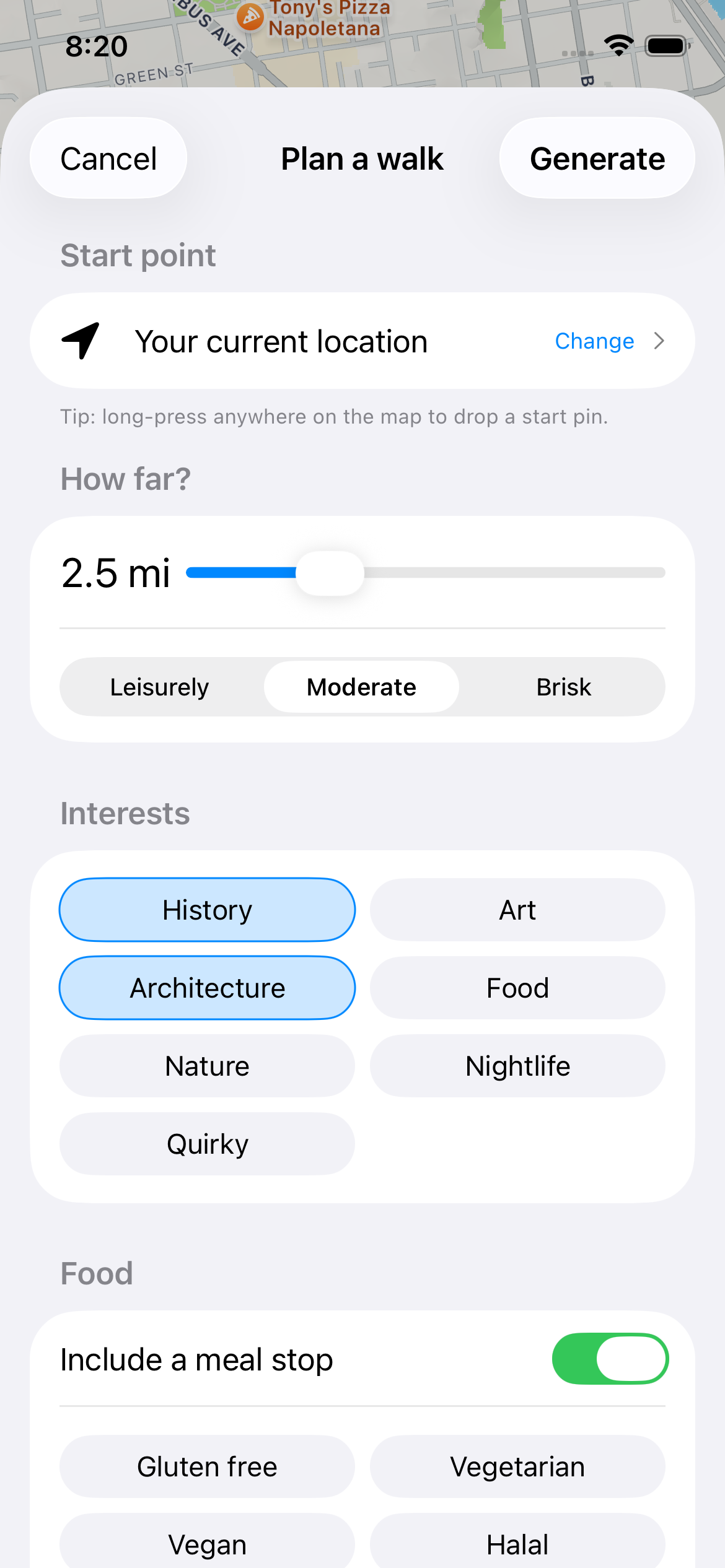
The Mosey app plots this as a stop-by-stop route with walking directions between each point, so you're not stopping to check a map on a brick corner. At each stop it surfaces the kind of detail — a construction date, an architect, a donor's name — that turns a pretty block into one you understand.
The Route: Central Park to Rollins College
"Central Park was laid out in the 1880s as part of Loring Chase and Oliver Chapman's original town plat, when Winter Park was marketed to wealthy northerners as a planned winter community. The bandshell and rose gardens were added in phases through the 20th century, and the park still hosts the Winter Park Sidewalk Art Festival every March, one of the oldest and largest outdoor art festivals in the Southeast, running continuously since 1960. The SunRail commuter line and the historic Amtrak depot sit at the park's north edge, a reminder that the railroad is what made this town commercially viable in the first place."
Start on the park's west lawn facing Park Avenue so you get the full sightline down the commercial strip before you start walking it. If you're here in March, expect serious crowds for the art festival; otherwise this end of the park is usually quiet in the morning.
"The Morse Museum holds the most comprehensive collection of works by Louis Comfort Tiffany anywhere, including the chapel interior Tiffany designed for the 1893 World's Columbian Exposition in Chicago and architectural fragments salvaged from Laurelton Hall, his Long Island estate, after a 1957 fire destroyed much of the building. The museum was founded in 1942 by Jeannette Genius McKean and later expanded by her husband Hugh McKean, a former Rollins College president, with the current building on Park Avenue opening in 1995 at 445 N Park Ave. The leaded-glass windows and the reassembled chapel interior are not reproductions; they're the originals, rescued piece by piece."
Admission is $7 for adults, free on Friday evenings from 4 to 8 pm November through April. Budget a full hour minimum if you want to actually see the Tiffany chapel and the Laurelton Hall fragments rather than rushing through. Photography without flash is allowed in most galleries.
"Most of the two-story brick buildings lining Park Avenue between Morse Boulevard and Fairbanks Avenue date to the 1920s building boom, when Winter Park's population and property values swelled during the Florida land boom before the 1926 bust. The street was paved and the first brick sidewalks laid around this same period, part of a deliberate effort by town boosters to market Park Avenue as a refined alternative to more commercial Orlando storefronts nine miles south. Several buildings retain their original transom windows and cast-iron storefront frames above modern retail signage at street level."
Look up, not just at shop windows; the second-story brickwork and window detailing is where the 1920s construction actually shows. Shops here skew toward boutiques and galleries rather than chains, which makes window shopping genuinely worth the time rather than a formality.
"Rollins College was founded in 1885, making it Florida's oldest recorded college, and its Spanish Mediterranean-style campus took shape largely in the 1930s under architect Ralph Adams Cram, who also designed portions of West Point and Princeton's chapel. Knowles Memorial Chapel, completed in 1932, was funded by Frances Knowles Warren in memory of her father Francis B. Knowles and remains the architectural centerpiece of the campus, built with coquina shell stone accents and a red tile roof typical of Cram's Mediterranean Revival work. The chapel still hosts the college's Bach Festival, an annual choral tradition dating to 1935."
The chapel is usually open to the public during daytime hours when no events are scheduled; step inside to see the vaulted wood ceiling even if you skip the rest of campus. Walking the lakeside path behind the chapel toward Lake Virginia is free and gives you the best angle on the Mediterranean Revival rooflines.
"The Cornell Fine Arts Museum opened its current building in 1978 on the Rollins College campus, though its collection dates back to a 1941 gift and now holds over 6,000 works spanning European Old Masters to American modernism and contemporary art. It's Florida's oldest continuously operating art museum, a distinction it holds because Rollins began building the collection decades before most Florida institutions existed. Rotating exhibitions sit alongside a permanent collection that includes works by Hudson River School painters and 20th-century American artists."
Admission is free, which makes this an easy add even if you only have twenty minutes. It's a short walk from Knowles Chapel along the same campus path, so there's no real reason to skip it on the way through.
"Hannibal Square is Winter Park's historically Black neighborhood, settled by freedmen in the years after the Civil War and formally platted in 1887, the same era Park Avenue itself was taking shape a few blocks east. The Heritage Center, opened in 2007 at 642 W New England Ave, documents the community through oral histories and photography, including portraits by photographer Maurice O'Sullivan and a permanent exhibit built from interviews with longtime residents. It's a direct counterpoint to the Park Avenue narrative of resort development, telling the story of the laborers and tradespeople who built and staffed that resort economy."
Admission is free and the center is small, so twenty minutes covers it well. It's a few minutes' walk west of Park Avenue proper, across the railroad tracks, and worth the detour for a side of Winter Park history the avenue itself doesn't tell.
"The Coop occupies a building on New England Avenue that traces its commercial use back to the early 20th century, and the restaurant itself has built a local following on fried chicken and biscuits served in a casual Southern diner format. It sits a block off Park Avenue, close enough to the walk's endpoint that it makes sense as a final stop rather than a mid-route detour. The restaurant is locally owned, distinct from the national chains that have crept into parts of the avenue's retail mix."
Go for the fried chicken biscuit if you're only eating one thing. Expect a wait at peak lunch hours on weekends; arriving before noon or after 1:30 pm avoids most of it. There's outdoor seating if the weather's cooperating.
Planning Your Walk
Best time to walk: Central Florida humidity is real from May through September; October through April is milder and the better season for this walk. Afternoon thunderstorms are common in summer, so mornings are safer bets most of the year.
Shoes: Flat, well-maintained brick sidewalks throughout with occasional uneven pavers near the park; regular walking shoes are fine, no hiking gear needed.
The narration: Each stop surfaces a specific construction date, architect, or donor behind the building or collection in front of you, rather than general background on Winter Park.
Walk Park Avenue with Mosey
Get turn-by-turn directions and stop-by-stop historical context for this exact route, right on your phone, with the Mosey app.
Download on the App Store — FreeFrequently asked questions
How long does it take to walk Park Avenue in Winter Park?
Walking Park Avenue end to end takes about 20 minutes without stopping. Budget closer to 2.5 hours if you're doing the full loop with museum stops, since the Morse Museum alone deserves an hour and the Cornell Fine Arts Museum and Rollins College chapel add another 45 minutes to an hour combined.
Is Park Avenue in Winter Park walkable without a car?
Yes. Park Avenue and the surrounding blocks, including Rollins College and Hannibal Square, are flat, compact, and connected by brick sidewalks. Most visitors park once near Central Park or the SunRail station and walk everything else, since the entire route covers under two miles.
Is the Morse Museum worth visiting on a Park Avenue walk?
Yes, it holds the largest Tiffany glass collection in the world, including the reassembled chapel interior from the 1893 World's Columbian Exposition. Admission is $7 for adults, and it's free on Friday evenings from 4 to 8 pm between November and April. Budget a full hour.
What's the best time of day to walk Park Avenue in Winter Park?
Morning, roughly 9 to 11 am, before lunch crowds arrive and before afternoon heat and humidity set in, especially May through September. Saturday mornings are busier due to the farmers market near Central Park, which runs year-round and is worth timing your visit around if you like local produce stalls.
Is there a farmers market on Park Avenue?
Yes, the Winter Park Farmers' Market runs every Saturday morning in the old train depot building at 200 W New England Ave, just off Park Avenue near Central Park. It operates year-round, rain or shine, and is a good first or last stop depending on your route direction.
How much does it cost to visit the museums on this Park Avenue walking tour?
The Morse Museum charges $7 for adults (free Friday evenings November–April). The Cornell Fine Arts Museum at Rollins College is free year-round. The Hannibal Square Heritage Center is also free. Total museum costs for this route run $7 per adult if you visit all three.
More Self-Guided Walks Nearby
If Park Avenue's mix of Tiffany glass and Mediterranean Revival architecture appeals to you, Mosey also maps walking routes through Orlando's Thornton Park, a bungalow-lined historic district just east of downtown with its own brick streets and independent cafes, and Winter Garden's historic downtown, built around a restored early-1900s rail depot and a walkable grid of citrus-era storefronts. Both pair well with a Winter Park day trip if you're building a longer Central Florida itinerary in the app.