U Street NW is where Washington's Black community built its own downtown in the early 1900s, when segregation closed most of the city's hotels, theaters and dance halls to them. By the 1920s the corridor around 12th and U was nicknamed Black Broadway, and Duke Ellington, who grew up a few blocks away, was one of the musicians who came up through it. A U Street walking tour works well because so much of that history is still standing, within a few blocks of each other.
This self-guided U Street tour starts at the African American Civil War Memorial, moves through former jazz club and hotel sites, passes the 1912 YMCA building designed by a Black architect, and finishes at the Lincoln Theatre and Ben's Chili Bowl for the meal stop. The route is flat and easy to follow, with six stops. Mosey built it for people interested in music and history, so most stops focus on who played, stayed, or organized here.
Load the route in the Mosey app and it will surface historical context at each stop as you reach it. The first three tours are free. Many buildings on this route are now restaurants, apartments or offices, so the experience is mostly exteriors, plaques and street-level detail rather than museum interiors.
The U Street Route: From the Civil War Memorial to Ben's Chili Bowl
"The memorial's bronze sculpture, Spirit of Freedom by Ed Hamilton, was dedicated in 1998. It shows Black soldiers and a sailor in uniform. Curved panels called the Wall of Honor list the names of more than 200,000 members of the United States Colored Troops, along with the white officers who led them. The location was chosen because U Street later became the center of the city's Black community."
Walk the full length of the wall and find a name or two; the panels are arranged by regiment. The outdoor memorial is free and open at all hours. The African American Civil War Museum is across the street at 1925 Vermont Ave NW; check its hours and admission before you plan to go in.
"The basement club at 2001 11th St NW opened in 1926 as Crystal Caverns, later renamed Bohemian Caverns. Its entrance was designed to look like a cave. It was one of the main venues on U Street's jazz circuit and is documented as hosting acts including Duke Ellington and Miles Davis. The room later went through a long closure and reopening cycle."
You are here for the exterior and the corner. Business use of the space changes, so look before assuming you can go inside. Stand across 11th Street to take in the building's full face.
"The Whitelaw at 1839 13th St NW opened in 1919. It was built by John Whitelaw Lewis, a Black businessman, and designed by Isaac Fleming, also a Black architect. At a time when most downtown hotels refused Black guests, it gave visiting musicians, lecturers and travelers a place to stay in the neighborhood. The building is listed on the National Register of Historic Places."
Look at the cornice and window detail from the sidewalk. It is not open as a public hotel, so there is nothing to go inside for. The residential streets around it are quieter than U Street itself, which is a good break from foot traffic.
"This building at 1816 12th St NW opened in 1912 as the Twelfth Street YMCA for Black residents. It was designed by William Sidney Pittman, a Black architect who was Booker T. Washington's son-in-law, with financial support from philanthropist Julius Rosenwald. Thurgood Marshall, Langston Hughes and Duke Ellington are among the figures associated with it. It now houses community and heritage programs."
Stop at the front steps and read the signs near the entrance. Interior access depends on events and programming, so treat this as an exterior stop unless something is posted. The brick facade and entry detail reward a closer look than most of the passing storefronts.
"The Lincoln Theatre at 1215 U St NW opened in 1922 as a movie house and performance space, designed by Reginald Geare for Harry Crandall. It became a center of Black Washington's entertainment life, and Duke Ellington and Ella Fitzgerald are among the performers connected to the hall. After years of decline, it was restored and reopened in 1994."
The marquee is the photo, so stand on the opposite side of U Street. Check the calendar if you want to see a show; tickets are sold per event and vary. If nothing is on, the lobby is generally not open for walk-in visits.
"Ben's Chili Bowl at 1213 U St NW opened in 1958, founded by Ben and Virginia Ali. It stayed open through the unrest that followed Martin Luther King Jr.'s assassination in 1968, and has served musicians, politicians and neighborhood regulars for decades. The house specialty is the half-smoke, a smoked sausage on a bun with mustard, onions and chili sauce. Ben Ali died in 2023, and the family still runs the business."
Order the half-smoke, either plain or as a chili half-smoke. The line can run long on weekend nights and after shows at the Lincoln next door, so late afternoon is easier. The back counter area moves faster than the sit-down dining room.
Planning Your U Street Walk: Timing, Crowds and What to Skip
Best time to walk: Late fall and early spring are the best times. Late November days are cool and often dry, but sunset comes before 5 p.m., so start by early afternoon to see the exteriors in daylight and reach Ben's as the dinner crowd builds. Summer afternoons are hot and humid with little shade on U Street. Bring a layer for evenings year-round.
Shoes: All sidewalks, flat and paved. The only incline is a gentle one on 12th Street. Regular walking shoes are fine. Brick sidewalk sections near the memorial can be uneven when wet.
The narration: At each stop Mosey surfaces the dates, architects, and documented events behind the building in front of you, with a focus on the music and civil rights history of the corridor.

Walk Washington's U Street with Mosey
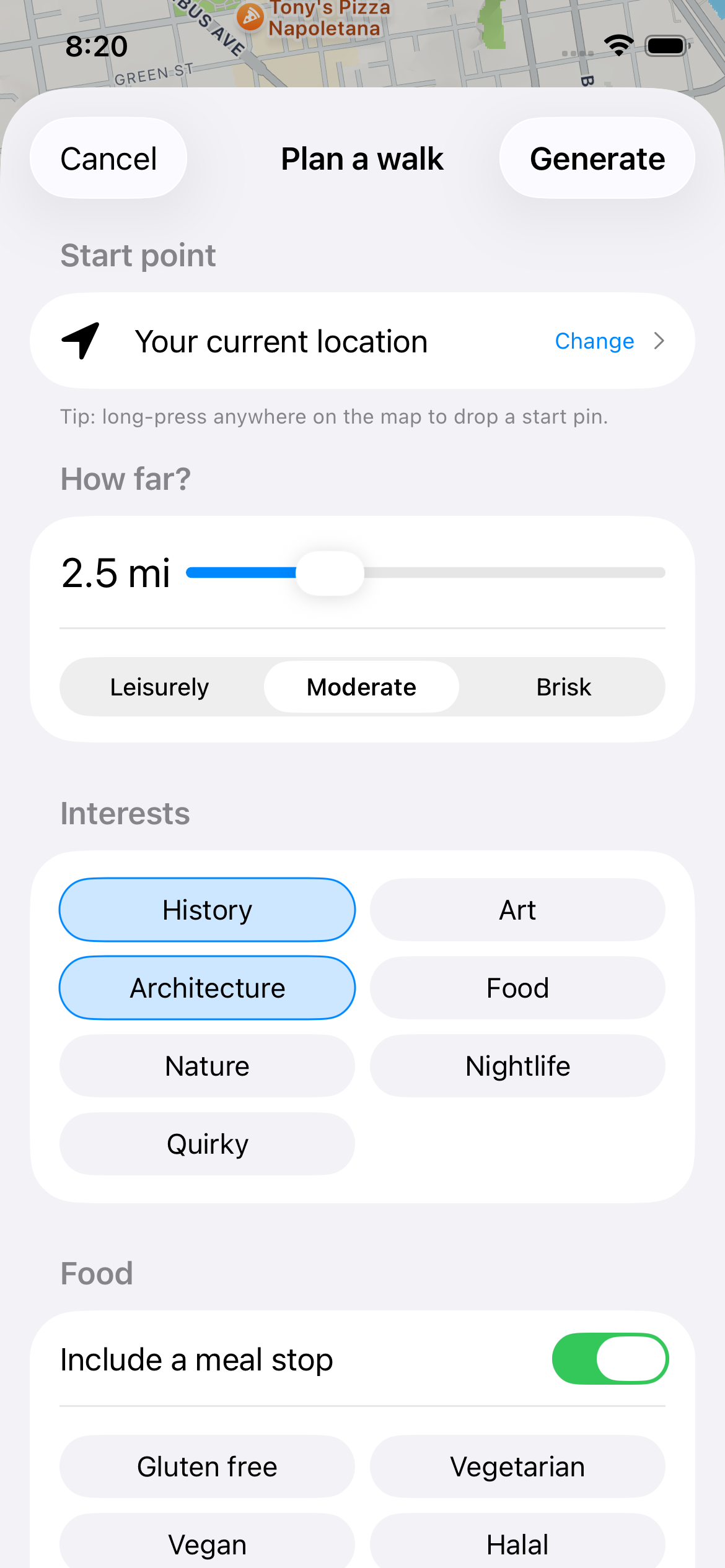
Mosey plans a walk like this one on your iPhone, starting wherever you choose.
- Set a distance or a time and pick what you're into
- Real stops in a walking order that makes sense on foot
- The story behind each stop, read aloud as you arrive
- A meal stop that fits the route

Free to download. iPhone, iOS 17 or later.
Frequently asked questions
How long does it take to walk U Street?
A U Street walking tour of six stops takes about two hours at an easy pace. The route is 1.8 miles on flat sidewalks. Allow extra time if you plan to eat at Ben's Chili Bowl during a busy evening or see a show at the Lincoln Theatre.
Where should I start a self-guided U Street tour?
Start at the African American Civil War Memorial at Vermont Avenue and U Street NW, beside the U Street Metro station. It gives you historical context for the neighborhood and lets you walk west along U Street toward the music venues and Ben's Chili Bowl.
Is U Street safe to walk at night?
U Street is a busy nightlife corridor, and the main stretch between 9th and 14th Streets is generally well lit and crowded in the evening. Stick to U Street and the main cross streets, and stay aware of your surroundings as you would in any large city.
Is the African American Civil War Memorial free?
Yes, the outdoor memorial at Vermont Avenue and U Street NW is free to visit and open at all hours. The African American Civil War Museum across the street at 1925 Vermont Ave NW is separate, so check its hours and admission before going.
Why is U Street called Black Broadway?
U Street earned the name Black Broadway in the early 20th century because Black residents built theaters, clubs, hotels and businesses here during segregation. The Lincoln Theatre, opened in 1922, and the Whitelaw Hotel, opened in 1919, are two surviving examples on this walking tour.
What should I eat on a U Street walking tour?
Eat a half-smoke at Ben's Chili Bowl, 1213 U St NW. The restaurant opened in 1958 and is the neighborhood's best-known food stop. A half-smoke is a smoked sausage on a bun topped with mustard, onions and chili sauce. Go in late afternoon to avoid long evening lines.
More DC Neighborhoods to Walk After U Street
If U Street leaves you wanting more, Shaw is directly south and continues the story of Black Washington, with Howard Theatre, a historic music venue, nearby. Adams Morgan is a short walk north and has a very different feel, with murals and international restaurants. Georgetown offers a contrasting kind of DC history, built around the C&O Canal and 18th-century architecture. All of them work as self-guided walks in Mosey.