Dupont Circle is where Washington's Gilded Age money built its houses, and enough of them survived that a walk here still reads as a lesson in turn-of-the-century architecture. Most of the neighborhood was laid out as a fashionable address in the 1880s and 1890s, when the city's wealthy moved northwest of the White House. Mining fortunes, brewing fortunes, and a Boston diplomat's inheritance all ended up on or near Massachusetts Avenue. That makes this a strong self-guided Dupont Circle tour if your interests run to architecture and history.
The route starts at the circle's fountain, loops through the nearby mansions on the eastern side, then heads up Massachusetts Avenue along the stretch known as Embassy Row. It passes two former private residences that now serve other purposes, takes in the Phillips Collection on a residential side street, and ends with a meal on Connecticut Avenue. There are seven stops. Three have interiors you can enter, and the rest are best appreciated from the sidewalk.
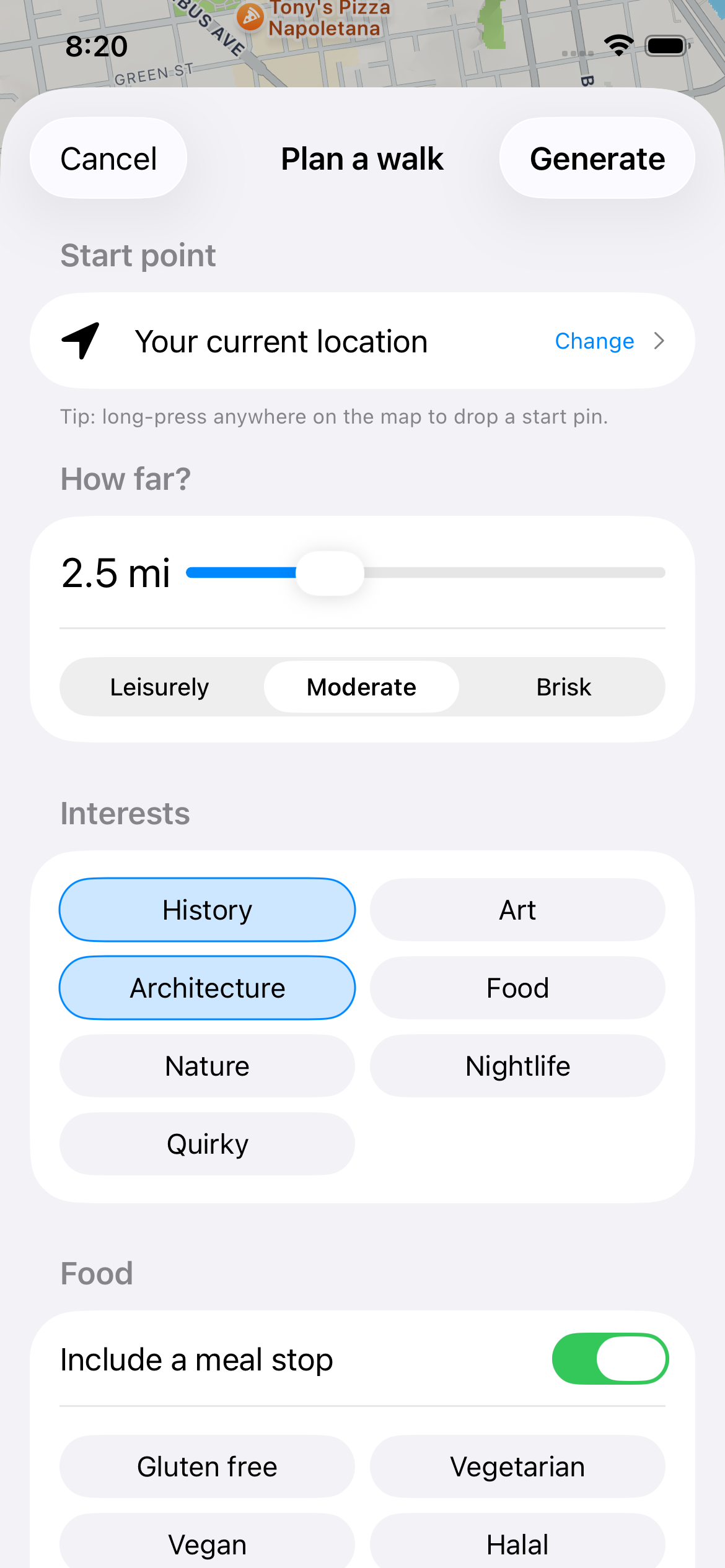
Mosey built this route and narrates each stop as you reach it, so you can keep your eyes on the cornices and bay windows rather than a phone screen. Your first three Mosey tours are free. Plan around the museum hours below, because the walk works best when you can go inside at least one or two of these buildings.
Mansions, Museums, and Massachusetts Avenue: The Dupont Circle Route
"The circle was originally called Pacific Circle and was renamed Du Pont Circle in 1882 for Rear Admiral Samuel Francis Du Pont, a Civil War naval officer. A bronze statue of him stood here from 1884. His family disliked it, and it was replaced by the current marble fountain, designed by sculptor Daniel Chester French (who also made the Lincoln statue inside the Lincoln Memorial) with architect Henry Bacon, and dedicated in 1921. The three figures on the fountain represent the Sea, the Stars, and the Wind, a nod to Du Pont's naval career."
Walk a full lap around the fountain's outer ring before you start moving. You will see the buildings that ring the circle, from stone mansions to later apartment blocks, which makes the architectural shift obvious. The circle is also a local gathering spot, with chess tables and benches. Expect noise and some traffic, and do not expect quiet.
"The mansion at 15 Dupont Circle was designed by Stanford White of McKim, Mead & White and completed in 1901 for Robert Patterson, publisher of the Chicago Tribune, and his wife Elinor. It is in the Italian Renaissance palazzo style, a favorite of wealthy clients in that era. Their daughter Eleanor 'Cissy' Patterson later became a prominent Washington newspaper publisher, and the house kept a place in the city's social and political life for decades."
This is an exterior stop. Stand across the circle or on the sidewalk to see the full facade rather than crowding the front steps. Notice how the building faces the circle rather than the avenue, which was the point of building here. Skip trying to find a way in, because the building is not open for casual visits.
"At 1307 New Hampshire Avenue NW, this house was built between 1892 and 1894 for German-born brewer Christian Heurich, whose Washington brewery became one of the largest in the city. The architect was John Granville Meyers, and the Romanesque Revival design uses heavy stonework and a turret. Heurich built the house to be fire-resistant, with concrete in the structure, and the family lived in it for decades. It is now a museum and a rare example of a Gilded Age home with much of its original character kept intact."
The house opens for tours on a limited schedule, so check the museum's calendar before you plan around it, and expect an admission fee. If it is closed, the exterior is still worth five minutes for the stonework and turret. The side street gives a good angle.
"The mansion at 2020 Massachusetts Avenue NW was designed by architect Henry Andersen and completed in 1903 for Thomas Walsh, an Irish immigrant who made a fortune from the Camp Bird gold mine in Colorado. It was a showpiece of Washington's Gilded Age, and it later passed to his daughter Evalyn Walsh McLean, who owned the Hope Diamond. The building is now the Embassy of Indonesia."
This is an exterior stop, since embassy buildings are not open to casual visitors. Stay on the public sidewalk and avoid photographing security checkpoints or staff. The scale of the house is easiest to judge from the opposite side of the avenue.
"Anderson House at 2118 Massachusetts Avenue NW was built between 1902 and 1905 for diplomat Larz Anderson and his wife Isabel Weld Anderson, to designs by the Boston firm Little & Browne. Isabel gave the house to the Society of the Cincinnati in 1938. The society, founded in 1783 by officers of the Continental Army, still uses it as its headquarters. The interior holds a formal ballroom, staircases, and the Andersons' collections."
Admission is free, and this is the best interior stop on the route if you want to see how these houses actually worked. Opening days are limited and Sunday and Monday are typically closed, so confirm the schedule first. Allow time for the ground floor, because the rooms reward slow looking.
"The Phillips Collection at 1600 21st Street NW opened in 1921, founded by Duncan Phillips as a memorial to his father and brother. It is often described as the first museum of modern art in the United States. The original house is a Georgian Revival building from 1897, designed by Hornblower & Marshall, and the museum has added galleries around it over the years. Its best-known painting is Renoir's Luncheon of the Boating Party."
The museum is closed on Mondays, so a Saturday works well. Ticket prices and any timed-entry rules change, so check before you go. Do not rush the original house rooms, where the paintings hang in a domestic setting that is part of the museum's character.
"Kramerbooks & Afterwords Cafe at 1517 Connecticut Avenue NW opened in 1976 as an independent bookstore and has long paired its shelves with a cafe and bar. It sits in the commercial strip just south of the circle, in the part of Dupont that developed with apartment houses and shops alongside the mansions. It is a neighborhood fixture and keeps late hours, which suits it as a finish to a long afternoon."
Browse the bookstore before you sit, since the cafe is attached and you can carry a book to the table. Weekend brunch can mean a wait, so go off-peak or put your name down early. Menu and prices change, so check current options if you have dietary needs.
Before You Go: Hours, Closures, and What to Skip
Best time to walk: Late fall and spring are the best seasons, with temperatures that suit a few hours on foot and bare trees that make the facades easier to see. Summer in Washington is hot and humid, so start early and use the museum interiors as air conditioning. In winter, the circle gets windy, and a cold, clear day is still good for the exterior-heavy stretch along Massachusetts Avenue.
Shoes: Sidewalks are paved and flat, with a gentle rise heading up Massachusetts Avenue. Brick sidewalks around the side streets are uneven in places, especially near tree roots, so wear shoes with real soles rather than thin flats. Expect to be on your feet for most of the visit, with seated breaks inside the museums.
The narration: At each stop, Mosey surfaces the context that matters: who built the place, what it was built from, the year it opened, and how it changed hands over the following century.

Walk Washington's Dupont Circle with Mosey
Mosey plans a walk like this one on your iPhone, starting wherever you choose.
- Set a distance or a time and pick what you're into
- Real stops in a walking order that makes sense on foot
- The story behind each stop, read aloud as you arrive
- A meal stop that fits the route

Free to download. iPhone, iOS 17 or later.
Frequently asked questions
How long does it take to walk Dupont Circle?
Plan on about three hours for this route. The walking itself is roughly two miles and takes an hour or so. The rest goes to the Phillips Collection, Anderson House, a possible Heurich House tour, and a sit-down meal at Kramerbooks.
Is Dupont Circle walkable?
Yes. Dupont Circle is flat, compact, and well served by sidewalks, with the Dupont Circle Metro station on the circle itself. The main sights are within a few blocks of each other along Massachusetts, Connecticut, and New Hampshire Avenues, so you do not need a car or rideshare.
What is the best route through Dupont Circle for architecture?
Start at the fountain, then see the Patterson Mansion at 15 Dupont Circle, Heurich House on New Hampshire Avenue, and the Massachusetts Avenue mansions including the Walsh-McLean House and Anderson House. Finish at the Phillips Collection and Connecticut Avenue for a meal.
Are the Dupont Circle mansions open to visitors?
Some are. Anderson House is free to enter and Heurich House runs tours on a limited schedule. The Phillips Collection is a museum with ticketed entry. The Patterson Mansion and the Embassy of Indonesia are exterior views only. Check opening days before you go.
What is the best time to walk Dupont Circle?
Late morning on a Tuesday through Saturday is the best time, because Anderson House and the Phillips Collection are typically open and the sidewalks are not crowded. Spring and fall are the most comfortable seasons. The Phillips is closed on Mondays.
More Washington Neighborhoods to Walk
If Dupont Circle's mansions leave you wanting more, Georgetown to the southwest has the city's oldest surviving houses and the C&O Canal towpath, and Logan Circle to the east has Victorian rowhouses from the same period of growth. Adams Morgan sits just north of Dupont and has a very different feel, with murals and international restaurants. Mosey builds self-guided routes for each of them, with the same stop-by-stop historical narration.