Georgetown predates Washington DC itself — and that fact alone makes it unlike any other neighborhood in the capital. Chartered as a tobacco port in 1751 by the Maryland colonial government, the district was already a prosperous merchant town when Pierre Charles L'Enfant was still sketching his grid on paper. Walking Georgetown today means moving through nearly three centuries of American ambition: Federal-style townhouses packed shoulder to shoulder, a canal that once fueled the westward trade economy, and estates perched above the Potomac whose owners shaped the nation's early politics and culture.
This self-guided tour threads through Georgetown's most historically and architecturally significant sites, beginning at the C&O Canal's Georgetown terminus and working uphill through the residential streets before ending at one of the neighborhood's enduring dining institutions. The Mosey app built this route to balance landmark stops with the quieter, block-by-block architecture that makes Georgetown genuinely worth slowing down for — this isn't a checklist of photo opportunities, it's a walk through a living streetscape that has changed less than almost anywhere else in DC.
Plan for a morning start if you can manage it. Georgetown's narrow streets and brick sidewalks fill quickly on summer afternoons, and the shade along the C&O Canal towpath is most pleasant before noon. July heat in DC is serious; carry water, wear light layers, and use the Mosey app to pace your stops — the route is designed so you're never far from a bench or a shaded plaza when you need a break.
The Georgetown Walking Tour Route: 7 Stops, History & Architecture
"The Chesapeake & Ohio Canal broke ground on July 4, 1828 — the same day the rival Baltimore & Ohio Railroad drove its ceremonial first spike, a coincidence that would prove ominous. President John Quincy Adams turned the first shovel of earth at a ceremony in Georgetown, beginning a project intended to connect the Potomac tidewater to the Ohio River valley. By the time the canal reached its terminus in Cumberland, Maryland in 1850, it stretched 184.5 miles and operated 74 lift locks to manage 600 feet of elevation change. Georgetown's Lock 1 — the first lock above tidewater — is where mule-drawn canal boats entered the system loaded with coal, flour, and whiskey from the interior, and where they returned empty or carrying manufactured goods from the coast. The canal operated commercially until a catastrophic 1924 flood, after which Supreme Court Justice William O. Douglas famously led a 1954 hike along the entire towpath to argue for its preservation as a national park."
Stand on the lock tender's wall and look both directions along the canal to get the full sense of the infrastructure's scale — the stonework is original 1830s construction. The National Park Service rangers stationed at the visitor center can answer questions and sometimes demonstrate how a lock operates with a working model inside. Entry to the towpath and lock area is free.
"The Old Stone House at 3051 M Street NW is the oldest standing structure in Washington DC, built in 1765 by cabinetmaker Christopher Layman on a lot purchased for about £26. Constructed of blue granite quarried locally, it is a rare surviving example of pre-Revolutionary vernacular domestic architecture in the mid-Atlantic colonies. For much of the 18th and 19th centuries the building served as a combination residence and workshop — exactly the mixed-use urban pattern that defined Georgetown's working-class blocks before the neighborhood gentrified in the 20th century. The house passed through numerous owners and commercial uses, including a period as an automobile showroom in the early 1900s, before the National Park Service acquired it in 1953. It has operated as a house museum since 1960, restored to its mid-18th-century appearance with period furnishings across five rooms."
The walled garden behind the house is one of the most undervisited calm spots on M Street — worth stepping into even if the house itself is closed. Interior tours are free and typically available Wednesday through Sunday; check NPS hours before your visit since seasonal schedules vary. The building sits incongruously between modern storefronts, which makes it more striking, not less.
"The intersection of M Street and Wisconsin Avenue has been Georgetown's commercial center since the colonial period, when it marked the convergence of the road from Alexandria and the main road north to Rockville and Frederick. Most of the buildings lining these blocks date from between 1800 and 1890, though their ground floors have been repeatedly renovated for retail use. Look above the storefronts: the Federal and Italianate brick facades on the upper stories are largely intact, preserving rooflines, window proportions, and cornice details that reveal how continuous and dense this commercial district was at the height of Georgetown's 19th-century prosperity. Georgetown was incorporated into the District of Columbia in 1871, ending its independent municipal status — a change that accelerated the neighborhood's economic decline relative to downtown Washington and paradoxically preserved much of its built fabric from the kind of large-scale redevelopment that erased comparable neighborhoods elsewhere."
Walk the north side of M Street between 30th and 33rd Streets and keep your eyes above the first floor — that's where the history is. The blocks between Wisconsin and 33rd are particularly well-preserved. This is a moving stop; you're reading the streetscape rather than visiting a single site, so take your time and don't feel anchored to the intersection itself.
"Georgetown University was founded in 1789 by Bishop John Carroll, making it the oldest Jesuit and oldest Catholic university in the United States. Healy Hall, the massive building that anchors the main campus gate on 37th Street, was completed in 1879 and named for Patrick Francis Healy, S.J., the university's 29th president and the first African American to lead a predominantly white university in the United States — a fact largely suppressed during his lifetime and for decades after. Healy passed as white throughout his career, a consequence of the racial categorizations of the antebellum South where he was born to an Irish planter and an enslaved woman. The building itself was designed by architect Smithmeyer & Pelz in the Flemish Romanesque Revival style, with its distinctive 200-foot spire visible from much of northwest DC. The university's 2019 report on its history with slavery — acknowledging that it sold 272 enslaved people in 1838 to pay its debts — prompted a formal reconciliation process that continues today."
The campus is open to the public; walk through the main gate on 37th Street and stand in the main quad facing Healy Hall for the best view of the spire and the full facade. The building's interior is not generally open to walk-in visitors, but the surrounding grounds and the view down toward the Potomac from the north side of campus are worth the short detour uphill. No entry fee to walk the campus.
"Dumbarton Oaks began as a Federal-period house built in 1801, but its significance in the 20th century stems from two distinct events. First, the estate's owners Robert Woods Bliss and Mildred Barnes Bliss commissioned landscape architect Beatrix Farrand beginning in 1921 to redesign the 10 acres of formal gardens, creating what is now considered one of the finest examples of garden design in North America — a sequence of terraced garden rooms that transition from formal geometric patterns near the house to wilder, more naturalistic planting toward the ravine. Second, in August and September of 1944, the estate hosted the Dumbarton Oaks Conference, the series of preliminary talks among the United States, United Kingdom, Soviet Union, and China that produced the blueprint for the United Nations Charter. The Blisses donated the house, gardens, and their collections of Byzantine and pre-Columbian art to Harvard University in 1940, and Harvard continues to operate the research institution and museum today."
The gardens are the main draw for this walk and are open Tuesday through Sunday; admission is $12 for adults in summer (free November through March when the gardens are less maintained). Arrive early — the garden fills on weekday mornings and sells out on summer weekends, so check the Dumbarton Oaks website for timed entry tickets before your visit. The pre-Columbian collection in the Philip Johnson-designed pavilion inside the house is small, free with garden admission, and genuinely exceptional.
"The block of N Street between 34th and 35th Streets contains Cox's Row, a group of five Federal-style townhouses built in 1817 by Colonel John Cox, Georgetown's first elected mayor. The houses at 3327–3339 N Street represent one of the best-preserved examples of early 19th-century speculative residential development in Washington, built in a unified architectural style that was fashionable among prosperous merchant families of the Federal period — red brick facades, splayed brick lintels above windows, symmetrical composition, and restrained decorative detail. John F. Kennedy and Jacqueline Kennedy lived at 3307 N Street from 1957 until Kennedy's election to the presidency in 1960; a plaque marks the house. The broader stretch of N Street between Wisconsin Avenue and 34th Street constitutes one of the most intact Federal-period residential blocks in the United States, with the majority of structures dating to between 1800 and 1840."
This is a public sidewalk stop — walk slowly and look at the variations in window height, door surround detail, and cornice design between houses that are nominally the same style but built across different decades. The Kennedy house at 3307 draws attention but the Cox's Row group at 3327–3339 is architecturally more significant. The street is residential and quiet; keep your volume down.
"Martin's Tavern at 1264 Wisconsin Avenue NW has operated continuously since William S. Martin opened it in 1933, making it the oldest family-owned restaurant in Washington DC. The tavern became a fixture of Georgetown political and social life through the middle decades of the 20th century: Harry Truman drank here, Dwight Eisenhower held meetings in the back booths, and John F. Kennedy — who lived nearby on N Street — reportedly proposed to Jacqueline Bouvier in Booth #3 in 1953, a booth that is now marked and known as the 'Proposal Booth.' Richard Nixon, Lyndon Johnson, and generations of senators, journalists, and Georgetown faculty have kept regulars' tabs here. The building itself is a classic Georgetown brick rowhouse adapted for commercial use, with the dark-paneled interior largely unchanged from its mid-century configuration."
Reserve a table in advance for lunch, especially on summer weekends — walk-ins are possible at the bar, which is a perfectly good option for a solo traveler or a pair. The menu is traditional American tavern food: burgers, crab cakes, and a respectable brunch on weekends. Ask to be seated near Booth #3 if you want the full historical experience. Cash and cards accepted.
Planning Your Self-Guided Georgetown Tour: Practical Tips
Best time to walk: DC in July is hot and humid with afternoon highs regularly above 90°F. Start no later than 9am to complete the uphill sections before peak heat. Afternoon thunderstorms are common from June through August — check the forecast before you leave and carry a compact umbrella. The C&O Canal towpath offers good tree cover; Wisconsin Ave and upper N Street have less shade.
Shoes: Georgetown's sidewalks are almost entirely original brick — uneven, charming, and hard on flat-soled shoes. Wear supportive sneakers or low walking boots. Heels are inadvisable on the cobblestone sections near the canal.
The narration: At each stop, Mosey surfaces architectural, political, and social history drawn from primary sources — deeds, census records, period maps, and historical society archives — to give you context that goes deeper than a standard guidebook entry.
Walk Georgetown with the Mosey App
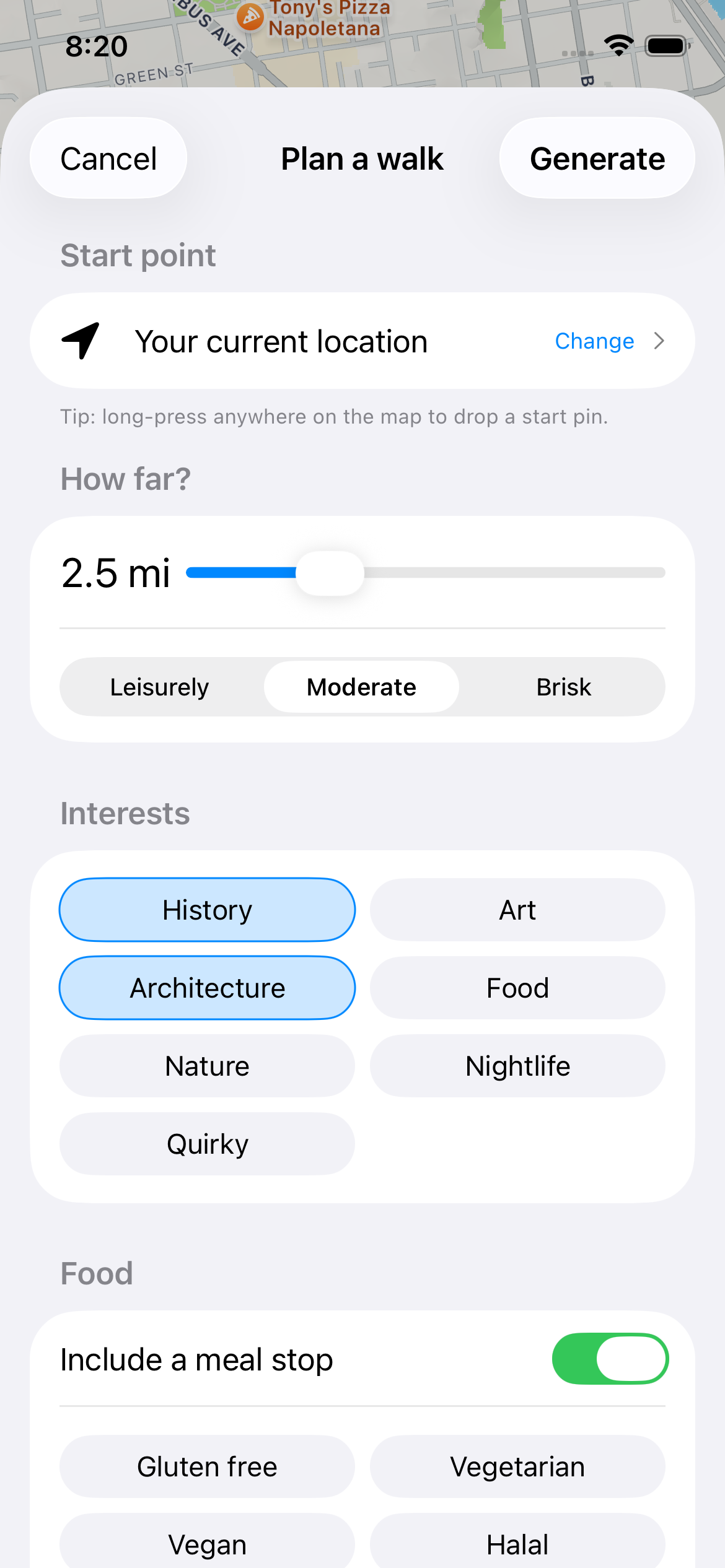
Mosey loads this full route onto your phone — narration, maps, and stop-by-stop guidance — so you can walk at your own pace without staring at a PDF. Build your Georgetown tour at moseytourbuilder.com.
Download on the App Store — FreeMore Washington DC Walking Tours Built by Mosey
If Georgetown has you wanting more DC history on foot, the Mosey app has routes ready for several adjacent and complementary neighborhoods. Dupont Circle picks up where Georgetown's Gilded Age wealth leaves off, with a concentration of Beaux-Arts mansions, embassy buildings, and early 20th-century apartment architecture that tells a different chapter of Washington's residential history. Capitol Hill is the natural counterpart for anyone more interested in political history than domestic architecture — the Senate and House blocks around East Capitol Street contain some of the finest Victorian rowhouse streetscapes in the city alongside the obvious landmarks. For a complete picture of DC's early urban planning, the L'Enfant Plan tour of the National Mall connects the dots between Georgetown's pre-federal origins and the monumental core that grew up around it after 1800.