Capitol Hill is the architectural and democratic heart of the United States. The neighborhood that rises east of the National Mall is home to the most consequential square mile in American civic life — the US Capitol, the Supreme Court, and the Library of Congress all sit within a few blocks of one another — yet it also contains one of DC's most livable and walkable residential districts, where 19th-century rowhouses line brick sidewalks and a century-old public market still draws crowds on weekends. If you're interested in history and architecture, this is the walk that delivers both at the highest possible level.
This self-guided tour, built with Mosey, threads together six stops that move from the grand federal campus on the western end of the Hill down through the residential streets to Eastern Market. Along the way you'll encounter neoclassical architecture on a scale that was deliberately designed to project permanence and power, along with the quieter domestic streetscapes that have housed congressional staff, abolitionists, and working families for nearly two centuries. The route is compact but layered — every block carries multiple eras of history.
Plan for a morning start if possible. The Capitol grounds and the Library of Congress's Great Hall are most manageable before midday crowds build, the light on the Capitol's east and west facades is best in the first half of the day, and you'll want to arrive at Eastern Market while the indoor market vendors are still fully set up. Mosey surfaces historical context at each stop so you can move at your own pace — linger as long as a place earns it.
The Route: 6 Stops Through Capitol Hill's Historic Core
"The Capitol has occupied Jenkins Hill — renamed Capitol Hill — since 1793, when President Washington laid the cornerstone using a Masonic ceremony. The building you see today is the product of continuous construction and expansion across more than a century: William Thornton's original design won a 1792 competition, Benjamin Henry Latrobe and later Charles Bulfinch oversaw significant changes in the early 19th century, and Thomas U. Walter added the iconic cast-iron dome between 1855 and 1866 — completing it during the Civil War as a deliberate signal of national continuity. The dome weighs approximately 8.9 million pounds and is topped by the Statue of Freedom, a bronze figure cast by enslaved laborers at a Maryland foundry in 1863. The Capitol has been burned (by British forces in 1814), expanded, and controversially stormed, but has remained the continuous seat of the United States Congress since 1800."
Start on the East Plaza rather than the West Front — this is the historic 'front' of the building, the side used for presidential inaugurations until Ronald Reagan switched to the West Front in 1981, and it offers an unobstructed view of the full facade. Free guided tours of the interior depart from the Capitol Visitor Center (entrance underground on the East Plaza); book in advance at visitthecapitol.gov or contact your congressional representative's office for gallery passes. Allow extra time if you plan to go inside.
"The Supreme Court building at One First Street NE was not completed until 1935 — for the first 145 years of its existence, the Court met in various Capitol rooms and rented spaces around Washington. Chief Justice William Howard Taft, the only person to serve as both president and Chief Justice, lobbied for a permanent building and lived to see construction begin in 1932, though he died before it was finished. Architect Cass Gilbert designed the building in Corinthian marble — 28 varieties from locations including Vermont, Alabama, Georgia, and Spain — in a style meant to equal the grandeur of the Capitol and the Lincoln Memorial. The famous inscription 'Equal Justice Under Law' above the west entrance was not a quotation from any legal document; Gilbert's office composed it to fit the frieze, and some justices initially objected that it overstated the Court's role."
The building is free to enter and the Great Hall and courtroom are open to the public on weekdays when the Court is not in session (and before arguments begin on days it is). The west entrance plaza — with its two marble fountains and the broad staircase — is where most visitors photograph, but walk around to the east side to see the less-photographed rear entrance and the quieter, tree-lined approach. A small permanent exhibit inside traces the Court's history and is worth 10 minutes even if you skip the courtroom.
"The Thomas Jefferson Building, opened in 1897, was the first purpose-built Library of Congress structure and remains one of the most ornate public buildings in the United States. Architects John L. Smithmeyer and Paul J. Pelz won the design commission in 1873, but construction was delayed by congressional disputes and cost overruns for more than a decade; Edward Pearce Casey oversaw the final interior work. The building's Great Hall and Main Reading Room feature more than 40 varieties of American marble, mosaics, murals by nearly 50 American artists, and sculptures representing the arc of human knowledge — the program was one of the most ambitious decorative commissions in American history. The Library itself traces its origins to 1800, when Congress appropriated $5,000 to purchase books for legislative use; after the British burned the original collection in 1814, Thomas Jefferson sold his personal library of 6,487 volumes to Congress, forming the nucleus of the modern institution, which now holds more than 173 million items."
Entry to the Jefferson Building is free and no reservation is required for general visits, though the Main Reading Room requires a reader registration card if you want to use the collections. The best single thing to do here, especially if time is limited, is to walk directly to the second-floor gallery overlook above the Main Reading Room — the view down into the domed reading room is one of the most spectacular interior spaces in Washington. Check loc.gov for current exhibition schedules; temporary exhibits on the ground floor frequently highlight items from the collection.
"The Folger Shakespeare Library at 201 East Capitol Street SE holds the world's largest collection of Shakespeare's printed works, including 82 of the 235 known surviving copies of the First Folio — the first collected edition of Shakespeare's plays, published in 1623. Standard Oil executive Henry Clay Folger and his wife Emily began collecting Shakespeariana in the 1880s and amassed their collection quietly over decades, purchasing items at auction under assumed identities to avoid driving up prices. The building, designed by Paul Philippe Cret and completed in 1932, is deliberately understated from the exterior — white Georgia marble panels with bas-relief scenes from Shakespeare's plays — while the interior features a richly paneled Elizabethan Great Hall modeled on the architecture of Shakespeare's England. The library was among the first major research institutions in America to be purpose-built for a private collection donated to the public."
The Folger underwent a major renovation completed in 2024 and has significantly expanded its public-facing spaces. The Great Hall and a permanent exhibition gallery are open to visitors without a research appointment; check folger.edu for current hours and any ticketed events. The bas-relief panels along the exterior are worth a slow look — each depicts a scene from a different play and were carved with unusual detail for what most passersby treat as background architecture.
"The blocks surrounding Seward Square — bounded roughly by Pennsylvania Avenue, East Capitol Street, and 5th through 7th Streets SE — contain some of the best-preserved Victorian rowhouse streetscapes in Washington. Development of this section of Capitol Hill accelerated after the Civil War, when the expansion of federal employment and the arrival of streetcar lines made the neighborhood accessible to the growing middle class. The architectural styles you see on these blocks — Italianate, Queen Anne, Romanesque Revival, and early Colonial Revival — represent almost the full span of late 19th-century American residential taste compressed into a few city blocks. The neighborhood was also the site of significant African American residential and commercial life in the late 19th and early 20th centuries, a history that is less marked in the built environment than in archival records."
This is a lived-in residential neighborhood — the streets are public but the rowhouses are private homes, so keep that in mind as you walk. The square itself (named for Secretary of State William Seward, who survived an assassination attempt the same night Lincoln was shot) is a small park worth pausing in. Walk the 300 and 400 blocks of East Capitol Street SE for a particularly intact stretch of rowhouse architecture, and look for the variety of cornice details, bay windows, and front stoop ironwork that distinguish buildings that were often constructed by the same developer but customized for individual buyers.
"Eastern Market at 225 7th Street SE is the oldest continuously operating public market in Washington, DC, established by an act of Congress in 1873 and operating from a building designed by Adolph Cluss, the same architect responsible for several DC public schools and the original Smithsonian Arts and Industries Building. The market survived the closure of other DC public markets in the 20th century largely through the loyalty of its surrounding neighborhood and the political organizing of Capitol Hill residents. A fire gutted the South Hall in 2007, but the market was rebuilt and reopened in 2009 following a community campaign that treated its restoration as a civic priority. The outdoor weekend market — which expands the indoor vendors with farmers, artists, and craftspeople along 7th Street — has operated in some form since the building opened."
On weekdays, the South Hall indoor market is the main draw, with produce vendors, a butcher, fishmonger, and bakeries operating from permanent stalls. On Saturdays and Sundays, the outdoor market along 7th Street SE adds significantly more vendors and is the more lively scene. For a meal, the Market Lunch counter inside the South Hall is the classic choice — a DC institution serving crab cakes, blueberry buckwheat pancakes, and fried fish from a no-frills counter that often has a line; arrive early or expect to wait. The surrounding blocks on 7th Street SE have additional cafés and restaurants if the Market Lunch line is long.
Planning Tips for Your Capitol Hill Walk
Best time to walk: July in DC is hot and humid — expect temperatures in the upper 80s to low 90s°F with high humidity that makes it feel hotter. Start by 8:30 or 9am to get the outdoor portions done before peak midday heat. Carry water; there are fountains inside the Library of Congress and the Capitol Visitor Center. Afternoon thunderstorms are common in summer — check the forecast and note that the Library of Congress and Eastern Market's indoor hall are good shelter options.
Shoes: The route is entirely on paved sidewalks and interior marble floors, with no significant elevation change. Comfortable walking shoes or sneakers are fine; avoid sandals if you plan to enter the Capitol Visitor Center, where you'll be on your feet for a sustained stretch on hard marble.
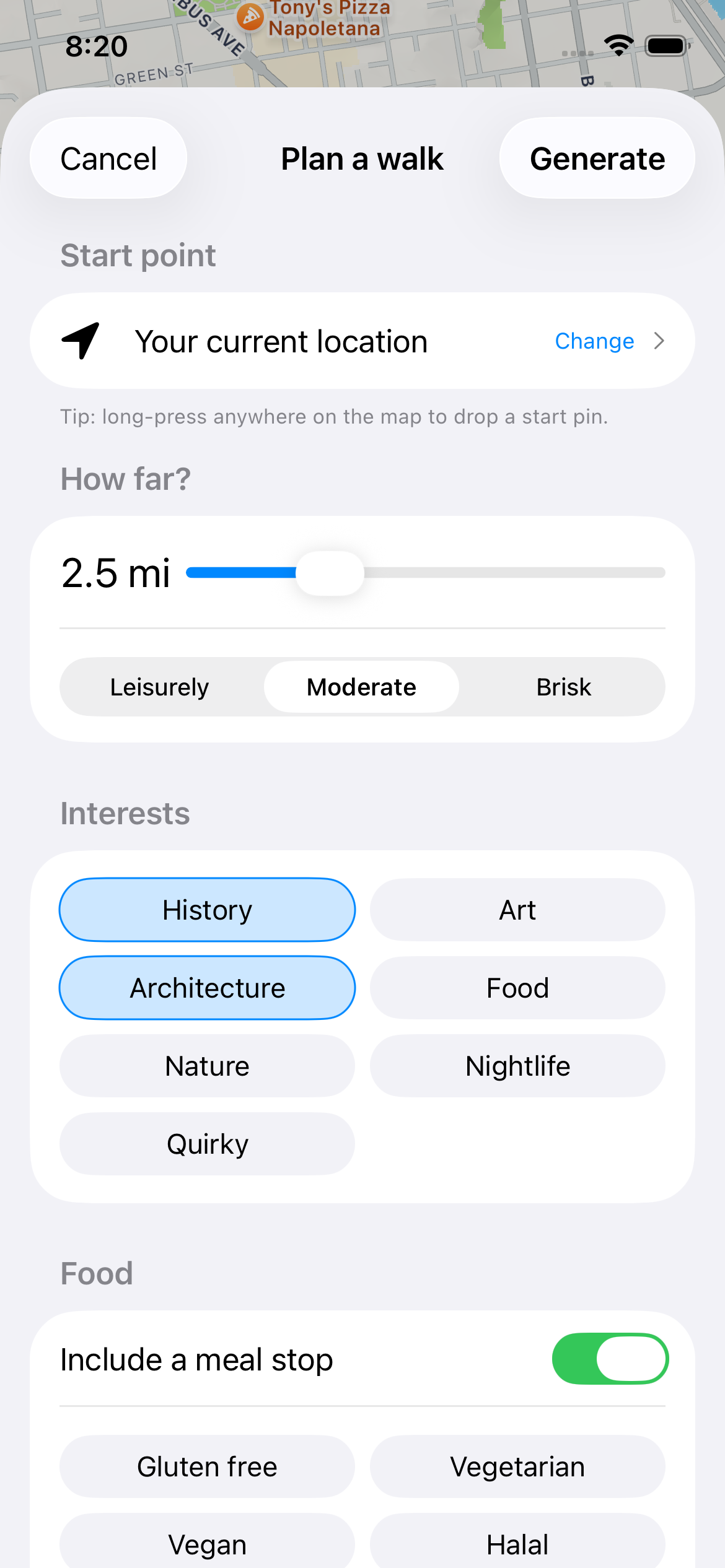
The narration: Mosey surfaces curated historical context at each stop — architectural details, key events, and the human stories that make these places more than monuments.
Walk Capitol Hill with Mosey
Mosey builds self-guided walking tours that surface the right historical context at the right moment — no audio required, no group to keep up with. Load this route before you go at moseytourbuilder.com.
Download on the App Store — FreeOther DC Neighborhoods Worth Exploring with Mosey
If Capitol Hill leaves you wanting more DC history and architecture, Mosey has routes worth considering in adjacent neighborhoods. The National Mall corridor — immediately west of the Hill — is its own half-day or full-day walk through the Smithsonian museums and monuments, with enough density of historically significant sites to warrant a separate tour. Penn Quarter and Chinatown, north and west of the Mall, offer a compelling mix of Civil War-era history (Ford's Theatre is there), early 20th-century commercial architecture, and the contemporary cultural district that has replaced the old Chinatown. And if you want a residential neighborhood tour with strong 19th-century character similar to Capitol Hill's rowhouse blocks, Lincoln Park and the H Street NE corridor — directly north of the Hill — carry their own layered histories and are increasingly walkable destinations in their own right.