Tulsa has more Art Deco buildings per square mile than almost any American city its size, a byproduct of the oil money that poured through downtown between 1920 and 1935. When the boom hit, local oil executives and the architects they hired didn't build cautiously. They built in zigzag Deco and Deco Gothic, with terra cotta facades, geometric ornament, and lobbies finished in marble and bronze that had no business existing in a prairie town of 140,000 people. Much of it survived not because Tulsa protected it, but because the money ran out before anyone could tear it down.
This route covers eight stops across downtown's Deco core, starting at the Philcade Building on Boston Avenue and ending at a lunch counter that's been slinging coney dogs since 1926. You'll walk past the buildings Waite Phillips built to house his oil empire, stand under what's arguably the finest Art Deco church sanctuary in the country, and see the zigzag terra cotta that made Tulsa's skyline a case study for architecture students. None of the stops charge admission to view exteriors, and most of downtown is flat, walkable, and quiet enough on a weekday morning that you can stand in the middle of the sidewalk and actually look up.
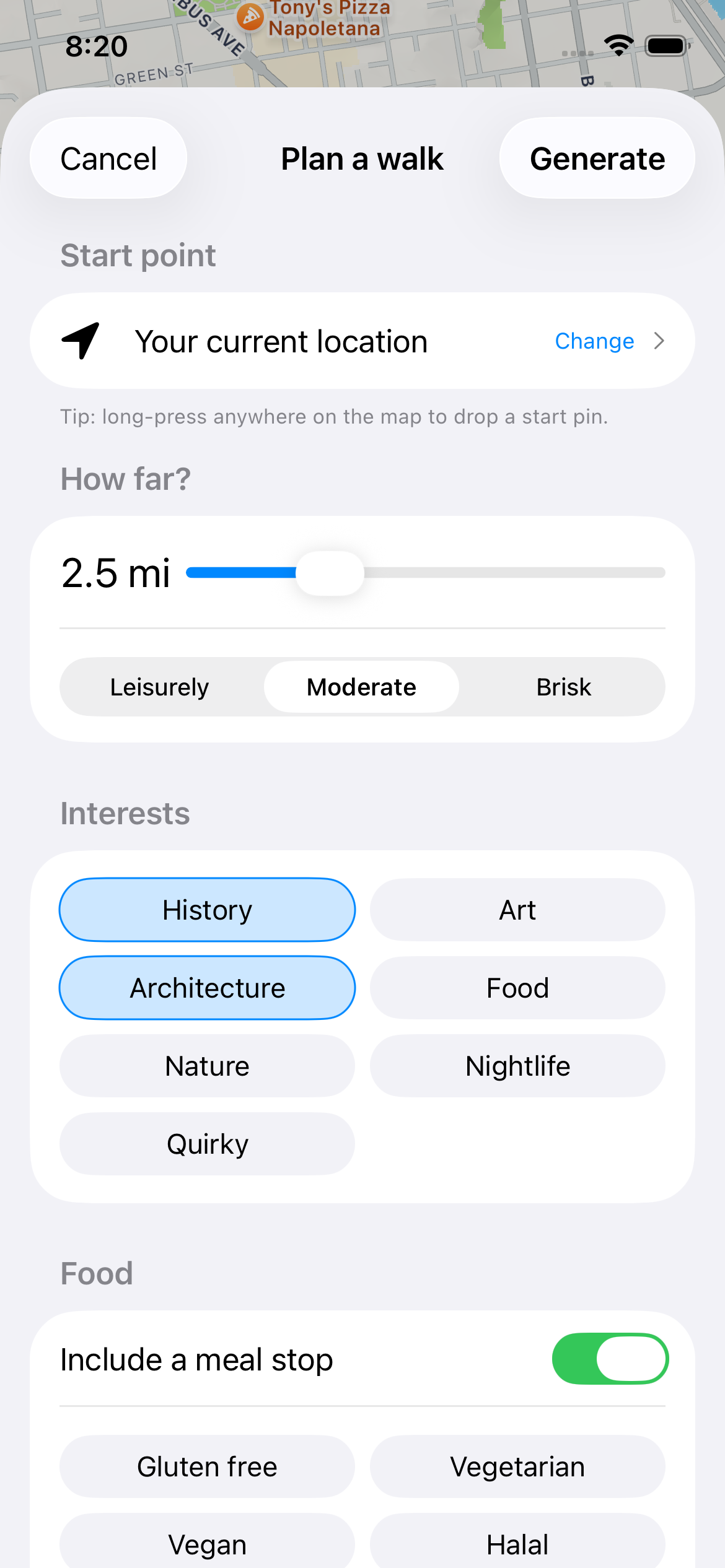
Mosey lays out the sequence so you're not backtracking across Main Street, and the app surfaces the history at each stop as you arrive rather than making you read a wall of text before you start walking. Bring the app or don't, but the route below works either way.
The Route: Eight Stops Through Tulsa's Deco Core
"Oil baron Waite Phillips commissioned the Philcade in 1930, and it went up fast, completed within the year to house offices for his Phillips Petroleum-adjacent ventures. Architects Frank Wallace, William Smith, and Leon B. Senter drew a zigzag Deco facade in terra cotta with polychrome ornament running along the arcade level. The interior arcade, restored in the 1990s, still has its original terrazzo floors and decorative plaster ceiling."
Walk through the interior arcade even if you skip everything else here — it's open to the public during business hours and free. Look up at the ceiling medallions before you head back out to Boston Avenue.
"Built in 1927–28, also for Waite Phillips, the Philtower mixes Gothic verticality with Deco ornament — a style sometimes labeled Deco Gothic. The roofline is tiled in a diamond pattern of green, red, and orange terra cotta, visible for blocks. Architect Edward Buehler Delk designed it as a visual anchor for Phillips's real estate holdings downtown, and at 24 stories it was among the tallest buildings in the state when it opened."
Best viewed from across the street at 5th and Boston so you can take in the full roofline. The lobby is generally accessible during weekday business hours and worth a two-minute look for the bronze elevator doors.
"Completed in 1929, this church was designed largely by Adah Robinson, an art teacher at Tulsa Central High School, working with architect Bruce Goff, then in his early twenties. The 225-foot tower is faced in Indiana limestone with sculptural figures by Robert Garrison representing pioneer spirit, and the sanctuary seats over 1,500 under a soaring vaulted ceiling. It was designated a National Historic Landmark in 1999, one of relatively few religious buildings to receive that status for architectural rather than purely historical significance."
The exterior is free to view any day. If you want the sanctuary interior, check the church's posted tour hours — as of recent years it's been open for self-guided visits on select weekday afternoons, free of charge. Don't skip the exterior sculptural detail around the base of the tower; it's easy to miss if you only look up at the spire.
"Opened in 1931, Union Depot served the Frisco and Santa Fe railroads during Tulsa's oil-boom peak, when passenger rail was still the fastest way in and out of the city. The building's stripped-down Deco styling — smooth limestone, minimal ornament, strong horizontal lines — reflects the more restrained end of the style compared to the terra cotta towers a few blocks north. Passenger service ended in the 1960s, and the building has since been repurposed for office and event use."
There's not much to do here beyond viewing the exterior, but it's a useful contrast stop — compare this restrained facade to the ornament-heavy Philcade and Philtower you just saw.
"Built in 1927 by architects Frederick Kershner and Arthur Schutze as a private social club for Tulsa's business elite, this building sat vacant and deteriorating for over three decades starting in the 1980s. A restoration completed in 2019 converted it into a Curio Collection hotel, using historic tax credits to preserve the original terra cotta exterior and much of the interior detailing. The building's survival — after a fire in 2010 nearly ended the preservation effort — is one of the closer calls in the Deco District's history."
Step into the lobby if you want to see the restoration work up close; it's a functioning hotel, so no fee to look around the public spaces. This is a good midpoint to check your pace before continuing to the last stretch of the walk.
"Completed in 1917 and later expanded, this building anchored Tulsa's financial district during the years oil money was flooding into downtown banks. It predates the strictest Deco period but its later renovations and neighboring additions picked up Deco detailing as the district's style solidified through the 1920s and '30s. The building has changed names and functions repeatedly, reflecting downtown Tulsa's shifting fortunes after the oil bust of the 1980s."
This stop is more about context than spectacle — it fills in the timeline between the pre-Deco building boom and the zigzag Deco that followed. A quick look from the sidewalk is enough.
"Main Street through this stretch of downtown was pedestrianized in the 1970s as part of an urban renewal push, then reopened to vehicle traffic decades later once the mall concept fell out of favor nationally. Walking it now gives you sightlines to several Deco facades at once, including terra cotta detailing on smaller commercial buildings that don't individually rate a stop but collectively make the district's density obvious."
Take your time on this block — it's the best single vantage point for photographing multiple Deco buildings in one frame without a wide-angle lens.
"Coney I-Lander has been serving Coney Island-style hot dogs in Tulsa since 1926, making it almost exactly contemporary with the Deco buildings you've just walked past. The chili-topped coney dog recipe has stayed close to its original Greek-immigrant roots, brought to Tulsa via the broader Coney Island hot dog tradition that spread through the Midwest in the early 20th century. It's counter service, cash-and-card, cheap by any city's standards."
Order two or three coneys — they're small — and a Coney I-Lander root beer if they've got it on tap. Expect a lunch rush between 11:30 and 1pm on weekdays; go earlier or later to get a seat without waiting.
Planning Your Walk
Best time to walk: Oklahoma summers push past 95°F with high humidity, so aim for morning starts May through September. Fall, including late September, is the sweet spot: mid-70s, low humidity, and good light for photographing the terra cotta facades. Winter can bring sudden cold snaps and occasional ice, so check conditions if you're walking December through February.
Shoes: Downtown Tulsa sidewalks are flat, wide, and in good repair — sneakers are fine, no technical footwear needed.
The narration: Mosey surfaces the architect, builder, and construction year at each stop, plus the oil-boom backstory that connects the buildings to each other.
Build This Walk in Mosey
Get turn-by-turn routing and on-site historical narration for all eight stops, right on your phone, no planning required.
Download on the App Store — FreeFrequently asked questions
How long does it take to walk Tulsa's Deco District?
Plan on about 2.5 hours for the full route, covering roughly 1.8 miles and eight stops. That includes time inside Boston Avenue Methodist Church and a sit-down lunch at Coney I-Lander. If you're only viewing exteriors and skipping the meal, you can do it in under 90 minutes.
Is the Tulsa Deco District walkable?
Yes, downtown Tulsa is flat, compact, and has wide sidewalks with working crosswalks at nearly every intersection. Traffic is light outside of weekday rush hours. Parking is easy to find and often free on weekends, making it simple to park once and walk the entire route without moving your car.
Do you need tickets to go inside the buildings on this tour?
No tickets are required for exteriors, and most lobbies (Philcade, Philtower, Tulsa Club) are open to the public free of charge during business hours. Boston Avenue United Methodist Church offers free self-guided access to its sanctuary on select weekday afternoons — check current posted hours before you go.
What's the best time of day to photograph Tulsa's Art Deco buildings?
Late morning to early afternoon gives the best light on the terra cotta facades, since most face east or south along Boston Avenue and 5th Street. Golden hour before sunset also works well for the Philtower's tiled roofline, but building interiors close earlier, so plan photography around your indoor stops.
Why does Tulsa have so much Art Deco architecture?
Tulsa's oil boom in the 1920s and early 1930s generated enormous private wealth concentrated in a short window, and oilmen like Waite Phillips spent it on new office towers built in the era's dominant style, Art Deco. The 1980s oil bust then froze downtown development for decades, which accidentally preserved the buildings instead of replacing them.
Is downtown Tulsa safe to walk during the day?
Yes, the Deco District and surrounding downtown blocks are well-trafficked during business hours with regular foot traffic, active businesses, and visible police presence. Weekday daytime walking is straightforward; use normal city awareness in the evenings, as some blocks quiet down after office hours end.
More Tulsa Walks Worth Building
Beyond the Deco District, Tulsa's Blue Dome District and Brady Arts District are worth a Mosey route of their own, covering the city's oil-boom warehouse architecture and its Greenwood/Black Wall Street history within walking distance of downtown. If you're building a longer weekend itinerary, pair this walk with a Riverside Drive route along the Arkansas River, which covers a different, quieter side of the city entirely.