Fourth Avenue has been Tucson's odd-shop-and-good-food strip since the streetcar first ran down it in the early 1900s, and it hasn't smoothed itself out for anyone. This is the stretch between the University of Arizona and downtown where head shops sit next to third-wave coffee, where a concrete underpass gets treated like a canvas instead of an eyesore, and where the same family has been slinging pizza by the slice since 1986. It's a short walk, but it's a dense one, packed with independent businesses that have outlasted at least three separate redevelopment plans for downtown Tucson.
This route runs roughly from the Fourth Avenue underpass at University Boulevard south to the edge of downtown near Ninth Street, tracing the spine of the neighborhood's commercial district. You'll pass murals, mid-century storefronts, the twice-yearly street fair grounds, and a couple of restaurants that Tucsonans will argue about defending as the city's best. The Mosey app times each stop and keeps the historical notes short enough to read while you're standing there, not after you've already walked past.
Give yourself a morning or a slow evening. Fourth Avenue is more fun after 4pm when shops are fully open and the heat has started to break, but if you're doing this in summer, plan around it — more on that below.
The Route: Underpass to Downtown
"The underpass beneath the Union Pacific tracks opened in 1974, engineered specifically to let Fourth Avenue traffic and pedestrians pass under the rail line without a grade crossing. Its concrete retaining walls became a public art canvas starting in the 1990s, and the space is now maintained through the Fourth Avenue Merchants Association's mural program. The murals rotate over the years, but recurring themes include Sonoran Desert imagery, Tucson counterculture, and tributes to local musicians. It remains one of the only pedestrian underpasses in the city treated as a destination rather than a shortcut."
Walk the full length on both sides — the murals differ wall to wall and get repainted periodically, so what's described in older guidebooks may not match what's there now. It's shadier here than almost anywhere else on the route, worth remembering if you're doing this walk in the heat.
"This stretch of Fourth Avenue developed as a streetcar commercial corridor starting around 1900, serving both the university and the growing residential neighborhoods to the south. Many of the one- and two-story brick storefronts date to the 1920s and 1930s, built to house hardware stores, grocers, and other everyday businesses rather than tourist trade. The Fourth Avenue Merchants Association, formed in 1961, has run the twice-yearly Fourth Avenue Street Fair since 1970, an event that now draws several hundred vendors each December and March."
Look up above the modern signage — a lot of the original brick parapets and transom windows are still intact even where the ground floor has been renovated. If you're here in December or March, check the street fair dates before you go; the crowds are a completely different experience than a normal weekday.
"Antigone Books opened in 1973 as a feminist bookstore and has operated continuously on Fourth Avenue since, currently at 411 N 4th Ave. It's one of the longest-running independent bookstores in Arizona and has kept its focus on women authors, LGBTQ+ titles, and small-press fiction even as the shop expanded its general stock over the decades. The store is employee-owned, a structure it moved to in recent years to keep it independent after its founders stepped back."
Worth ten minutes even if you're not buying — the staff picks shelf is genuinely curated, not a marketing gimmick. It's a good place to duck into if a monsoon storm rolls through mid-walk.
"Beyond the underpass, individual business owners along Fourth Avenue have commissioned murals on side walls and alley-facing facades since at least the 1980s, turning the corridor into an informal open-air gallery. Local artists including Joe Pagac, a Tucson muralist known for large-scale desert wildlife and portrait work found throughout the city, have contributed pieces here over the years. The murals aren't part of a single coordinated program — most are paid for directly by the shop owners whose walls they cover."
Check the side streets and alleys, not just the main avenue frontage — some of the best pieces are on cross streets like 6th Street and University Boulevard just off the main drag. Nothing here costs money to see, and there's no fixed route; wander a block off Fourth if something catches your eye.
"Buffalo Exchange was founded on Fourth Avenue in 1974 by Kerstin Block and Spencer Block, starting as a single secondhand clothing shop before growing into a national resale chain with dozens of locations across the country. The original store concept — buying, selling, and trading clothing on the spot for cash or store credit — was considered unusual for the time and became the company's signature model. Tucson remains the corporate headquarters city for the chain."
The current Fourth Avenue location isn't the exact original storefront, but it's a straight-line descendant of a business that started here and reshaped how secondhand clothing retail works nationally. Bring things to sell if you're a local — cash offers are made on the spot, no appointment needed.
"The Sun Link modern streetcar began service in 2014, connecting the University of Arizona through Fourth Avenue to downtown Tucson and the Mercado district, largely following the route of Tucson's original horse-and-mule streetcar line that ran from 1897 into the 1930s. The revival line was funded through a mix of federal grants and city bonds, part of a broader push to bring foot traffic back to Fourth Avenue and downtown after decades of suburban flight."
You don't need to ride it for this walk, but it's worth noting the tracks run right down the center of the avenue — a direct physical link to the streetcar era that originally built this commercial strip. Fare is $1.50 if you want to hop a stop or two.
"The southern stretch of Fourth Avenue, closer to Ninth Street, marks the historic edge where the shopping district gave way to residential blocks built up in the early 20th century for university faculty, railroad workers, and merchants. Some of the small bungalow houses just off the avenue here date to the 1900s–1920s and reflect the working- and middle-class neighborhoods that supported the original commercial strip. This transition zone is less polished than the northern blocks, with more vacancies and older, unrenovated storefronts."
This is a good stretch to slow down rather than speed through — it's quieter, with fewer shops, but the building stock is older and gives a clearer sense of what Fourth Avenue looked like before the recent wave of restaurant openings.
"Time Market opened in 2012 at 444 E University Blvd, just off Fourth Avenue, combining a small grocery, wine shop, and full kitchen in one space. It's built around scratch cooking with a rotating menu that includes breakfast sandwiches, salads, and a well-known burger, alongside a market stocking local produce and specialty goods. The concept was part of a wave of Tucson businesses in the early 2010s built around sourcing from Southern Arizona farms and producers."
Go for breakfast or lunch rather than dinner — the kitchen and market both run strongest earlier in the day, and the patio seating is limited. Expect to spend $12–18 per person; it's counter service, so order at the register and grab a table.
Planning Your Walk
Best time to walk: Tucson in late August is monsoon season — expect highs near 100°F with a real chance of afternoon thunderstorms. Walk early morning (before 10am) or after 6pm, and carry water regardless; the underpass and a few storefronts are the only guaranteed shade.
Shoes: Flat, easy sidewalks the whole way — sneakers are fine. A few blocks have uneven or narrow curb cuts near older storefronts, so keep an eye down if you're not watching the murals.
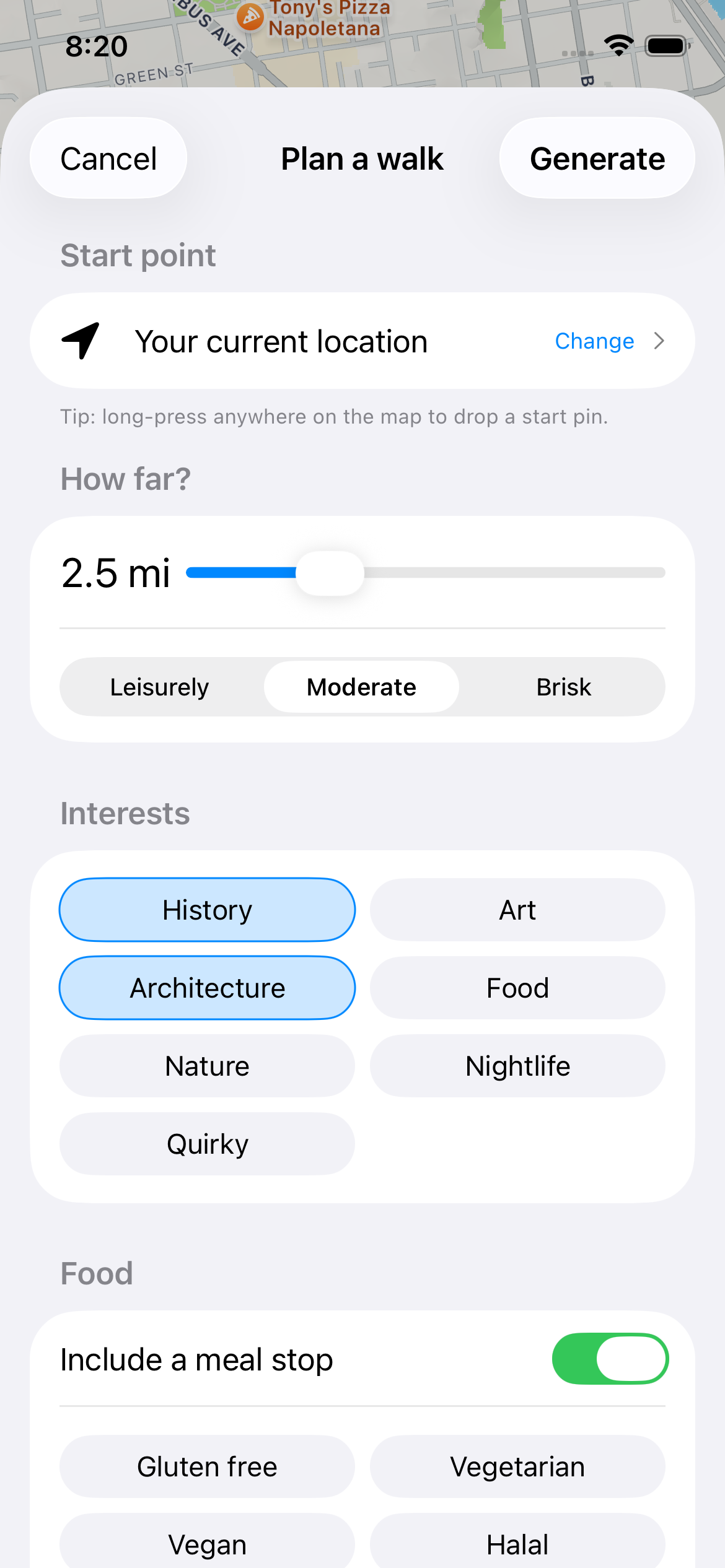
The narration: Mosey surfaces short historical notes at each stop — the year a building went up, who painted a mural, what used to occupy a storefront — so you get context without breaking stride.
Walk Fourth Avenue with Mosey
Open the Mosey app to get turn-by-turn guidance, timed stops, and the historical notes above delivered right when you're standing in front of each place.
Download on the App Store — FreeFrequently asked questions
How long does it take to walk Fourth Avenue in Tucson?
Walking Fourth Avenue end to end takes about 20–25 minutes without stopping, but a proper self-guided tour with stops at the underpass, shops, and murals runs about 2 to 2.5 hours. The full corridor between University Boulevard and downtown covers roughly 1.5 miles.
Is Fourth Avenue in Tucson walkable?
Yes. Fourth Avenue has continuous sidewalks, a pedestrian underpass beneath the rail tracks, and a streetcar line running its length, making it one of the most walkable commercial corridors in Tucson. Traffic moves slowly through the district and most storefronts sit directly on the sidewalk.
What is the best time of day to walk Fourth Avenue?
Late afternoon into early evening, after 4pm, when shops are fully open and the desert heat starts to ease. In summer months, an early morning walk before 10am avoids the worst heat; many shops don't open until 10 or 11am, so factor that into timing.
Where should I eat on Fourth Avenue?
Time Market at 444 E University Blvd is a reliable stop for breakfast or lunch, built around scratch cooking and local sourcing since 2012. Delectables Restaurant & Catering and various taco and pizza spots along the avenue are also long-running local favorites worth checking depending on what you're craving.
Is Fourth Avenue in Tucson safe to walk at night?
Fourth Avenue is generally busy and well-lit in the evening, especially between 6 and 10pm when restaurants and bars are active, and it's considered one of Tucson's safer walking districts after dark. Standard city precautions apply — stick to the lit main strip rather than side alleys late at night.
When is the Fourth Avenue Street Fair?
The Fourth Avenue Street Fair happens twice a year, typically in December and March, and has run continuously since 1970. It draws several hundred vendors and dramatically changes foot traffic and parking on the avenue, so check exact dates before planning a quiet self-guided walk.
More Tucson Neighborhoods to Mosey
Mosey also maps a route through downtown Tucson's Congress Street corridor, covering the Rialto Theatre and the Hotel Congress, both a short streetcar ride from Fourth Avenue's south end. If you've got another afternoon, the University of Arizona campus tour picks up right where this one starts, with a different pace and a lot more shade from mature trees planted in the early 1900s.