Downtown Tacoma spent decades being the punchline to Seattle jokes, but the neighborhood was built on serious money and it shows. This was a lumber and shipping fortune town at the turn of the 20th century, and the terra cotta, copper domes, and Beaux-Arts facades left behind by that boom are still standing, mostly intact, and largely uncrowded. The city's glass art scene, anchored by Dale Chihuly's ties to the area, gives the walk a second layer: a former warehouse district turned into a corridor of studios and museums.
This route runs from the restored Union Station through the Chihuly Bridge of Glass, up into the theater district on Broadway, and past the antique dealers on St. Helens Avenue before ending at a diner that's been feeding the neighborhood since the 1930s. It's a walk that rewards looking up — a lot of the interesting stuff in Tacoma is on the upper floors and rooflines, not at street level.
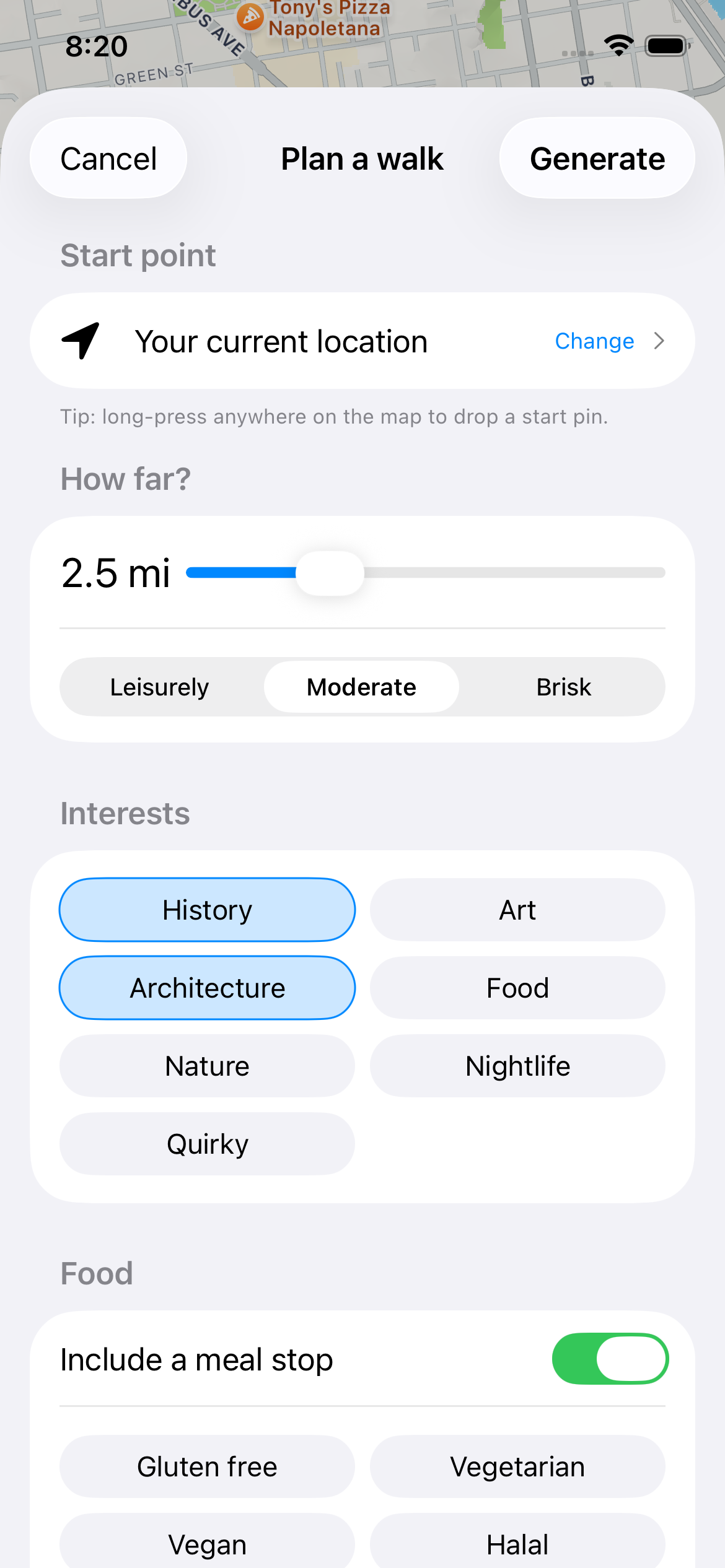
The Mosey app runs this whole route on your phone, with the historical detail below queued up automatically as you reach each stop, so you're not standing on a corner reading paragraphs off a screen before you can look at the building in front of you.
The Route: Union Station to Broadway
"Designed by Reed and Stem, the same firm behind New York's Grand Central Terminal, Union Station opened in 1911 for the Northern Pacific Railroad. Its copper dome rises 90 feet and was modeled loosely on Rome's Pantheon. Passenger rail service ended here in 1984, and the building sat empty for over a decade before a 1992 restoration converted it into a U.S. District Courthouse. Several large-scale Chihuly glass installations now hang inside the rotunda, on permanent loan since the building's reopening."
The interior is free and open during business hours (it's an active federal courthouse, so expect a security check). Stand under the dome and look for the Chihuly chandeliers — the piece hanging in the center is one of his largest permanent installations anywhere.
"This 500-foot pedestrian bridge opened in 2002, connecting Union Station to the Museum of Glass over active railroad tracks and I-705. Dale Chihuly, a Tacoma native who grew up near Point Defiance, designed three major installations along its length, including the Seaform Pavilion ceiling made of 2,364 individual glass pieces. The bridge is a public-private project funded partly by the City of Tacoma and partly by Chihuly himself."
It's free, unstaffed, and open 24 hours, though the glass reads best in daylight with the sun coming through the Seaform ceiling around midday. Don't rush the walk across — the Crystal Towers sculptures at the museum end are easy to miss if you're looking down at the tracks below.
"Opened in 2002, the museum's slanted stainless-steel cone was designed by Seattle architect Arthur Erickson to evoke a sawdust burner from Tacoma's old lumber mills. Inside the cone sits the Hot Shop, an active glassblowing studio where visiting artists give live demonstrations on a working furnace. The museum was built partly to give Chihuly's hometown a permanent showcase for Pacific Northwest studio glass, a movement he helped found in the 1970s alongside the Pilchuck Glass School."
Admission runs $19 for adults; check the demo schedule at the door since Hot Shop sessions run on a timer, not continuously. Budget real time here — this is the one stop on the route worth going over the suggested minutes for if a demonstration is underway.
"Opened in 1996, the building was designed to echo Union Station's brick and arch motifs right next door, with five brick arches deliberately matching the station's scale. The museum holds over a million artifacts covering Washington statehood, tribal history, and the state's logging and fishing economies. Its Great Hall runs 100 feet under a barrel-vaulted brick ceiling built to reference the region's railroad architecture directly."
Admission is $18 for adults, free on the third Thursday evening of most months from 2–8pm. If you're short on time, the exterior alone — walking the arcade along Pacific Avenue — is worth the five minutes even if you skip the ticket.
"The Pantages Theater at 901 Broadway opened in 1918, designed by theater architect B. Marcus Priteca for vaudeville magnate Alexander Pantages. It originally showed vaudeville acts and silent films before falling into disrepair by the 1970s. The City of Tacoma bought and restored it in 1983, reopening it as a performing arts venue with its original terra cotta facade and ornate plaster interior largely intact."
The lobby is sometimes open during the day if there's a matinee or rehearsal, worth a peek if the doors are unlocked. Otherwise, appreciate the exterior detail from across Broadway — the terra cotta ornamentation is some of the best-preserved in the city.
"This stretch of St. Helens Avenue between 7th and 9th developed as a furniture and antique dealer district starting in the early 1900s, and it's kept that identity longer than almost any other part of downtown. Several buildings here date to the 1890s and early 1900s reconstruction after Tacoma's push to rebuild in brick following fire ordinances passed in the 1880s. The Old City Hall building at 625 Commerce, visible from this stretch, was completed in 1893 in Italianate style with a clock tower modeled on Italian civic architecture."
Most shops open around 10 or 11am and close by 5 or 6, so this stop only works if you're walking earlier in the day. Even with shops closed, the streetscape itself — cast iron storefronts, painted brick, low-rise scale — is the point.
"The current building at 1701 Pacific Avenue opened in 2003, designed by Seattle architect Antoine Predock with an angular metal-clad form meant to reference the industrial landscape of the Tacoma tideflats. The museum holds a significant Chihuly collection along with a dedicated wing built specifically to house Northwest studio glass and Pacific Northwest paintings. Its Haub Family Collection, added in 2014, focuses on Western American art from the 19th and 20th centuries."
Admission is $18, free on the first Thursday of the month from 5–8pm. The Benaroya Wing on the second floor is easy to skip if you're short on time, but the glass gallery on the main floor pairs directly with what you just saw at the Museum of Glass.
"Harmon opened in 1997 in a building near the museum district, taking its name from early Tacoma resident and businessman Frank Harmon. It's one of the longer-running breweries in a city that had a substantial brewing industry in the late 1800s and early 1900s, when Tacoma's clean water supply made it a regional beer producer before Prohibition shut most of it down in 1916."
Order the pizza or the fish and chips — both are the menu's strong points. It's a five-minute walk from the Tacoma Art Museum, making it a natural stop to close out the route, and it's rarely so busy you'll wait long for a table.
Planning Your Walk
Best time to walk: Late August in Tacoma runs mild, usually in the mid-70s with a decent shot of sun, but Puget Sound weather can flip fast — bring a light layer for the breeze off Commencement Bay near the Bridge of Glass.
Shoes: Flat, easily walkable terrain with some hills between downtown and the theater district — regular walking shoes are fine, nothing technical needed.
The narration: At each stop, Mosey surfaces the building's construction date, architect, and the specific event or industry that shaped it, rather than generic historical color.
Walk This Route with Mosey
Get turn-by-turn navigation and the full historical narration for every stop, timed to arrive as you do — no reading required.
Download on the App Store — FreeFrequently asked questions
How long does it take to walk Downtown Tacoma's main sights?
About 2.5 hours covering roughly 2 miles if you go at a normal pace and spend real time inside the Museum of Glass and Tacoma Art Museum. Skip the museum interiors and you can do the outdoor stops — Union Station, the Bridge of Glass, Antique Row — in under an hour.
Is Downtown Tacoma walkable?
Yes. Downtown Tacoma is compact and flat near the waterfront, with a moderate uphill stretch between the museum district and Broadway. Sidewalks are consistent, blocks are short, and most major sights sit within a half-mile of Union Station.
Is the Chihuly Bridge of Glass free?
Yes, the Bridge of Glass is free and open to the public 24 hours a day. It connects Union Station to the Museum of Glass over I-705, and the three Chihuly installations along it, including the Seaform Pavilion ceiling, require no ticket.
What's the best time of day to walk Downtown Tacoma?
Late morning through mid-afternoon works best, roughly 10am to 4pm, since Antique Row shops and museum galleries are open and daylight shows the Bridge of Glass installations well. Evenings are quieter but several storefronts and museum ticket counters close by 5 or 6pm.
Do I need tickets in advance for the Museum of Glass or Tacoma Art Museum?
No, advance tickets aren't required for either. Museum of Glass admission is $19 and Tacoma Art Museum is $18 for adults, both purchasable at the door. Tacoma Art Museum is free on the first Thursday of the month from 5–8pm.
Is Downtown Tacoma safe to walk during the day?
Yes, the museum district and Broadway theater corridor covered on this route see steady foot traffic during the day and are considered safe for walking. Standard city awareness applies around the Commerce Street and Pacific Avenue transit areas after dark.
More Walks Near Tacoma
Mosey also runs a route through Tacoma's Stadium District, built around the Stadium High School's German Renaissance turrets and the residential mansions along North I Street, and a Point Defiance walk covering the park's old-growth forest trails and the Five Mile Drive. If you're extending the trip to Seattle, the Pioneer Square route pairs well with this one — same era of brick-and-terra-cotta boomtown architecture, different city.