St. Petersburg spent decades being described as a retirement town, and then around the early 2000s a batch of museums, galleries, and a city-backed mural program turned downtown into something else entirely. The Central Arts District, roughly bounded by Central Avenue and spilling into the Edge District and Grand Central corridor, is now dense enough with art that you can cover a surprising amount of it without a car. This walk links the big-ticket museums with the free stuff: alley murals, a working glass studio, and a historic commercial strip that's been repainted more times than anyone's bothered to count.
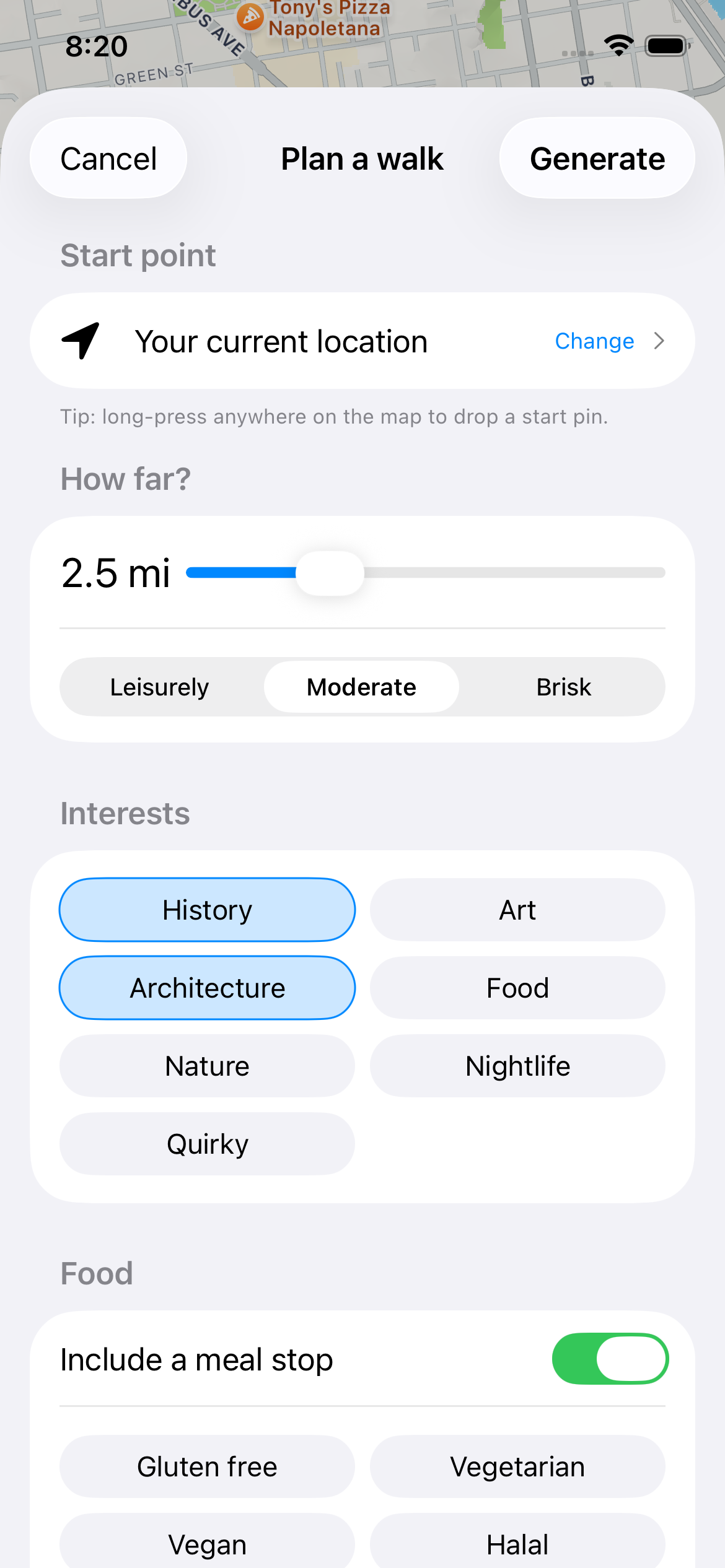
The route starts near the Dali Museum on the waterfront and works north and west through downtown, finishing on Central Avenue proper where the gallery density and the lunch options are both highest. It's flat the entire way, which matters in Florida heat, and shaded in patches but not consistently, so timing matters more than mileage here. Mosey built this as a self-guided route, meaning your phone tells you what you're looking at when you're standing in front of it rather than making you cross-reference a map and a guidebook at the same time.
Budget around two and a half hours if you go inside the Dali and the Chihuly Collection, less if you're doing the outdoor stops only. Most of what makes this neighborhood interesting — the murals, the street art, the storefronts — costs nothing to see. The paid stops are optional add-ons, not the spine of the walk.
The Walk, Stop by Stop
"The museum opened at this location in 2011, designed by architect Yann Weymouth, who also worked on the glass pyramid at the Louvre — the resemblance in the museum's 75-foot geodesic glass bubble, nicknamed the 'enigma,' is not an accident. The collection itself traces back to Cleveland industrialists Reynolds and Eleanor Morse, who began buying Dali's work directly from the artist in 1943 and amassed what's now the largest collection of his work outside Spain. St. Petersburg won the collection in the 1980s after the Morses decided Cleveland's planned museum site wasn't right, and a group of local backers raised the funds to build the first version of this museum in 1982."
Tickets run $30 for adults; Thursday evenings after 5pm are discounted to $10 and get busy. The hurricane-proof building (built to withstand a Category 5) is worth noting even if you skip the paid galleries — walk the free outdoor garden and reflecting pool on the south side first.
"This free garden on the museum's south side was designed with a labyrinth path and topiary meant to echo motifs from Dali's paintings — melting clocks, eyes, and elephants with spindly legs appear in the hedge work and sculpture placement. It was added after the 2011 building opened and functions as public space even when the museum itself is closed."
No ticket required. It's small, so ten to fifteen minutes covers it, but it's a good spot to sit before tackling the rest of the walk in the heat.
"Opened in 2010 at 720 Central Avenue, this permanent collection shows glass work by Dale Chihuly inside a space designed with his direct input, including a darkened room built specifically for his 'Mille Fiori' installation and a persian ceiling piece installed overhead. The building sits in the Morean Arts Center complex, and a connected hot shop next door lets visitors watch glassblowers working with 2,000-degree furnaces in real time."
Combined ticket with the Morean Arts Center hot shop demo runs about $25. Go in the late morning on a weekday if you want to actually watch the glassblowing without a crowd three-deep at the window.
"The hot shop next to the Chihuly Collection is a functioning studio, not a staged demo space, where resident glassblowers produce pieces sold in the adjoining gallery. St. Petersburg has leaned into glass art specifically because of the Chihuly connection, and the Morean has run public glassblowing demonstrations here since the early 2000s."
Demonstrations are included with Chihuly admission and run on a schedule posted at the entrance — check times before you plan your stop order, since an empty hot shop is a lot less interesting than a working one.
"This is a converted warehouse space where dozens of local and visiting artists have painted floor-to-ceiling murals across connected rooms, an approach modeled on immersive art spaces that became popular in the mid-2010s. It's not tied to a single historic building the way the other stops are — it's a deliberately rotating, Instagram-era addition to the arts district, with sections repainted periodically."
Tickets are around $20 and the space is genuinely large — plan on 30 to 45 minutes if you're taking photos in each room. Skip it if you're short on time; it's the most optional stop on this route compared to the historic buildings around it.
"The stretch of Central Avenue between roughly 9th and 16th Streets carries the bulk of St. Petersburg's outdoor mural program, which the city formalized through its SHINE mural festival starting in 2015. Local arts nonprofit Keep St. Pete Lit and the St. Pete Arts Alliance have coordinated with building owners to turn blank commercial walls into rotating canvases, meaning what you see here changes year to year."
This is entirely free and the best photo stretch of the walk. Side streets and alleys just off Central often hide additional pieces the main corridor doesn't show, so detour down 1st Avenue N if you have time.
"Bodega on Central, at 1120 Central Avenue, serves Cuban sandwiches and small plates out of a space designed to look like a converted corner store, playing on St. Petersburg's history as a stop on the Cuban sandwich trail that runs through Tampa Bay. The restaurant is part of the Edge District's broader restaurant cluster that grew up alongside the arts scene starting in the 2010s."
The Cuban sandwich and the frita are the standard orders; the back patio bar is a good place to end the walk if the afternoon heat has caught up with you. Expect a wait on weekend evenings — weekday lunch is the easier time to get a table.
Planning Notes Before You Go
Best time to walk: Florida sun is the real obstacle here, not distance. Mornings before 10am or after 4pm in fall keep you out of the worst heat; October still regularly hits the mid-80s. Afternoon thunderstorms are common June through September and still possible in early October, so check radar before you commit to the outdoor mural stops.
Shoes: Flat sidewalks and paved paths the entire route — sandals are fine, but bring something closed-toe if you're ducking into Fairgrounds St Pete, where the floor is painted concrete and occasionally under renovation.
The narration: At each stop, Mosey surfaces the specific building history, artist names, and founding dates behind what you're looking at, rather than generic museum-plaque summaries.
Walk This Route With Mosey
Open the Mosey app to get turn-by-turn navigation and the full historical narration at every stop on this route, hands-free.
Download on the App Store — FreeFrequently asked questions
How long does it take to walk the Central Arts District in St. Petersburg?
Plan on about two and a half hours if you go inside the Dali Museum and Chihuly Collection, or roughly 90 minutes for the outdoor stops only. The route itself covers 1.8 miles on flat downtown sidewalks, so walking time alone is under an hour — the museums are what add time.
Is the Central Arts District in St. Petersburg walkable?
Yes, it's one of the most walkable districts in St. Petersburg. Sidewalks are consistent, blocks are short, and the major stops — the Dali, Chihuly Collection, and Central Avenue's mural corridor — sit within about a mile of each other with no major road crossings beyond standard downtown intersections.
Do I need tickets in advance for the Dali Museum or Chihuly Collection?
Advance tickets aren't required but are recommended on weekends. The Dali Museum charges $30 for adults ($10 after 5pm on Thursdays), and the Chihuly Collection combined with the Morean hot shop demo runs about $25. Both sell timed tickets online to skip the walk-up line.
Are the murals in St. Petersburg's Central Arts District free to see?
Yes, all the outdoor murals along Central Avenue and the surrounding alleys are free and viewable any time. Only indoor attractions like Fairgrounds St Pete ($20) and the museums charge admission. The mural corridor roughly spans 9th to 16th Streets along Central Avenue.
What's the best time of day to walk this route in St. Petersburg?
Late morning on a weekday, roughly 9:30 to 11am, avoids both the worst heat and weekend crowds at the Dali and Chihuly Collection. October afternoons can still hit the mid-80s with a chance of storms, so starting early also gives you a buffer before any afternoon rain.
Can you do this walk with kids?
Yes, though the Dali Museum's galleries skew toward older visitors interested in surrealism. Kids generally respond well to the Chihuly glass colors, the hot shop demonstrations, and the mural corridor, which doubles as a built-in scavenger hunt if you let them spot repeated motifs like eyes or melting clocks.
Other St. Petersburg Neighborhoods Worth Walking
Mosey also maps St. Petersburg's Grand Central District just west of downtown, a strip heavier on vintage shops and indie restaurants than fine art, and the Warehouse Arts District near 22nd Street South, home to working artist studios through the Morean's Shed space and a different, grittier mural scene than Central Avenue's. If you've got an extra afternoon, both pair well with the walk above without retracing any of the same blocks.