St. Augustine was founded by Spanish admiral Pedro Menéndez de Avilés in 1565, which makes it the oldest continuously occupied European-established city in the continental United States. The Historic District packs four centuries of that story into a grid of narrow streets you can walk in an afternoon: Spanish colonial coquina construction, a Gilded Age hotel built by Henry Flagler, and a fort that's weathered sieges by English, pirate, and colonial forces without ever falling. Most of it sits within a half-mile of the bayfront, which is part of why this remains one of the most walkable historic cores in Florida.
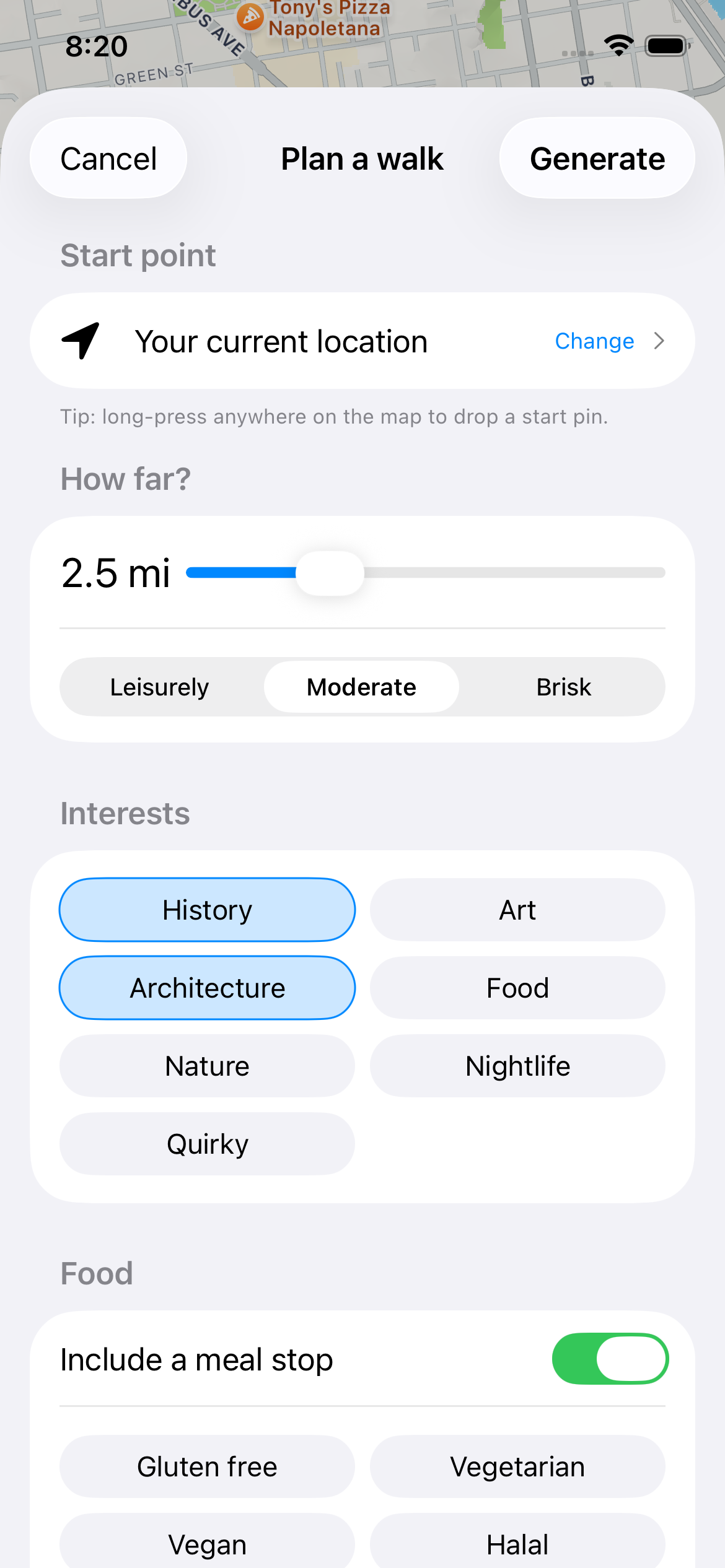
This route starts at the Castillo de San Marcos and loops south through the old city gates, down St. George Street, past the Spanish Quarter Museum and Flagler College, before finishing near the Plaza de la Constitución. You'll cross between Spanish colonial, British occupation, and American territorial-era buildings, sometimes within the same block. The Mosey app runs this as a self-guided route on your phone, with GPS-triggered narration at each stop so you're not stopping to read plaques in the Florida sun.
Plan for roughly two and a half hours if you go inside the Castillo and stop for lunch. St. George Street gets crowded by midday, especially on weekends and during the October cooler-weather season, so an early start pays off. Everything here is flat and paved, but much of St. George Street is pedestrian-only brick and coquina shell paving that can be uneven in spots.
The Route: Castillo to Columbia Restaurant
"Construction began in 1672 under Spanish royal engineer Ignacio Daza and finished in 1695, replacing a series of nine earlier wooden forts that had burned or rotted since 1565. It's built from coquina, a sedimentary rock made of compressed shell quarried from nearby Anastasia Island, which had the odd advantage of absorbing cannonballs rather than shattering. The fort withstood two prolonged English sieges, in 1702 and 1740, without being taken by force. Ownership passed between Spain, Britain, and the United States over the centuries; it was transferred to the National Park Service in 1933."
Admission is $15 for adults 16 and up, good for seven days, and covered by the America the Beautiful pass. Climb to the gun deck for the best harbor views and arrive near opening at 9am to beat tour bus crowds. Ranger talks and cannon-firing demonstrations run on a posted schedule at the entrance, worth timing your visit around.
"The coquina pillars standing here were built in 1808, replacing earlier wooden gates that had marked the northern defensive line of the walled colonial city since the 1700s. This was the only land entrance into St. Augustine for pedestrians and carts, flanked by a defensive line called the Cubo Line that ran west to the San Sebastián River. Spanish sentries controlled who passed in and out, and the gate's narrow opening was intentional, built for defense rather than convenience."
It's a quick photo stop, not a lingering one. Stand on the Castillo side and look south down St. George Street to frame the gate with the pedestrian corridor behind it, a shot most people miss by walking straight through.
"This has been the commercial spine of the city since the Spanish colonial period, laid out according to the 1573 Laws of the Indies that governed town planning across Spanish America. Several structures along the street date to the second Spanish colonial period (1784-1821), identifiable by their coquina walls, covered balconies, and construction flush to the property line with no front yard, a style suited to narrow urban lots. The street was closed to vehicle traffic in the 1960s as part of a broader preservation push tied to the city's 400th anniversary in 1965."
Browse is the operative word here; it's heavy with souvenir shops and fudge counters now. Look up past the storefronts at the second-floor balconies and roof lines for the older architecture the ground floor signage tends to bury.
"This living-history site recreates the city as it looked around 1740, built on and around several original colonial lots on St. George Street. Costumed interpreters work at trades like blacksmithing, carpentry, and leatherworking using period methods, and some structures incorporate archaeological findings from excavations conducted on the site starting in the 1960s. The reconstruction draws on Spanish colonial records and archaeological digs rather than guesswork, which is part of why historians treat it as a reasonably faithful model of 18th-century daily life."
Admission runs around $12 for adults; check current hours since it's not always open daily. It's a good counterweight to the Castillo's military history, showing domestic and working life instead of fortification and siege.
"Laid out in 1598 under Spanish governor Gonzalo Méndez de Canzo, this is the oldest public square in the United States, still occupying its original footprint. The obelisk-like monument near the center commemorates the Spanish Constitution of 1812, one of only a handful of such monuments remaining in former Spanish territories. The plaza also held the city's slave market into the 19th century; a marker today provides that history rather than erasing it."
Benches under the oaks make this a good rest point roughly halfway through the walk. The Basilica Cathedral of St. Augustine sits on the plaza's north side if you want a quick stop, free to enter.
"The current cathedral dates to 1797, built on the site of earlier wooden parish churches that burned or deteriorated, making this the oldest Catholic parish in the continental US, with records going back to the 1565 founding of the city. The bell tower and much of the facade were rebuilt after an 1887 fire gutted the structure, with architect James Renwick Jr., known for New York's St. Patrick's Cathedral, overseeing the reconstruction. Pope John Paul II elevated it to minor basilica status in 1976."
Free to enter outside of services; dress modestly out of respect. The interior murals and the restored 1888 organ are worth five minutes even if you're not stopping for Mass.
"Built in 1888 by railroad and oil magnate Henry Flagler as the Hotel Ponce de León, this was one of the first major buildings in the country constructed with poured concrete, designed by New York architects John Carrère and Thomas Hastings, who went on to design the New York Public Library. The Spanish Renaissance Revival exterior and the Tiffany stained glass windows inside were meant to announce St. Augustine as a winter resort destination for wealthy northerners. The hotel closed in 1967 and reopened as Flagler College in 1968, which still operates in the original building."
Paid 45-minute guided tours run several times daily and are the only way to see the full dining hall and rotunda; check the college's tour desk near the entrance for current pricing, typically around $20. If you skip the tour, you can still view the exterior and courtyard from King Street for free.
"This St. Augustine location opened in 1983 as an outpost of the original Columbia Restaurant founded in Tampa's Ybor City in 1905 by Casimiro Hernandez Sr., making the Tampa original Florida's oldest continuously operating restaurant. The St. Augustine branch occupies a building on St. George Street and carries the same Spanish-Cuban menu the family has served for over a century, built around dishes brought by Spanish and Cuban immigrant communities in Tampa."
The 1905 Salad, tossed tableside, and the paella are the dishes regulars order. It gets busy at peak lunch hours around 12:30, so arrive by noon or plan for a short wait; reservations are accepted for dinner.
Planning Your Walk
Best time to walk: October in St. Augustine runs warm, typically 75-82°F with lower humidity than summer and a real chance of clear skies. Afternoon thunderstorms are less common than in July and August but still possible, so check the forecast before you head out. Mornings before 10am are noticeably cooler and less crowded.
Shoes: Flat, comfortable shoes are fine; St. George Street is brick and shell-aggregate paving that can be uneven, and the Castillo's gun deck has stairs with no elevator access.
The narration: At each stop, Mosey surfaces the specific construction dates, builders, and documented events tied to that exact spot, rather than general background on St. Augustine as a whole.
Walk This Route With Mosey
Open the Mosey app to follow this exact route with GPS-triggered narration at every stop, so you can keep your eyes up and your phone in your pocket.
Download on the App Store — FreeFrequently asked questions
How long does it take to walk the St. Augustine Historic District?
Plan for about two to two and a half hours to cover the core sites, including time inside the Castillo de San Marcos and a stop for lunch. The full route covers 1.8 miles on flat, mostly paved ground, so it's manageable for most fitness levels without needing a car or shuttle between stops.
Is the St. Augustine Historic District walkable?
Yes, it's one of the most walkable historic districts in Florida. St. George Street is closed to vehicles entirely, the Castillo, Plaza de la Constitución, and Flagler College all sit within a short walk of each other, and most paid parking garages are within a few minutes of the bayfront start point.
What is the best time of day to walk St. George Street?
Before 10am or after 5pm. St. George Street fills with tour groups and cruise-ship-style foot traffic by midday, especially on weekends, and the narrow pedestrian corridor can feel crowded. Early morning also means cooler temperatures, which matters even in October's warm Florida weather.
Do you need to pay to enter the Castillo de San Marcos?
Yes, admission is $15 for adults 16 and older, valid for seven consecutive days and covered by the America the Beautiful annual pass. Kids 15 and under enter free. The fee is collected at the entrance and goes toward National Park Service maintenance of the 1695 fort.
Is Flagler College open to the public?
Partially. The grounds and courtyard of the former Hotel Ponce de León are visible from King Street for free, but the ornate interior, including the Tiffany glass and dining hall, is only accessible via paid guided tour, typically offered several times daily and lasting about 45 minutes.
What's a good lunch stop in the St. Augustine Historic District?
Columbia Restaurant on St. George Street is the well-known choice, a Spanish-Cuban restaurant tied to the original 1905 Columbia in Tampa's Ybor City. Order the 1905 Salad or the paella. It gets busy around 12:30pm, so arrive by noon or plan ahead for dinner reservations.
More Self-Guided Tours Nearby
If the colonial core leaves you wanting more, Mosey also covers St. Augustine's Lincolnville neighborhood, the city's historically Black district and a key site of the 1964 civil rights demonstrations that helped push the Civil Rights Act forward, with Victorian-era shotgun houses and a very different architectural story from the Spanish colonial district. Further north along the coast, Mosey's Jacksonville and Amelia Island routes pick up where St. Augustine's Gilded Age thread leaves off, tracing Henry Flagler's railroad-driven development of Florida's east coast.