Fremont calls itself the Center of the Universe, and the neighborhood has spent decades defending the claim with concrete, bronze and surplus aerospace hardware. It sits on the north bank of the Lake Washington Ship Canal, a former mill and brickworks district that was platted in 1888 and annexed by Seattle in 1891. What makes this a good Fremont walking tour is how much public art sits within a few blocks of each other, most of it free, all of it outdoors, and most of it put there by residents rather than by a city planner.
This self-guided Fremont tour runs 1.8 miles and covers seven stops: the Fremont Bridge, the Waiting for the Interurban sculpture, the Center of the Universe signpost, the Fremont Rocket, the Lenin statue, the Fremont Troll and a sit-down meal at Revel. The route starts at the water, climbs gently through the commercial core, then drops west under the Aurora Bridge. Expect sidewalks the whole way, one moderate hill, and a lot of stopping to read plaques and stare at things.
Mosey built this route as a loop you can finish in about two and a half hours, including time to eat. The app surfaces the history at each stop as you arrive, so you do not need to read signs on a rainy corner. Your first three Mosey tours are free, which covers this one.
Seven Stops Between the Ship Canal and the Aurora Bridge
"The Fremont Bridge opened in 1917, the same year as the Hiram M. Chittenden Locks, when the Lake Washington Ship Canal connected Lake Union to Puget Sound. It is a double-leaf bascule drawbridge sitting low over the water, which means it has to open for sailboat masts and tugs far more often than other Seattle crossings; it is regularly cited as one of the most frequently opened drawbridges in the United States. The span is painted orange and blue, and the neighborhood's name comes from Fremont, Nebraska, hometown of a partner of plat developer Edward Blewett."
Walk a few steps out on the sidewalk and look back at the neighborhood. If the bells ring and the gates drop, stay and watch the leaves rise, which is free entertainment and a good excuse to catch your breath. Skip trying to drive across at rush hour; the openings back up traffic for blocks.
"Richard Beyer's cast aluminum group was installed in 1979 and shows commuters standing at a stop for a train that is not coming. The Seattle-Everett Interurban electric railway ran from 1910 until 1939, and its cars once rattled through this part of Fremont. One figure is a man with a dog's head, and the dog's face is reportedly modeled on Armen Stepanian, a longtime Fremont character and community figure."
The statues are regularly dressed up by locals with scarves, hats, flags and seasonal decorations, so what you see will change by the week. Stand at the street edge for the full group, then circle behind to read the plaque. It is free, always open and gets almost no crowd before late morning.
"Fremont's self-declared title of Center of the Universe is a joke the neighborhood has kept going since its arts community adopted it in the 1970s and 1980s. The signpost near Fremont Ave N and N 35th St has arrows pointing toward places like the North Pole and Atlantis, and the neighborhood has also styled itself the Republic of Fremont, with its own mock foreign policy. The city's annual Fremont Solstice Parade, begun in 1989 by the Fremont Arts Council, runs on the same spirit."
Do not expect a dramatic monument; it is a signpost at an ordinary intersection, and a photo takes two minutes. Look at the surrounding storefronts and building plaques while you are here, since they give a better sense of the commercial core. On Sundays, the street market can fill the sidewalks nearby.
"The Fremont Rocket is a 1950s-era rocket fuselage that was mounted on the corner of Evanston Ave N and N 35th St in 1994. It is built from surplus Cold War hardware, and the Latin motto painted on it, De Libertas Quirkas, translates roughly to Freedom to Be Quirky. The mounting was a neighborhood project, not a city commission."
Look up from the sidewalk across Evanston Ave N for the cleanest view, since the rocket is mounted high on the building corner. On Sundays the Fremont Sunday Market takes over the streets nearby, with stalls typically running roughly 10 to 4 year-round; check hours before you go, and expect it to be crowded and slow-moving.
"Sculptor Emil Venkov cast this bronze Lenin in 1988 for the Slovak city of Poprad, in what was then Czechoslovakia. After the 1989 Velvet Revolution, toppled statues were left in storage or scrapped, and Lewis Carpenter, an American teaching in Poprad, found this one lying in a scrapyard and arranged to ship it to the United States. It was installed in Fremont in 1995 at the corner of Evanston Ave N and N 36th St, and it stands roughly 16 feet tall and weighs about seven tons."
The statue sits on private property and has been listed for sale for years, so there is a sign saying so. People disagree about whether it belongs here, and local opinion is split. Skip the temptation to stage a photo in front of traffic; the sidewalk is tight, so step back across the street.
"The Troll was built in 1990 by artists Steve Badanes, Will Martin, Donna Walter and Ross Whitehead from steel rebar, wire and concrete. It won a Fremont Arts Council competition to reclaim the space beneath the George Washington Memorial Bridge, which opened in 1932 and had become a dumping ground. It is about 18 feet tall, with a hubcap for an eye and a real Volkswagen Beetle crushed in one hand."
Go early or late in the day to avoid the line of climbers and posers that builds by noon. You can climb on the Troll, but the surface is rough, and wet concrete is slippery in November. Free, always open, and it can feel isolated and poorly lit after dark, so finish before sunset.
"Revel, at 403 N 36th St, opened in 2011 from chefs Rachel Yang and Seif Chirchi, who built their menu around Korean flavors served in a small-plate style, with dumplings, noodles and rice bowls. The pair had earlier opened Joule in Wallingford, and Revel is the Fremont follow-up. The space is a compact, wood-and-concrete room with a counter and a handful of tables, which keeps it feeling like a neighborhood place."
Check current hours and reservation options before you go, as the room is small and fills up at dinner and on weekends. Dumplings and noodle dishes are the safest order if you are not sure where to start. Walk-ins are easier at off-peak times, so aim for a late lunch rather than a prime dinner slot.
Practical Notes Before You Walk Fremont
Best time to walk: November in Seattle means gray skies, intermittent drizzle and sunset before 5 p.m. once daylight saving time ends on the morning of November 1. Bring a real rain shell rather than an umbrella, since the wind off the ship canal makes umbrellas a nuisance on the bridge. Summer is drier but the Troll gets crowded, so mornings are better any time of year.
Shoes: All sidewalk, with one moderate climb up from the canal toward N 36th St. Waterproof shoes with decent tread are worth it in autumn, because wet leaves and painted crosswalks are slick. The brick and cobbled patches around Fremont Ave N can be uneven, so skip heels.
The narration: At each stop Mosey gives you the dated, checkable background: who made the piece, when it went up, and what the neighborhood was fighting about at the time.

Walk Seattle's Fremont with Mosey
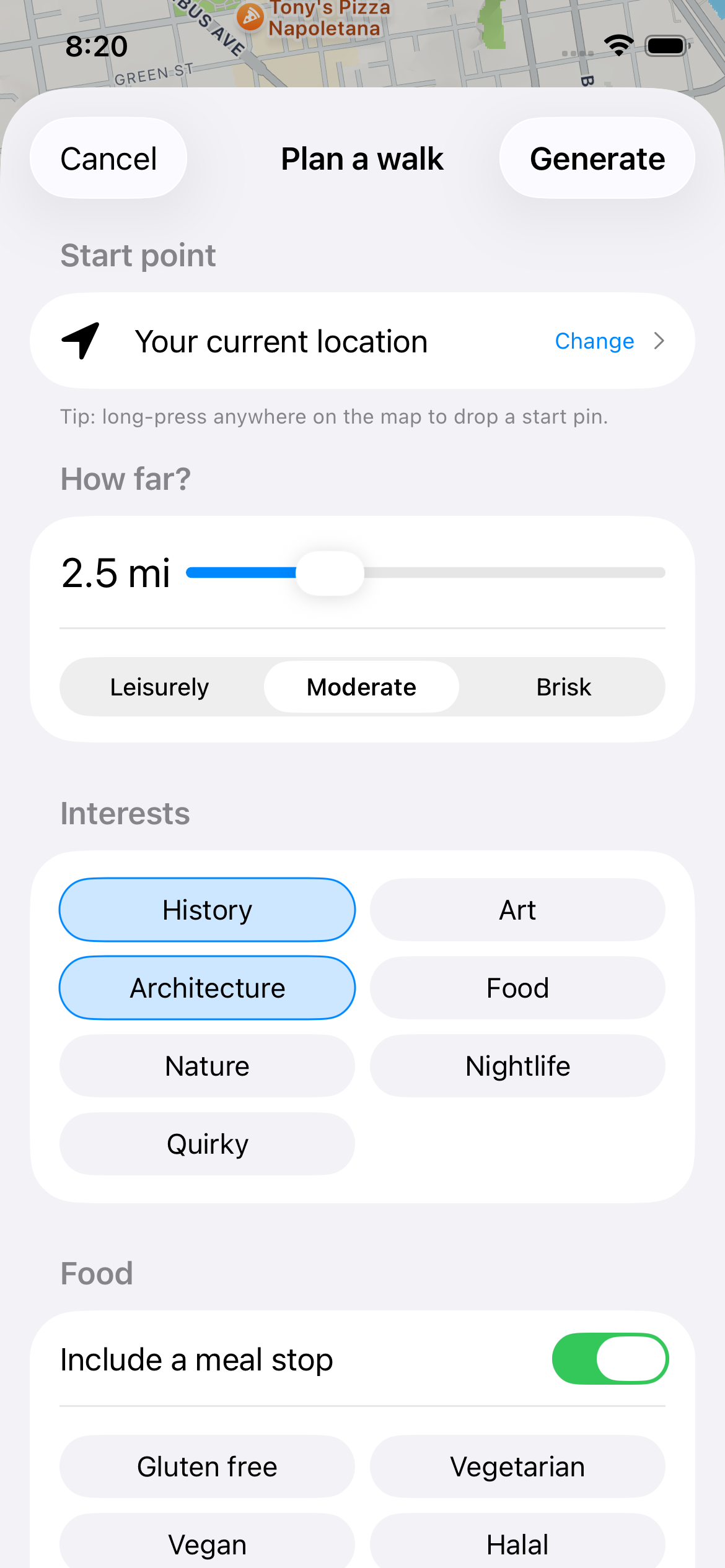
Mosey plans a walk like this one on your iPhone, starting wherever you choose.
- Set a distance or a time and pick what you're into
- Real stops in a walking order that makes sense on foot
- The story behind each stop, read aloud as you arrive
- A meal stop that fits the route

Free to download. iPhone, iOS 17 or later.
Frequently asked questions
How long does it take to walk Fremont in Seattle?
Plan about two and a half hours for this 1.8-mile Fremont route, including a meal. Walking alone takes roughly 45 minutes, but the Troll, the Lenin statue and the Interurban sculpture each reward a stop of 10 to 20 minutes. Add time if the Sunday Market is running.
Is Fremont walkable?
Yes, Fremont is very walkable, with continuous sidewalks and most of its public art within a few blocks of each other. The main hill climbs from the ship canal toward N 36th St. The Troll sits slightly west under the Aurora Bridge, which adds an easy downhill stretch.
Is the Fremont Troll free to visit?
Yes, the Fremont Troll is free and open around the clock. It sits under the Aurora Bridge at N 36th St and Troll Ave N. You can climb on it, but go early or late to avoid midday crowds, and avoid the area alone after dark.
What is the best time of day to walk Fremont?
Morning is best, particularly before 11 a.m., when the Troll and the sidewalk sculptures are quiet. On Sundays the Fremont Sunday Market fills the streets from roughly 10 to 4 and slows foot traffic. In November, finish before sunset, which comes before 5 p.m.
Can you walk to the Fremont Troll from the Fremont Bridge?
Yes, the Troll is an easy walk from the Fremont Bridge. Head north up Fremont Ave N, turn west on N 36th St, and continue under the Aurora Bridge to Troll Ave N. This guide includes the Interurban sculpture, the Rocket and the Lenin statue along the way.
More Seattle Neighborhoods Worth Walking
If Fremont leaves you wanting more of the ship canal, Mosey also builds routes through Ballard, which has its own locks, brewery district and old Scandinavian fishing roots just west. Wallingford and the Gas Works Park area sit directly east, and Queen Anne offers a steeper, more residential walk with views back across Lake Union.