Capitol Hill is the kind of neighborhood that rewards slow walking. Perched on a ridge east of downtown Seattle, it has been the city's cultural engine for over a century — first as a streetcar suburb of grand Victorian homes, then as the heart of Seattle's counterculture and LGBTQ+ community, and now as a dense urban district where Craftsman bungalows sit beside modernist apartment towers and murals cover nearly every blank wall. The architecture alone tells three or four different eras of Seattle history simultaneously, and the public art woven through it gives the neighborhood a visual identity unlike anywhere else in the Pacific Northwest.
This self-guided tour moves through the neighborhood's core, from the stately homes of Millionaire's Row on 14th Avenue to the busy commercial spine of Broadway, with detours into Cal Anderson Park, the Pike/Pine corridor, and the Harvard-Belmont Historic District. Mosey built this route to surface the historical and architectural context that's easy to miss when you're just passing through — the stories behind the buildings, the artists behind the murals, and the events that shaped each block. Expect a mix of tree-lined residential streets and lively commercial corridors, with a meal stop near the end to cap the walk.
The route works year-round, but late June is an especially good time to walk Capitol Hill. The days are long, the street-level patios are open, and Pride Month activity fills the neighborhood with color and energy — the Seattle Pride parade typically runs the last weekend of June, making the Broadway corridor particularly vibrant. Plan to start mid-morning to beat the afternoon heat and have the residential streets largely to yourself before the neighborhood fully wakes up.
The Route: 7 Stops Through Capitol Hill's Art and Architecture
"Volunteer Park was designed in 1904 by the Olmsted Brothers — the same firm responsible for New York's Central Park — as part of a sweeping park system plan commissioned by the City of Seattle. The park was named to honor American soldiers who died in the Spanish-American War and the Philippine-American War. The brick water tower at the park's center dates to 1906 and stands 75 feet tall; climbing its 107 spiral steps rewards you with a panoramic view of the Capitol Hill ridge, Lake Union, and the Olympic Mountains. The Art Deco building at the park's south end opened in 1933 as the Seattle Art Museum's original home and was rededicated in 1994 as the Seattle Asian Art Museum after SAM moved downtown, housing one of the most significant Asian art collections in the American West."
Climb the water tower first thing — it's free, and the view orients you to the entire neighborhood before you descend into it. The Seattle Asian Art Museum charges admission (check seattleartmuseum.org for current pricing), but the exterior and the park grounds, including the iconic Isamu Noguchi sculpture 'Black Sun' installed in 1969, are always free. The Noguchi sits just south of the museum and is one of the most photographed works of public art in Seattle.
"The Harvard-Belmont Historic District, listed on the National Register of Historic Places in 1982, preserves one of Seattle's finest concentrations of early 20th-century residential architecture. The district runs along Belmont Ave E and Harvard Ave E and includes examples of Colonial Revival, Tudor Revival, Italian Renaissance, and Craftsman styles built between roughly 1900 and 1930. Many of the homes were constructed for Seattle's merchant and professional class during the city's first great boom following the 1897 Klondike Gold Rush, when Capitol Hill was marketed as a refined alternative to the crowded downtown waterfront. The streetcar lines that once ran on Broadway made the Hill accessible while keeping it a deliberate step removed from the industrial city below."
Walk slowly along Belmont Ave E between E Aloha St and E Roy St — this two-block stretch has the densest concentration of landmark homes. You're not going inside any of these (they're private residences), so focus on the rooflines, the porch columns, and the variation in facade materials. The contrast between the ornate pre-Depression homes and the mid-century apartment buildings inserted between them tells the story of Capitol Hill's postwar densification more clearly than any exhibit could.
"Cal Anderson Park occupies the site of a former underground reservoir that supplied Seattle's water from 1901 until 1997. The park itself opened in 2005 after a major redesign and was named for Calvin Anderson, the first openly gay member of the Washington State Legislature, who represented Capitol Hill from 1987 until his death from AIDS-related illness in 1995. The park became the symbolic center of the Capitol Hill Organized Protest (CHOP) zone in June 2020, a period that received international attention and left a complicated legacy in the neighborhood. The reflecting pool and the brick pump house structure at the park's north end are remnants of the original reservoir infrastructure."
The park is a genuine community gathering place — on a late June morning you'll find it busy with dog walkers, joggers, and people heading to the Broadway Farmers Market nearby. Pause at the reflecting pool and look back toward the pump house to understand the reservoir's original footprint. The park's lawn area to the south is where the most significant CHOP activity was concentrated in 2020; interpretive context about that period is something Mosey surfaces at this stop if you want to understand what happened here and why.
"Broadway has been Capitol Hill's main commercial street since the neighborhood's earliest development, and it remains one of the most culturally layered corridors in Seattle. The street is the traditional center of Seattle's LGBTQ+ community — a status it has held since the 1970s, when gay-owned businesses began concentrating here after being pushed out of downtown. The iconic Jack Mackie bronze dance-step inlays embedded in the Broadway sidewalks between E Pike St and E Roy St were installed in 1982 as part of a city public art initiative; the inlays depict eight different dance styles including the tango, the foxtrot, and the Broadway Boogie. The Link Light Rail station at Broadway and John St, opened in 2016 as part of the Capitol Hill Station, features an extensive public art program including work by artists Pae White and Stephen Vitiello integrated directly into the station architecture."
Walk the full length of Broadway between E Pike and E Roy and look down — the Mackie dance steps are easy to miss if you're not watching for them, but they're one of the most charming pieces of permanent public art in the city. If it's Sunday morning, the Broadway Farmers Market runs at the Cal Anderson Park end of Broadway and is worth a browse. The Capitol Hill Light Rail station's underground concourse is free to enter and worth a few minutes to see the public art without buying a ticket.
"The stretch of Pike Street and Pine Street between Broadway and 15th Ave E has become one of Seattle's most concentrated zones of street art and adaptive reuse architecture. Many of the buildings along this corridor are former auto row structures — garages, showrooms, and service stations built in the 1920s and 1930s that were later converted into bars, music venues, and galleries as Capitol Hill's nightlife economy expanded in the 1990s and 2000s. The neighborhood was badly destabilized by rapid development pressure in the 2010s, and the murals that cover many buildings along this stretch are partly a community response to displacement — works commissioned by building owners and tenant organizations to assert neighborhood identity during a period of intense change. Several murals reference the history of the LGBTQ+ community specifically, including tributes to figures lost to the AIDS crisis."
Walk Pine Street east from Broadway toward 15th and then loop back on Pike Street — this two-block loop gives you the highest density of murals without backtracking awkwardly. The building at 1510 E Olive Way (the Sunset Electric building) is one of the best examples of adaptive reuse on the Hill — look for its distinctive neon signage. Don't rush this stretch; the murals are best read up close, and new work gets added seasonally.
"St. Mark's Episcopal Cathedral, at 10th Ave E and E Galer St, is one of the most architecturally significant religious buildings in the Pacific Northwest. Construction began in 1928 but was halted by the Great Depression before the building was completed according to its original design — as a result, the cathedral was consecrated in 1931 in what architects intended as a temporary concrete shell. That unfinished concrete interior, described by some as 'American Bauhaus' and by others as accidentally brutalist, became beloved in its own right, and the building was never fully completed as originally designed. The cathedral is home to one of the finest pipe organs in the American West, a 1950 Flentrop instrument restored and expanded over subsequent decades, and hosts a renowned Sunday Compline service that has drawn listeners since 1956."
The exterior is striking but the interior is the real reward — step inside during open hours (the cathedral is typically open to visitors daily; check saintmarks.org for current access hours). The bare concrete nave is genuinely unlike any other religious interior in Seattle. If your visit falls on a Sunday evening, the Compline service at 9:30pm is free and open to all — it's a candlelit choral service in the dark that has become a Capitol Hill institution.
"Stateside opened on E Pike Street in Capitol Hill in 2014 and has been one of the neighborhood's most consistently praised restaurants since. The kitchen focuses on French-Vietnamese cuisine — a culinary tradition rooted in Vietnam's colonial history that produces dishes like bánh mì alongside French-influenced preparations of duck, seafood, and vegetables. The restaurant occupies a converted older building on the Pike/Pine corridor, fitting the neighborhood's broader pattern of adaptive reuse, and its bar program, focused on spirits and wine, has developed a reputation independent of the food."
Stateside is located at 300 E Pike St, at the intersection of Pike and Belmont. Reservations are strongly recommended for dinner — book ahead at exploretock.com/stateside or OpenTable. If you're doing this as a lunch walk, note that Stateside opens for dinner service only; in that case, Vivace Espresso on Broadway or Oddfellows Café + Bar nearby are solid daytime alternatives. The covered outdoor seating area on Pike Street is the right call on a warm June evening.
Planning Your Capitol Hill Self-Guided Tour
Best time to walk: Late June in Seattle is generally mild and dry — one of the best months to walk. Expect temperatures between 65–75°F and low rain probability, though a light layer is always worth carrying. Morning marine fog occasionally lingers until 10am. The summer solstice means long evenings if you want to extend the walk.
Shoes: The route mixes smooth sidewalks with some uneven brick and moderate elevation changes on the residential streets. Comfortable walking shoes or sneakers are fine — no trail footwear needed.
The narration: At each stop, Mosey surfaces the architectural era, key historical figures, and neighborhood context that helps you read the place rather than just look at it.
Walk Capitol Hill with Mosey
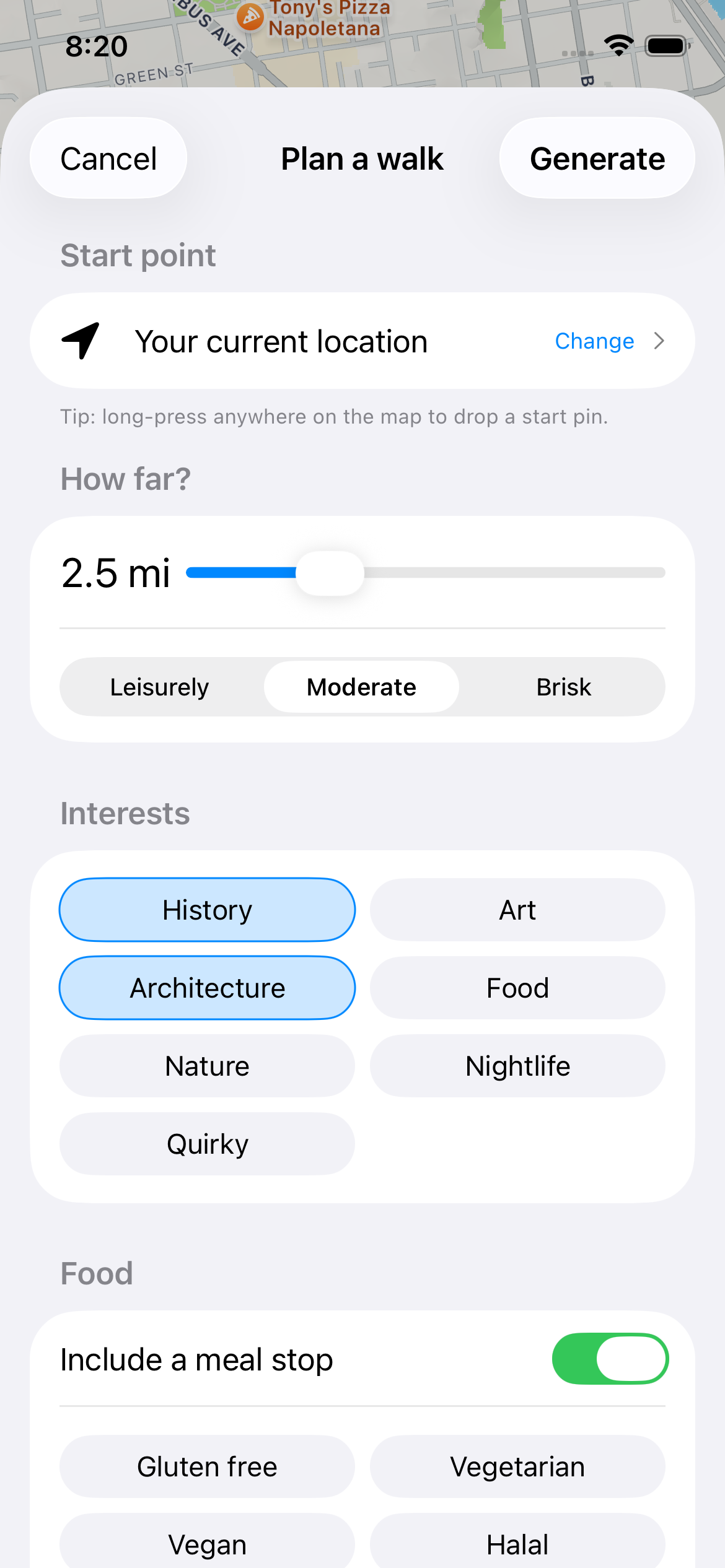
Mosey built this route to surface the context that makes a neighborhood readable — architecture notes, historical detail, and public art background at every stop. Open the app, drop a pin, and start walking.
Download on the App Store — FreeOther Seattle Neighborhoods to Explore with Mosey
If Capitol Hill leaves you wanting more Seattle architecture and public art, Mosey has routes worth exploring in several adjacent neighborhoods. First Hill, immediately to the west, contains Seattle's oldest surviving brick commercial buildings and the Frye Art Museum, which is free to enter year-round. The Central District, directly south of Capitol Hill, is one of Seattle's most historically significant Black neighborhoods and contains a growing concentration of murals and community-oriented public art. For a complete contrast, the Eastlake neighborhood runs north along the western shore of Lake Union and offers a quieter, more residential walk with significant mid-century residential architecture and water views that reward a slower pace.