Most Savannah itineraries stop at Forsyth Park and turn back north to the squares. The Starland District is the part that begins where the tourist map thins out: a run of Bull Street south of the park where studios, coffee counters, a food-truck lot and one of the city's best-known bakeries share the same low-rise blocks. It is where a lot of SCAD students and working artists actually spend their afternoons, and it reads differently from the oak-and-moss postcard version of the city. If you want a Savannah Starland District walking tour built around art and food, this is the stretch.
The route runs south from the Park Avenue end of Forsyth Park down Bull Street, with five stops: the park fountain, a long-running coffeehouse, an artist-run gallery, an outdoor lot of food vendors, and a bakery for the sit-down meal at the end. It is mostly one straight street, which makes it easy to shorten, stretch or pause for a second coffee. Distance and time are on the stats card; budget more time than the walking alone suggests, because the stops are the point.
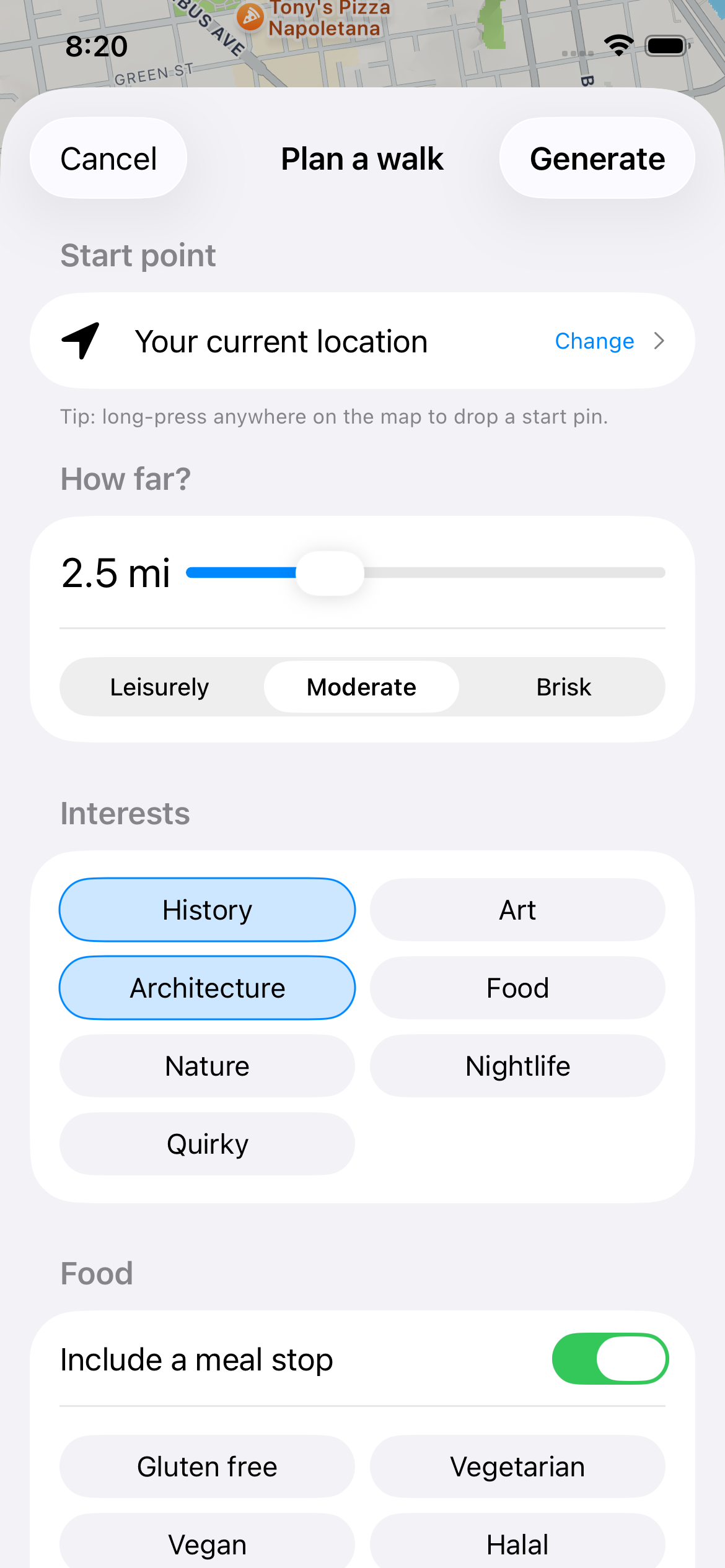
This route was built in the Mosey app as a self-guided Starland District tour, with narration that plays at each stop so you can keep your eyes on the street rather than a guidebook. The first three tours are free, so you can try this one without committing to anything. Opening hours in this neighborhood change often, so check each place before you go.
The Starland District Route: Down Bull Street, Stop by Stop
"Forsyth Park is named for Georgia Governor John Forsyth, and the park was laid out in the early 1850s. The cast-iron fountain at its center was installed in 1858 and is modeled on fountains in Paris's Place de la Concorde. The park today covers about 30 acres, well beyond its original footprint, and it marks the southern boundary of Savannah's historic squares district. Beyond it, the grid of Oglethorpe's 1733 plan gives way to a more ordinary city, and that is where Starland begins."
Look at the fountain from the south side with the oaks behind it, which gives a cleaner view than the crowded north approach. Entry is free and the park is open to the public. Skip the fountain's busiest hours, roughly midday on Saturdays, when wedding photographers and tour groups stack up around the basin.
"Foxy Loxy sits at 1919 Bull Street, on the stretch of Bull that Oglethorpe's surveyors named for William Bull, one of the men who helped lay out the original town in 1733. The street runs from the river through the historic squares, past Forsyth Park, and out into the neighborhoods that grew in the early twentieth century. This block is where the Starland area's coffee-and-studio culture settled before the rest of the district filled in. The cafe has a shaded patio that is part of the draw."
Order at the counter and take your drink to the patio rather than standing inside, where space is tight. This is a coffee stop, not a meal stop, so save your appetite for the end of the route. Expect a line on weekend mornings; a weekday visit moves faster.
"Sulfur Studios operates at 2301 Bull Street as an artist-run nonprofit, with exhibition space alongside working studios. It is one of the anchors of the arts scene that gave the Starland District its identity as an area of studios and small creative businesses. The district takes its name from the old Starland Dairy, a reminder that this was a working-class commercial corridor long before it became an arts address. Shows rotate through the gallery, so what hangs on the walls depends entirely on when you arrive."
Check the current exhibition and opening hours before you plan around it, since gallery hours here are not the same as a museum's. Admission to exhibitions has generally been free or donation-based, but confirm on arrival. If the gallery is closed, the block's exterior murals and storefronts still reward a slow look.
"Starland Yard is a lot of food vendors and seating along Bull Street that carries the district's name. It reflects how the neighborhood redevelops: low-cost, open-air and built around what is already on the block instead of a new tower. The surrounding blocks were once light commercial and dairy-related property, and the lot keeps that scale. The Starland name itself comes from Starland Dairy, which the neighborhood adopted as its identity."
Vendors and hours vary by day, so treat this as a snack or drink stop and do not count on a specific menu. It is open-air, which is a real plus in November and a drawback in August. If it looks quiet, keep walking rather than waiting for it to fill.
"Back in the Day Bakery is at 2403 Bull Street and was founded by Cheryl and Griff Day in 2002. It built a national reputation for Southern baking, and the couple later published the Back in the Day Bakery Cookbook. The shop is known for its cupcakes, biscuits and layer cakes, and it serves breakfast and lunch as well as pastries. It is a sensible place to end an arts route, because it fits the neighborhood's small-business, owner-run character."
Go for lunch rather than a pastry-only stop, since the sandwiches and breakfast items give you a proper meal. Lines build on weekend mornings, so a weekday visit or an early arrival saves time. Prices are bakery-cafe level, and you can split a dessert to keep costs down.
What to Know Before You Walk Starland
Best time to walk: Mid-November is one of the best times to walk Savannah: afternoons are typically in the upper 60s Fahrenheit and the humidity of summer is gone. Mornings can be cool, so bring a light layer. Bull Street has little shade south of the park, which makes the heat a real problem from May through September.
Shoes: Flat, closed-toe walking shoes. The route is entirely paved, but Savannah sidewalks are uneven in places where oak roots have lifted the slabs, and some stretches have no curb ramps. Skip heels and thin sandals.
The narration: At each stop, Mosey surfaces the street's origins, the building or business behind it, and the documented dates that explain why this part of Savannah looks the way it does.

Walk Savannah's Starland District with Mosey
Mosey plans a walk like this one on your iPhone, starting wherever you choose.
- Set a distance or a time and pick what you're into
- Real stops in a walking order that makes sense on foot
- The story behind each stop, read aloud as you arrive
- A meal stop that fits the route

Free to download. iPhone, iOS 17 or later.
Frequently asked questions
How long does it take to walk the Starland District in Savannah?
Allow about two and a half hours for this route. The walk is 1.6 miles and takes under an hour of actual walking, but coffee, a gallery visit, a snack at Starland Yard and a sit-down meal at Back in the Day Bakery account for the rest.
Where is the Starland District in Savannah?
The Starland District is just south of Forsyth Park, centered on Bull Street. It sits beyond the historic squares district, where Oglethorpe's 1733 grid ends. You can walk there from the park's Park Avenue entrance, passing coffee shops, galleries and the Back in the Day Bakery at 2403 Bull Street.
Is the Starland District walkable from downtown Savannah?
Yes, but it is a real walk from the river and the squares. Most visitors start at Forsyth Park and walk south along Bull Street, which is flat and paved. If you are staying near River Street, a rideshare to the park saves energy for the route itself.
What is the best time of year to walk Savannah's Starland District?
Late October through April is best, with November afternoons typically in the upper 60s Fahrenheit. Summer is hot and humid, and Bull Street south of Forsyth Park has little shade. If you must go in summer, start before 10 a.m. and plan indoor stops.
Is Sulfur Studios free to visit?
Exhibitions at Sulfur Studios, at 2301 Bull Street, have generally been free or donation-based, but confirm before you go. It is an artist-run nonprofit, so gallery hours are limited and change with the exhibition schedule. Check its current hours before building your route around it.
More Savannah Walks Beyond Starland
If Starland leaves you wanting more of Savannah, pair it with the Historic District's squares just north of Forsyth Park, where Oglethorpe's 1733 plan is easiest to read on foot. Thomas Square, to the east, is a quieter residential area with Victorian streetcar-era houses. Each makes a good second Mosey walk, and the first three tours are free.