Savannah is often described as a city you can't walk wrong. Twenty-two squares planted with live oaks, draped in Spanish moss, spaced perfectly for a rest — the whole city is a grid designed for wandering. But I'd wandered Savannah unguided before and somehow missed half of it: the haunted house, the Forrest Gump bench, the cobblestone waterfront. Last spring I gave Mosey a 3-mile budget and let it route through the Historic District properly.
What Mosey built was a loop starting at Forsyth Park and working north through the grid of squares before dropping down to the river. The narration it played at each stop was the best part — context I'd never had before. Standing in Chippewa Square hearing about the 1733 founding of Georgia while knowing Forrest Gump sat on that same bench somehow made both facts more interesting.
Here's the full route with every stop's narration, so you can walk it yourself.
The Route
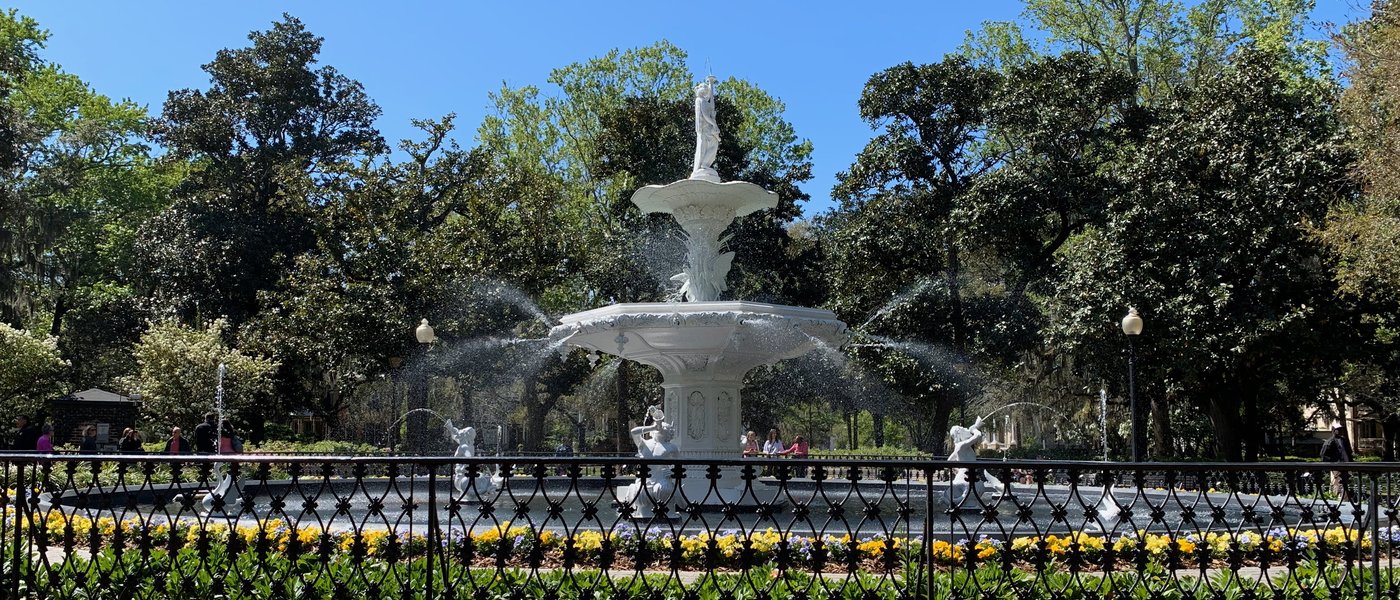
"Forsyth Park is Savannah's Central Park — 30 acres of live oak canopy at the southern end of the Historic District, designed in 1851 and laid out in 1853. The park's signature landmark, the cast-iron fountain near the main entrance, was installed in 1858 and modeled after fountains at the Place de la Concorde in Paris and at Corcoran Gallery in Washington. The fountain's design was so admired that identical versions were installed in Poughkeepsie, New York and in Cushing Square, Massachusetts. During the Civil War, Confederate troops camped in the park and a makeshift Confederate hospital operated in the park's perimeter buildings."
Start at the fountain and walk the full length of the park before heading north. The southern half has the famous fragrant garden (best in late winter) and a small café pavilion where you can grab a coffee to carry. The northern end has a beautiful Spanish-moss canopy and a Civil War memorial.
"The Mercer Williams House at 429 Bull Street was designed in 1860 by New York architect John S. Norris — the same architect who designed Savannah's Green-Meldrim House and the Cotton Exchange — for General Hugh Weedon Mercer, great-grandfather of the songwriter Johnny Mercer. The house was never completed before the Civil War interrupted construction; it was finally finished in 1868 by a new owner. The house became nationally famous as the setting of the 1994 nonfiction bestseller 'Midnight in the Garden of Good and Evil' by John Berendt, which chronicled the 1981 shooting death of Danny Hansford by antiques dealer Jim Williams. Williams was tried four times for the murder — the most tried criminal case in Georgia history — before being acquitted."
The house museum is open for tours and worth the $12.50 admission — the interior is exactly as described in the book. Even from the street the iron balconies and Italianate detailing are striking. This is Monterey Square, one of the loveliest of Savannah's 22 squares, anchored by a monument to Count Casimir Pulaski, the Polish cavalry general killed defending Savannah from the British in 1779.
"Chippewa Square was laid out in 1815 and named for the Battle of Chippawa, a War of 1812 engagement in which American forces defeated British regulars on the Canadian frontier. The square is anchored by a 1910 bronze statue of General James Edward Oglethorpe — founder of the Georgia colony in 1733 — by sculptor Daniel Chester French, who also created the seated Lincoln at the Lincoln Memorial in Washington. Film enthusiasts know Chippewa Square as the site where the bus bench scenes from the 1994 film 'Forrest Gump' were filmed. The bench itself was a prop and is now on display at the Savannah History Museum, two blocks west."
There's no bench here now — just the square and Oglethorpe's statue, which is the real treasure. The inscription on the base reads simply "Oglethorpe" with no dates; Savannah considers him present tense. Walk a full circuit of the square to see the buildings on all four sides.
"The Cathedral of St. John the Baptist is the oldest Roman Catholic church in Georgia, founded in 1799 by French-speaking refugees from Saint-Domingue — present-day Haiti — who fled the island's slave rebellion. The current Gothic Revival structure dates to 1876, rebuilt after a devastating fire. The cathedral's twin spires rise 210 feet and are visible from much of the Historic District; inside, the stained glass windows depicting the life of St. John the Baptist were installed in the early 20th century. The cathedral was consecrated as a cathedral in 1956, elevated from a parish church, and serves as the mother church for the Diocese of Savannah."
The interior is quietly spectacular — worth ten minutes sitting inside even if you're not religious. The stained glass is particularly fine in morning light. Lafayette Square, in front of the cathedral, has a small fountain and is one of the quieter squares in the district.
"The Owens-Thomas House is considered one of the finest examples of English Regency architecture in the United States, designed by English architect William Jay and completed in 1819 when Jay was just 23 years old. The Marquis de Lafayette stayed here during his celebrated 1825 American tour, addressing a crowd from the south balcony above what is now recognized as one of the best-preserved urban slave quarters in the American South. The carriage house and quarters behind the main house, where enslaved workers lived, have been carefully preserved and interpreted. The property was bequeathed to the Telfair Museums in 1951 and remains one of Savannah's most-visited historic homes."
The Telfair Museums run the house ($20 admission, worth it). The interpretation of the slave quarters behind the main house is unusually candid and moving — the contrast between the opulent Regency interiors and the adjacent quarters tells Savannah's full story in a single property.
"Factor's Walk is a network of iron pedestrian bridges and ramps connecting Savannah's bluff-top city to the riverfront warehouses below. 'Factors' were the cotton brokers who controlled the flow of Georgia's most valuable commodity through Savannah's port — at its peak, Savannah was the world's largest cotton exporting city, shipping more raw cotton than any other port on earth. The warehouses along the riverfront, built between 1820 and 1860, stored cotton bales awaiting shipment. River Street itself, cobbled with the ballast stones brought over in European ships, runs along the Savannah River and stretches about a half-mile from the Hyatt Regency to the Eastern Wharf development."
The iron bridge ramps down from Bay Street to Factor's Walk feel like the best-kept urban secret in the city — narrow, steep, and completely unlike anywhere else in America. At the bottom, River Street is tourist-heavy but authentically beautiful; the cobbles are the actual ballast stones from 18th and 19th century European ships.
"The Collins Quarter, in a restored 1880s building at 151 Bull Street, brought Melbourne's specialty coffee culture to Savannah — the first café in the city to make flat whites and proper cortados the centerpiece of the menu. Named for the Collins Quarter district of Melbourne, Australia, the café quickly became the city's busiest brunch spot after opening in 2014. The building's exposed brick and tin ceiling are original to the 1880s construction; the balcony overlooks the north end of Forsyth Park."
Mosey routed me back toward Forsyth for the meal stop, which closes the loop beautifully. The Collins Quarter's lavender honey latte is the best thing I ate in Savannah. Arrive before 10 AM or expect a wait — the brunch crowd is real and it fills up fast. The savory french toast with bacon and fig jam is worth making a reservation for.
What to Know Before You Go
Best time to walk: Spring (March–April) and fall (October–November) are ideal — mild temperatures and low humidity. Savannah summers are humid and hot; if you're visiting June through August, start before 9 AM. The squares provide good shade throughout.
The squares: Savannah's 22 squares are the main attraction and they slow you down (intentionally). Don't rush past them. Each has a central monument, mature trees, and benches. The route hits five squares; take your time in each.
Midnight in the Garden: If you're a fan of the book, add the Bonaventure Cemetery to a separate afternoon outing — it's not walkable from the Historic District but is unmissable. The cemetery is about 10 minutes by Uber and contains the grave of Conrad Aiken, the Bird Girl statue's original location (now in the Telfair Museum), and some of the most beautiful funerary sculpture in America.
Shoes: The cobblestones on River Street are genuinely rough and slippery when wet. Wear shoes with grip. The squares and Bull Street corridor are smooth brick and easy walking.
Plan Your Own Savannah Tour
Mosey builds walking tours for any city, any distance, any interest. Set your preferences and it routes through the best stops — with narration at every one.
Download on the App Store — FreeOther Savannah Walks Worth Planning
The Historic District is dense enough that a single Mosey tour will feel too short. I've since run the same starting point with "Hidden Gems" and "Art" filters and gotten a completely different six-stop route — heavier on the independent galleries along Broughton Street and lighter on the squares. If you have more time, the Victorian District immediately south of Forsyth Park has the city's best collection of Victorian houses and almost no tourists. And Bonaventure Cemetery, while not walkable from downtown, is among the most beautiful cemeteries in America and deserves an afternoon of its own.