Santa Fe's Plaza and Canyon Road hold two different centuries side by side. The Plaza dates to 1610, laid out under Spanish colonial law as the civic heart of a frontier capital, and it's still ringed by the buildings that made this the oldest seat of government in the United States. Canyon Road, a short walk uphill, was a Tewa footpath and later an acequia-fed farming lane before it became, in the early 20th century, one of the most concentrated art districts in the country. Walking between them means walking through the whole arc of Santa Fe history — Puebloan, Spanish, Mexican, territorial American, and the art colony that rebranded the city for the century that followed.
This route starts on the Plaza, loops past the Palace of the Governors and the cathedral, then climbs into the gallery district on Canyon Road before finishing with lunch. It's a walk best done slowly — this is not a route to rush, since half the point is ducking into galleries and reading historical markers you'd otherwise miss. Mosey built this route stop by stop so you're not guessing which adobe building matters and which is a gift shop; each stop below includes the kind of context the Mosey app surfaces as you approach it, so your phone tells you the story right as you're standing in front of the thing.
Plan for a couple of hours if you actually go into a few galleries, longer if it's Indian Market season or a summer weekend when the Palace of the Governors portal is packed with Native artists selling jewelry. Late July means afternoon monsoon storms are common, so mornings are the better window. The whole walk is flat to gently uphill, entirely on sidewalks and portals, and easy for most fitness levels.
The Route: Plaza to Canyon Road, Stop by Stop
"Founded around 1610 by Spanish colonial governor Pedro de Peralta, the Plaza was built to the specifications of Spain's Laws of the Indies, which dictated that colonial towns be organized around a central civic square. It has served as the endpoint of the Santa Fe Trail, a Spanish military parade ground, a public execution site, and a marketplace continuously for over four centuries. The obelisk at its center, erected in 1868, honors soldiers who died fighting 'Indians' — a plaque acknowledging the offensive phrasing was added in 1974 after decades of controversy."
Start at the obelisk and orient yourself — the Palace of the Governors is on the north side, the cathedral is a few blocks east. Weekends often bring artisan markets on the Plaza itself, so budget extra time if you're browsing.
"Built around 1610, this single-story adobe structure is the oldest continuously occupied public building in the United States, having served as the seat of government under Spanish, Pueblo, Mexican, and American rule. Pueblo Revolt leaders occupied it after driving out the Spanish in 1680, and it later housed territorial governors including Lew Wallace, who wrote part of 'Ben-Hur' here in the 1870s. Since 1976, Native American artisans have sold jewelry and pottery under its portal, a tradition regulated by a Native-artist-only vetting system still in place today."
The portal market outside is free to browse and worth ten minutes even if you skip the museum inside — ask vendors about their work, most are happy to talk process. If you go in, the museum covers Spanish colonial and territorial history in depth; allow at least 20 minutes.
"Archbishop Jean-Baptiste Lamy commissioned this Romanesque Revival cathedral in 1869, built directly around and over the older adobe parish church it replaced, in a deliberate move to bring French architectural style to a Spanish colonial town. Lamy is the historical basis for the archbishop in Willa Cather's 'Death Comes for the Archbishop.' A small adobe chapel to the side, La Conquistadora, survived from the original 1610s church and holds a wooden Marian statue believed to be one of the oldest in North America."
Step inside — it's free and usually open during the day. Look for La Conquistadora chapel on the right side, easy to miss but the oldest surviving piece of the original church complex.
"Often cited as one of the oldest church structures in the continental U.S., San Miguel's original adobe walls date to around 1610, built by Tlaxcalan servants who accompanied Spanish colonists north from Mexico. It was damaged during the 1680 Pueblo Revolt and rebuilt in 1710. The building sits just off the Old Santa Fe Trail route, a reminder that this stretch of the city predates the Plaza's American-era development by centuries."
This is a short detour off the direct Plaza-to-Canyon-Road path but worth the few extra minutes — it's usually quiet and far less crowded than the cathedral. Check posted hours, as it sometimes closes for private events.
"Canyon Road began as a footpath used by Tewa-speaking Pueblo people and was later lined with acequias — gravity-fed irrigation ditches — that watered small Hispanic farming plots into the 20th century. Artists began settling here in the 1920s, drawn by cheap adobe houses and the founding of art colonies tied to the Museum of New Mexico. By the 1950s and '60s it had transformed from residential farmland into the gallery row it remains today, now home to over 80 galleries in less than a mile."
This is where the walk shifts character — slow down here. Galleries are free to enter and most welcome browsers even if you're clearly not buying; staff are usually knowledgeable and happy to talk about the artists on the walls.
"This long adobe building at 545 Canyon Road began as a modest 1849 house and was expanded through the 19th century by James Johnson, a trader who used it as a residence and warehouse along the Santa Fe Trail trade route. It later fell into disrepair before preservationists — including writer and arts patron Margretta Dietrich — restored it in the mid-20th century, helping launch the historic preservation movement that shaped Canyon Road's protected status today. It's now headquarters for the Historic Santa Fe Foundation."
The garden behind the building is public and free — a quiet, shaded spot to sit partway through the gallery walk. Easy to walk past without noticing; look for the low adobe wall and wooden gate roughly midway up Canyon Road.
"Housed in a 19th-century adobe hacienda at 653 Canyon Road, this building was redesigned in the 1960s by architect Alexander Girard, known for his work on the Santa Fe airport and Braniff Airlines branding. Chef Mark Kiffin took over the restaurant in the early 2000s and won a James Beard Award for it, cementing its reputation as one of Canyon Road's best-known dining rooms. It sits at the upper end of the gallery district, marking a natural endpoint for the walk."
Reservations are strongly recommended, especially for dinner — walk-in lunch is more feasible on weekdays. The patio is lovely in good weather; if it's monsoon season, ask for a table with a garden view indoors instead. Expect higher prices than the rest of Santa Fe, but the quality and setting match it.
Planning Your Santa Fe Plaza & Canyon Road Walk
Best time to walk: July afternoons bring near-daily monsoon thunderstorms in Santa Fe; start by 9 or 10am and aim to be indoors or done by early afternoon. Elevation is 7,000 feet, so sun exposure is intense even when it's not hot — bring sunscreen and water.
Shoes: Flat, comfortable walking shoes are fine — sidewalks and paved portals throughout, with one gentle uphill grade on Canyon Road and some uneven brick in spots.
The narration: At each stop, Mosey surfaces short, sourced historical notes — who built it, what it replaced, and why it still matters — timed to when you're standing in front of it.
Walk It With Mosey
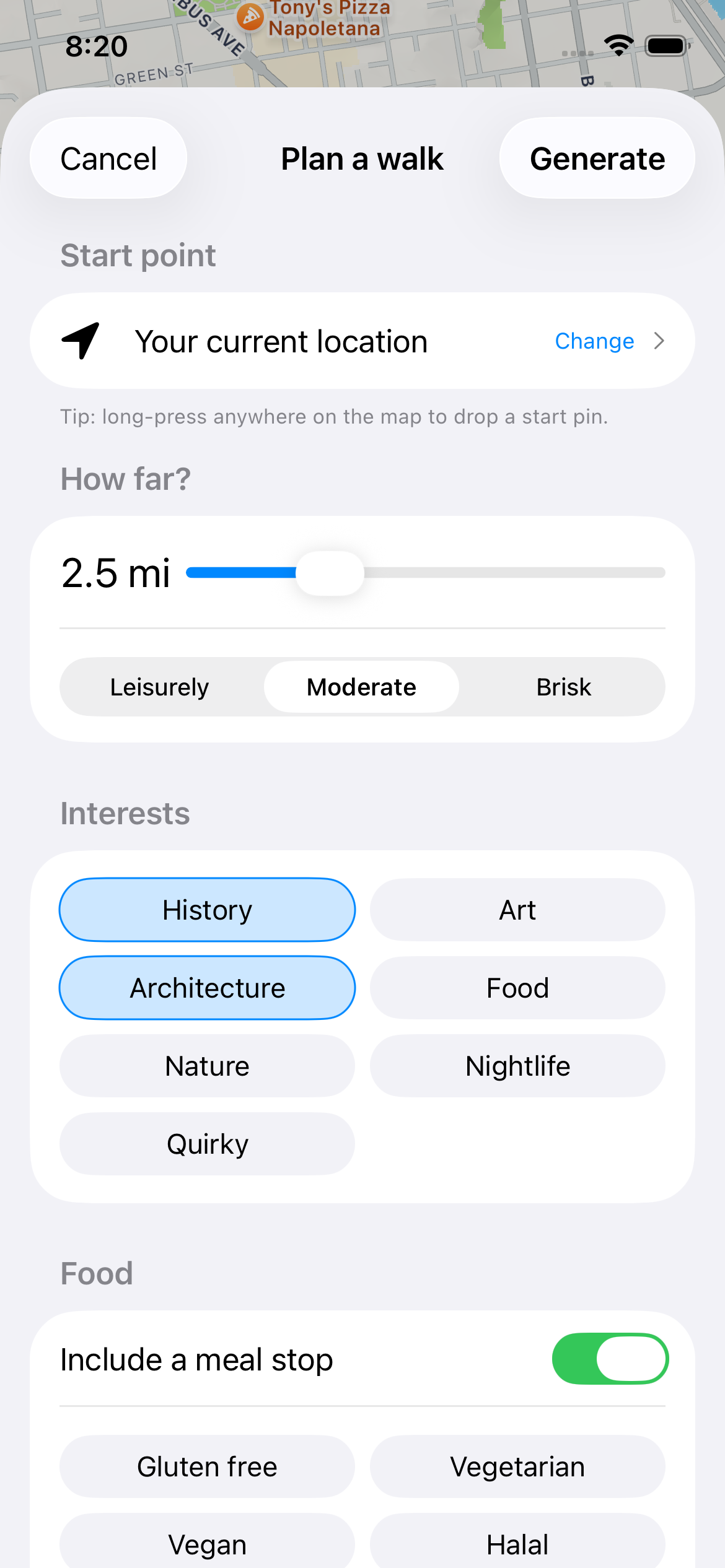
Open this route in the Mosey app for turn-by-turn walking directions and historical narration timed to each stop, so you can look up instead of at a map.
Download on the App Store — Free