The Funk Zone is the strip of warehouses and machine shops between the railroad tracks and the harbor, and it still looks like what it was: industrial. That's the point. Instead of tearing down the corrugated-metal buildings that once housed surfboard shapers and auto repair shops, Santa Barbara let wineries, muralists, and small kitchens move in around them. You'll walk past a working art foundry, a converted lumberyard, and more than a dozen tasting rooms packed into a grid of maybe six blocks.
This route starts near the Amtrak station and loops south toward the harbor, hitting the neighborhood's best public murals, its oldest surviving industrial buildings, and a cluster of wine and food stops that show why this became Santa Barbara's most walkable drinking district. None of it requires a car, and most of it is free to look at even if you skip the tasting fees.
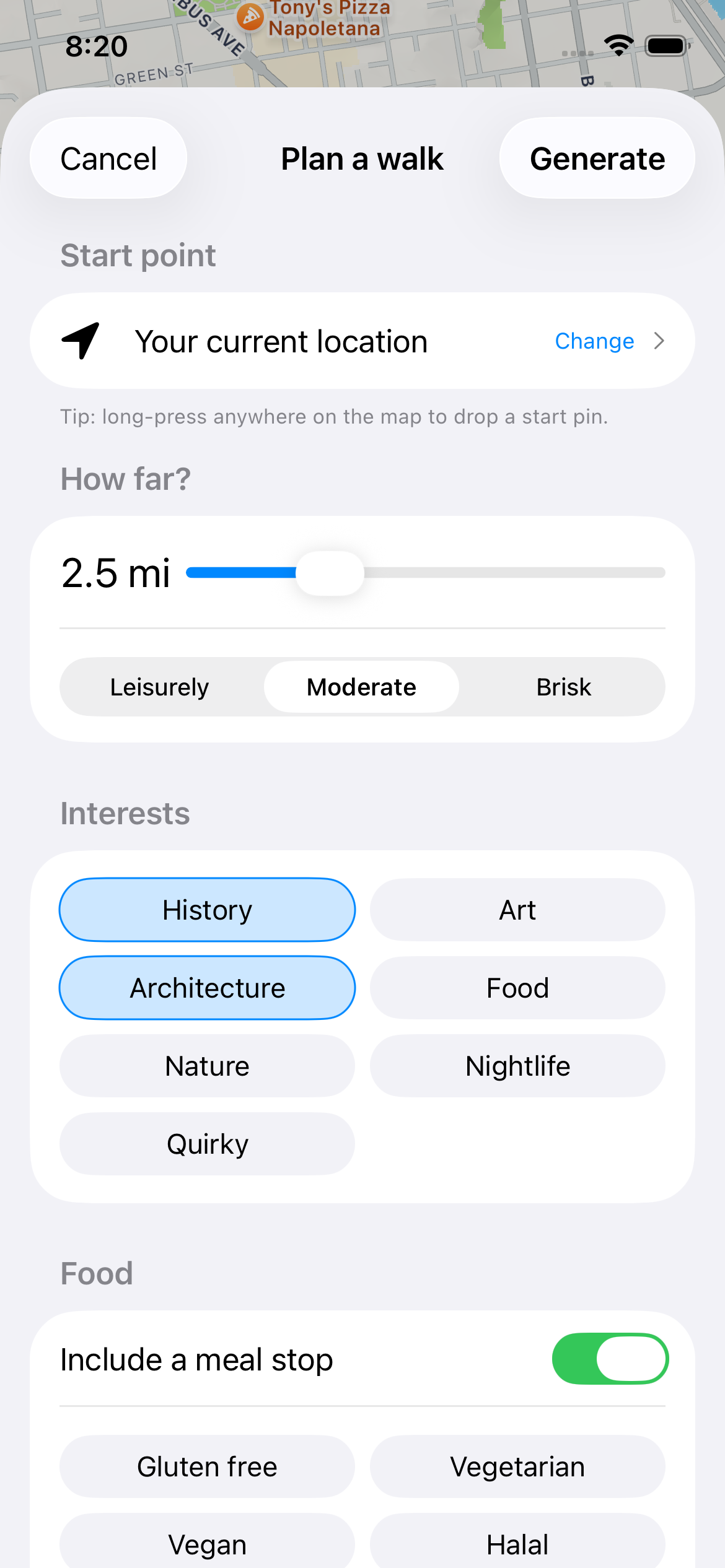
The Mosey app runs this as a self-guided route on your phone, with the historical notes below queued up automatically as you approach each stop, so you're not standing on a sidewalk squinting at a screen trying to figure out which building is which.
The Route: Murals, Warehouses, and Wine
"Yanonali Street carries the highest concentration of murals in the Funk Zone, painted mostly on the blank sides of warehouse buildings that had no architectural detail to protect. The murals date largely from the 2010s, part of an informal wave of building owners commissioning work once the neighborhood's wine-tasting economy took off and foot traffic increased. There's no single curator or program running the whole corridor — it's a patchwork of building owners, local artists, and the occasional festival commission."
Walk the full block between Anacapa and Santa Barbara streets rather than just the corner — the best pieces are mid-block, easy to miss if you're moving fast. Free to view any time; morning light works better for photos since the street faces east.
"This is a functioning bronze foundry using the lost-wax casting method, producing sculpture for artists and institutions across the region. It's one of the few Funk Zone businesses doing exactly what its 1970s-era predecessors did before wine bars arrived — actual industrial fabrication, not a repurposed version of it. The building itself is unadorned corrugated metal, typical of the light-industrial stock that defined this area from the 1920s through the 1980s."
You can usually see into the workspace through open bay doors during business hours; there's no formal tour, so don't expect a docent. Worth five minutes just to see what the rest of the neighborhood looked like before renovation.
"Housed in a former Naval Reserve training center built in 1942 on Harbor Way, the museum opened in this building in 2000. Exhibits cover the Chumash tomol canoe tradition, the local Portuguese fishing families who worked this harbor, and the offshore oil industry that's shaped the Santa Barbara coastline since the 1890s. The building's Streamline Moderne shell is a rare surviving example of WWII-era military architecture on this stretch of coast."
Admission is $10 for adults, $8 for seniors and active military, free for kids under 6; check current hours before you go since it's closed some weekdays. The rooftop deck has a decent harbor view even if you skip the exhibits.
"This stretch anchors what's marketed as the Urban Wine Trail, a term that emerged in the mid-2000s as Santa Barbara County wineries — many with vineyards over an hour north in the Santa Ynez Valley — opened urban tasting rooms here instead of requiring visitors to drive out. The draw was proximity to the train station and harbor hotels; it let wineries reach tourists who weren't renting cars. More than 20 tasting rooms now operate within a half-mile radius."
Tasting flights typically run $15-25 for four to six pours; most rooms don't require reservations on weekdays but do on weekend afternoons. Pick one or two rather than trying to hit several — flights add up fast, and the point of this stop is pacing, not volume.
"The rotunda building at the corner of State and Cabrillo has cycled through several identities, including a stint as a movie theater in the mid-20th century, before its current life as a mixed retail and gallery space. Its curved facade and clock tower make it one of the more recognizable silhouettes at the State Street–waterfront junction. It marks roughly where the Funk Zone's warehouse blocks give way to the tourist-oriented stretch of lower State Street."
Worth a glance from the outside; the interior shops rotate frequently so there's no fixed must-see inside. This is a good spot to reorient if you've lost track of the grid — Cabrillo Boulevard and the harbor are one block south.
"The alley behind the Fish Camp restaurant complex carries rotating large-scale work tied to Santa Barbara's annual mural and street-art events, distinct from the more permanent Yanonali Street pieces. These are painted on temporary panels and repainted every year or two, which means the content is genuinely current rather than fixed decoration from a decade ago."
Don't expect the same artists or images from photos you've seen online — check what's actually up when you arrive. It's a quick stop, mainly worth it if you're already walking past on the way to lunch.
"Opened in 2014 at 38 W. Victoria St., the Public Market occupies a converted warehouse space and brought a dozen-plus independent vendors under one roof, including Randy's Fresh Fish and Empty Bowl. It sits just north of the main Funk Zone cluster but is considered part of the same revitalized industrial district, and it was one of the early anchor projects that made the neighborhood viable for foot traffic beyond wine tourism."
Go for the seafood counter or the wood-fired pizza stand rather than trying to sample everything; seating is shared and communal, so expect to grab a table rather than reserve one. Best around 1pm on a weekday — the noon rush from downtown offices clears out fast, and weekend mornings get crowded with the adjacent farmers market crowd.
Planning Your Funk Zone Walk
Best time to walk: August in Santa Barbara runs mild and marine-layer heavy in the morning, often burning off by 11am. Expect low-to-mid 70s and afternoon sun with little humidity — bring sunglasses, skip the umbrella.
Shoes: Flat sidewalks and paved lots throughout; sneakers or sandals both work fine, no hills.
The narration: Mosey surfaces short historical notes tied to each stop's GPS location, covering what each building used to be before the neighborhood's 1990s-2000s conversion from light industry to wine and art.
Walk the Funk Zone with Mosey
Get turn-by-turn guidance and location-triggered history at every stop — no planning required, just open the app and start walking.
Download on the App Store — FreeFrequently asked questions
Is the Funk Zone in Santa Barbara walkable?
Yes, entirely. The neighborhood covers roughly six blocks between the railroad tracks and Cabrillo Boulevard, flat and fully sidewalked, with no stretch requiring more than a few minutes on foot. Most visitors walk it in under an hour without stops, or two to three hours including tastings, museum visits, and a meal.
How much does it cost to do a Funk Zone wine tasting tour?
Expect $15-25 per tasting flight at most Funk Zone tasting rooms, with four to six pours per flight. Doing two or three rooms runs $45-75 per person. Many rooms waive the fee with a bottle purchase, and some offer flight credit toward bottles bought on-site.
What's the best time of day to walk the Funk Zone?
Late morning to early afternoon, roughly 11am to 3pm, works best. Santa Barbara's marine layer typically clears by 11am, tasting rooms open around 11-noon, and the Public Market lunch crowd peaks around noon before thinning out by 1:30pm. Evenings get crowded on Friday and Saturday nights.
Is the Funk Zone good for kids or families?
Partially. The Maritime Museum and public murals work fine for kids, but the neighborhood's core identity is wine tasting, and many tasting rooms are 21-and-up focused with limited seating for non-drinkers. The Public Market is the most family-friendly stop, with varied food options and casual communal seating.
How far is the Funk Zone from downtown Santa Barbara?
About a 10-15 minute walk from lower State Street's main shopping stretch, and directly adjacent to the Amtrak station at 209 State St. There's no need to drive between downtown and the Funk Zone; it's a straight, flat walk along State Street or Chapala Street.
Are the Funk Zone murals a formal public art program?
No single organization runs all of it. The murals are a mix of privately commissioned building-owner projects, artist collaborations, and rotating installations tied to annual street-art events. Yanonali Street has the most permanent, long-standing pieces; alleys near restaurants tend to rotate every year or two.
More Santa Barbara Routes on Mosey
Mosey also runs self-guided routes through Santa Barbara's downtown State Street corridor, the Presidio Neighborhood's Spanish colonial sites, and the Waterfront/Stearns Wharf stretch just south of the Funk Zone — all built the same way, with historical narration tied to your location so you're not stopping to read a guidebook mid-block.