Chinatown rewards a slow walk better than almost any other San Francisco neighborhood, because the real neighborhood is not on Grant Avenue. Grant is where the souvenir shops are. The history sits one street over, in alleys, upstairs temples, a former YWCA, and a plaza where the American flag first went up over the town in 1846. A good San Francisco Chinatown walking tour moves between the two, and this self-guided Chinatown tour is built to do exactly that.
The route starts at Dragon's Gate on Bush Street, drops down to Old St. Mary's Cathedral, then cuts into Waverly Place and Ross Alley for the tight, vertical side of the neighborhood. From there it opens out to Portsmouth Square, passes the Chinese Historical Society of America's museum on Clay Street, and finishes with dim sum at Hang Ah Tea Room. Seven stops, with the meal last, and plenty of hills in the mix on the way to Clay Street.
Mosey built this route for travelers interested in history and food, and it surfaces short historical context as you arrive at each stop, so you do not need a guidebook open on Grant Avenue. The first three Mosey tours are free, which is enough to try this one and see whether the format suits you.
Seven Stops from Dragon's Gate to Dim Sum
"Dragon's Gate, at Grant Avenue and Bush Street, was a gift from the Republic of China (Taiwan) and was dedicated in 1970. It is a relatively recent addition: the neighborhood's pagoda-style look dates to the rebuilding after the 1906 earthquake, when Chinatown leaders worked to present an architecture that outsiders would find appealing. Grant Avenue itself was called Dupont Street until after the 1906 disaster. A pair of stone guardian lions flank the entrance."
Stand across Bush Street, not directly under the arch, to get the whole gate with the street running up behind it. Photo crowds peak mid-morning, so arrive early. The shops immediately past the gate are the most tourist-oriented on the route; keep walking before buying anything.
"Old St. Mary's, at 660 California Street at Grant, was dedicated in 1854 and served as San Francisco's Catholic cathedral until 1891. It was built largely of brick brought around Cape Horn from the East Coast, and it is commonly reported that the granite for the foundation came from China. The 1906 earthquake and fire left the walls standing but gutted the interior, and the church was rebuilt and reopened in 1909. The clock tower carries the inscription "Son, observe the time and fly from evil.""
Read the clock inscription from the sidewalk first, then go inside; entry is free, though visiting hours vary and services close the sanctuary at times, so check before you plan around it. The church sits at the edge of the old Barbary Coast district, which is the reason for that blunt message on the tower. Keep voices down inside.
"Waverly Place, running between Sacramento and Washington streets, is known as the Street of Painted Balconies for the brightly painted upper-floor balconies added to its buildings after 1906. Tin How Temple, at 125 Waverly Place, is traditionally dated to 1852 and is often described as the oldest Chinese temple in the United States. It is dedicated to Tin How, the goddess of heaven and of sailors, and like many temples here it occupies an upper floor, a practical choice in a neighborhood where ground-floor space was expensive."
The temple is up several flights of stairs and is a working place of worship, so keep a low profile, and bring a small cash donation if you go in. Opening hours are informal; if the door is closed, the balconies and the street itself are still worth the detour. Look up, since the best detail is above eye level.
"Ross Alley, between Washington and Jackson streets, is one of the oldest alleys in the city and in the 19th century was lined with gambling dens and brothels. The Golden Gate Fortune Cookie Factory at 56 Ross Alley opened in 1962 and still makes cookies by hand on small rotating griddles. The true origin of the fortune cookie is disputed, with San Francisco's Japanese community, including the Japanese Tea Garden in Golden Gate Park, claiming an early role."
The shop is tiny and you will stand in the doorway to watch the folding. Bring cash, and expect to be asked to buy a bag if you take photos. The cookies are fine but plain; the real draw is seeing the process, which takes five minutes.
"Portsmouth Square, at Kearny and Clay streets, is the oldest public open space in San Francisco and was the center of the Mexican-era village of Yerba Buena. On July 9, 1846, Captain John B. Montgomery of the USS Portsmouth raised the American flag here, and the square took the ship's name. A 1897 monument to Robert Louis Stevenson, by sculptor Bruce Porter, features a galleon, and a replica of the Goddess of Democracy from the 1989 Tiananmen Square protests stands at the Kearny Street end."
The square sits on top of a parking garage, which explains the odd raised footprint and the pedestrian bridge over Kearny. Mornings and afternoons here are crowded with card and xiangqi (Chinese chess) players, a real local scene; watch quietly and do not photograph people at close range without asking.
"The museum at 965 Clay Street occupies the former Chinatown YWCA, designed by Julia Morgan and completed in 1932. Morgan, the first licensed woman architect in California, is best known for Hearst Castle. The Chinese Historical Society of America, founded in 1963, moved its collections into the building in 2001. Exhibits cover the Gold Rush, railroad labor, the 1882 Chinese Exclusion Act, and the neighborhood's rebuilding after 1906."
This is the best place on the route for context on exclusion-era law and daily life, and it is worth more time than any shop on Grant. Hours are limited and admission details change, so check the society's current schedule before you go. If you are short on time, Morgan's facade on Clay Street is worth a look even from the sidewalk.
"Hang Ah Tea Room, at 1 Pagoda Place off Sacramento Street, has operated since 1920 and is widely billed as the oldest dim sum restaurant in the United States. Dim sum itself is a Cantonese tradition of small steamed and fried dishes served with tea, and it arrived in San Francisco with immigrants from Guangdong province, the origin of most of the city's early Chinese residents. Pagoda Place is a short alley, easy to miss from Sacramento Street."
Order a mix of steamed and baked items and share them; plates are small and a table of two can sample six or seven. Lunch on a weekday is far easier than weekend midday, when waits stretch. Confirm current hours and whether they take cards before you go, since small family restaurants change both.
What to Know Before You Start Up Grant Avenue
Best time to walk: Early November is a good window: expect mild daytime temperatures in the mid-50s to low 60s Fahrenheit, with the first real rain of the season possible. Fog is less of a factor than in summer. Bring a light waterproof layer rather than an umbrella, since the alleys are narrow and umbrellas collide. Morning gives you open shops and quieter sidewalks; by early afternoon on weekends Grant Avenue is packed.
Shoes: Wear shoes with real grip. Chinatown sits on the slope of Nob Hill, so Clay, Washington, and Sacramento streets climb noticeably, and the alleys can be damp and uneven. Waverly Place's temple involves a steep staircase. Carry a little cash for the fortune cookie factory and for small purchases from produce and bakery counters on Stockton Street.
The narration: At each stop Mosey surfaces the documented background: who built it, when, what it replaced, and how it fits into the neighborhood's history from the Gold Rush through the 1906 earthquake and rebuilding.

Walk San Francisco's Chinatown with Mosey
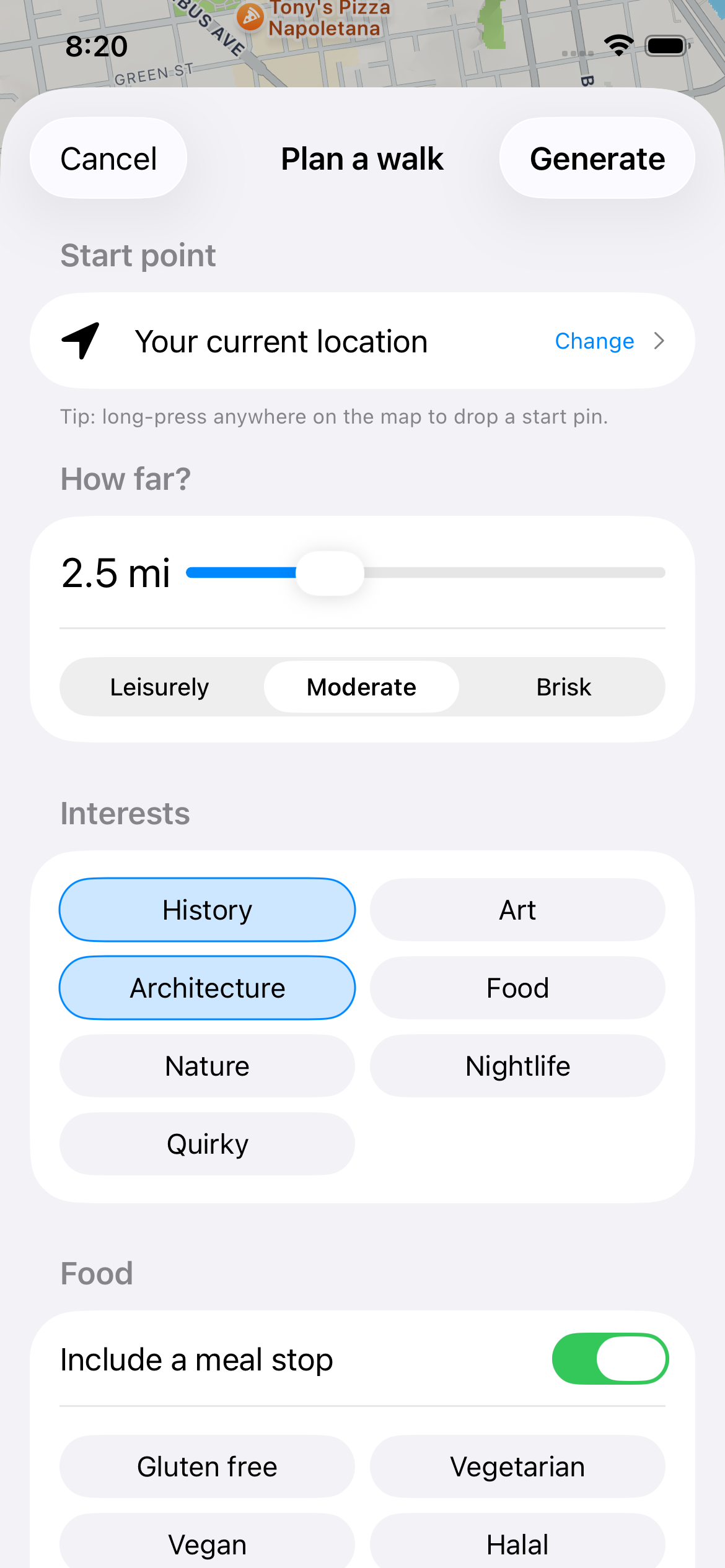
Mosey plans a walk like this one on your iPhone, starting wherever you choose.
- Set a distance or a time and pick what you're into
- Real stops in a walking order that makes sense on foot
- The story behind each stop, read aloud as you arrive
- A meal stop that fits the route

Free to download. iPhone, iOS 17 or later.
Frequently asked questions
How long does it take to walk San Francisco's Chinatown?
Plan for about 2.5 hours for this 1.5-mile route with seven stops, including a sit-down dim sum lunch. Without the museum or meal, you can walk it in 90 minutes. Hills on Clay, Washington, and Sacramento streets slow the pace more than the distance does.
Is Chinatown in San Francisco walkable?
Yes, Chinatown is compact and best seen on foot, since the key alleys and temples are too narrow for cars. The main challenge is slope: streets climb toward Nob Hill. Sidewalks on Grant Avenue and Stockton Street are crowded, especially on weekend afternoons.
What is the best time of day to walk Chinatown?
Mornings, roughly 9 to 11 a.m., are best. Shops are opening, produce markets on Stockton Street are at their busiest with locals, and Grant Avenue is not yet packed. Weekday lunch is the easiest time to get a table at dim sum restaurants.
Is Chinatown San Francisco safe to walk at night?
Main streets like Grant Avenue and Stockton Street are generally busy into the evening, but many alleys, including Ross Alley and Waverly Place, are quiet after dark and most shops close early. Stay on lit main streets after dark, and keep phones and bags secure like anywhere downtown.
What is the oldest thing to see in Chinatown?
Tin How Temple on Waverly Place, traditionally dated to 1852, is often called the oldest Chinese temple in the United States. Old St. Mary's Cathedral, dedicated in 1854, is the oldest cathedral building in the area. Portsmouth Square predates both as the village's original plaza.
Where to Walk Next After Chinatown
Chinatown backs onto several areas that pair well with a second Mosey route. North Beach, just across Broadway, has Italian-American cafes and Beat-era landmarks like City Lights Booksellers. The Financial District to the east holds the remnants of Gold Rush shoreline and early skyscrapers. Nob Hill, uphill to the west, is where the railroad barons built their mansions before 1906. Each of these makes a natural half-day extension to a Chinatown morning.