Old Town is where San Diego started as a civilian town, and it is one of the few California neighborhoods where you can walk between adobe and early American brick buildings in a few minutes. The core is Old Town San Diego State Historic Park, which has no entry gate, no ticket, and no fence. Streets run straight through it, and several of the buildings are open for free. That makes it a good self-guided walk for anyone interested in the Mexican and early American periods of Southern California.
This Old Town San Diego walking tour starts at the park's visitor center and loops through the plaza, the Estudillo house, the stable and hotel on Calhoun Street, and the Whaley House on San Diego Avenue. It ends with lunch at a restaurant where tortillas are made by hand in the front window. The loop is flat and short, but allow time for the buildings you want to enter. Two of them, the Whaley House and a few museum rooms, charge admission or keep limited hours.
The route was built in the Mosey app, which surfaces dated, checkable context at each stop so you are not reading a plaque and guessing. The first three Mosey tours are free. Wear comfortable shoes, bring water, and know that the commercial blocks around the park lean heavily toward souvenirs. The walk below stays with the stops that have real history behind them.
The Old Town loop: from visitor center to the tortilla window
"The Robinson-Rose House was built in 1853 by James W. Robinson, a lawyer who had been a short-term governor of Texas before settling in San Diego. It was built of adobe with a plastered exterior, in the style of the earlier Mexican-era houses around it. Today it serves as the visitor center for Old Town San Diego State Historic Park, which was established as a state park in 1968."
Go in first. Entry is free, and the park map and the town model inside give you a layout before you start walking. Ask what is open that day, since staffing at the smaller buildings varies. Do not expect a long museum visit; ten to fifteen minutes is enough.
"This open square was the center of the pueblo of San Diego, which the Mexican government granted pueblo status around 1834. Families moved down from the hilltop presidio, founded in 1769, to be closer to water and farmland along the river. The town later lost its commercial role after Alonzo Horton began developing New Town near the bay in 1867, and a major fire in 1872 destroyed part of Old Town, speeding the shift downtown."
Stand near the center and turn slowly to see the roof lines of adobe and later wood-frame buildings. This is the best spot for photos without crowds if you arrive early. The shops on the edges are mostly modern retail, so treat the plaza itself as the point and keep moving.
"José María Estudillo, commandante of the San Diego presidio, built this courtyard adobe in 1827 for his family. The house is arranged around an open patio, a plan common in Mexican California. It later became tied to Helen Hunt Jackson's 1884 novel Ramona, and in the early 1900s was restored by John D. Spreckels and promoted as Ramona's Marriage Place, a claim that rests on the novel's popularity rather than documented events."
Entry is free. Walk the full patio loop and look into the rooms from the covered corridor to see how the house is furnished. Do not take the Ramona story as fact; the house is real, the heroine is not. Lighting is better in the late morning when the courtyard catches sun.
"Albert Seeley built this stable in 1867 to support his stagecoach line, which ran between San Diego and Los Angeles and operated from the Cosmopolitan Hotel next door. Horses and coaches were housed here, and it was a working piece of the town's transportation network before railroads took over. The building now holds wagons, carriages, saddles, and other Western artifacts."
Entry is free and the pace is slow, which suits it. Look at the wagon and stagecoach displays rather than reading every label. If you are short on time, this is the first stop you can compress to ten minutes.
"Juan Bandini, a Peruvian-born rancher and political figure, built the original adobe here in 1829 as his home. Albert Seeley bought the property in 1869, added a second story with a balcony, and ran it as the Cosmopolitan Hotel. Its location on the plaza made it a natural stagecoach stop and gathering place for the town."
The building at 2660 Calhoun Street is easy to recognize by its long upper balcony. Look at it from the street and walk the courtyard side if it is open. The restaurant inside is tourist-oriented, so appreciate the architecture here and save your meal for the last stop.
"Thomas Whaley completed this two-story brick house at 2476 San Diego Avenue in 1857, using bricks from his own kiln. It is generally described as the first two-story brick building in Southern California. The house later served as a courtroom and county offices, and the lot is associated with the 1852 hanging of James 'Yankee Jim' Robinson, which occurred before the house was built."
Admission is charged and hours vary, so check the day's schedule before you go. The museum leans on its reputation as haunted, which is a legend, not history, so listen to the stories but rely on the documented dates. Midweek mornings are the least crowded; weekends bring lines.
"Old Town Mexican Cafe, at 2489 San Diego Avenue, opened in 1973 and has been a fixture of the neighborhood's dining scene for decades. It is known for tortillas made by hand in view of the dining room and street. Its menu leans on carnitas, enchiladas, and other Mexican-American standards that fit the area's long Mexican heritage."
Expect a wait at lunch on weekends and in the evening, so go at opening or mid-afternoon if you want a shorter line. Order the carnitas or a plate that comes with the fresh tortillas rather than a generic combo. Margaritas are popular here, but a quieter meal is easier on weekday afternoons.
What to know before you walk Old Town
Best time to walk: November is one of the best months for this walk. Expect daytime highs in the high 60s to low 70s and mostly dry weather, though a marine layer can keep mornings gray until about 10 a.m. There is little shade on the plaza, so bring a hat on sunny days. Weekday mornings are quietest; weekends and holiday periods get busy by noon.
Shoes: Flat and easy, but not all paved. The plaza and some park paths are packed dirt and uneven brick, and adobe interiors have uneven floors. Regular walking shoes or sneakers are fine; skip sandals if rain has recently fallen.
The narration: At each stop Mosey surfaces dated context on who built it, what it was used for, and how Old Town shifted from Mexican pueblo to American town to state park.

Walk San Diego's Old Town with Mosey
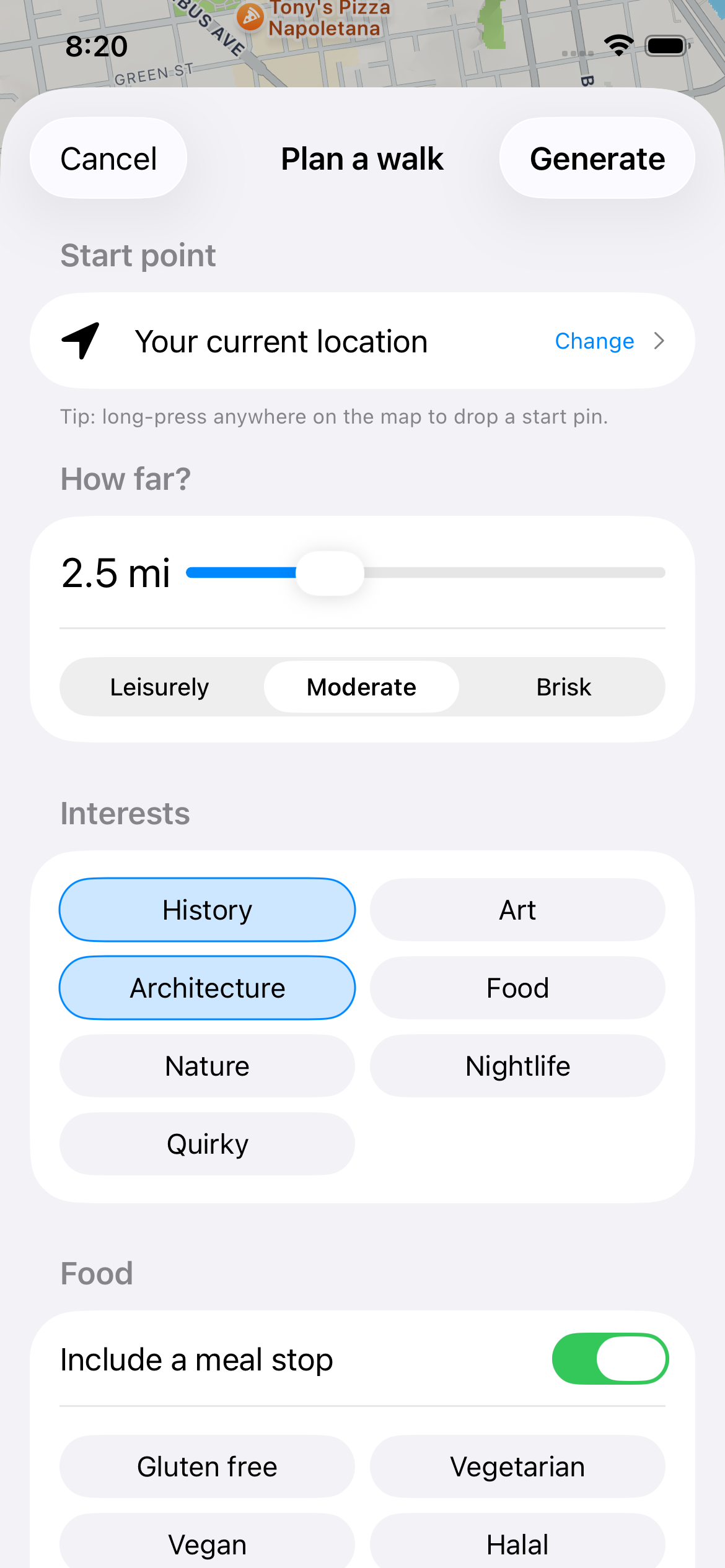
Mosey plans a walk like this one on your iPhone, starting wherever you choose.
- Set a distance or a time and pick what you're into
- Real stops in a walking order that makes sense on foot
- The story behind each stop, read aloud as you arrive
- A meal stop that fits the route

Free to download. iPhone, iOS 17 or later.
Frequently asked questions
How long does it take to walk Old Town San Diego?
Plan on about 2.5 hours for this 1.5-mile route, including time inside buildings and lunch. Walking alone takes under an hour, but the Casa de Estudillo, Seeley Stable, and Whaley House each take 15 to 40 minutes, and a sit-down meal adds about an hour.
Is Old Town San Diego State Historic Park free?
Yes, entry to the park and most of its buildings is free, including the visitor center, Casa de Estudillo, and Seeley Stable. The Whaley House Museum is a separate paid attraction. Individual shops, restaurants, and special exhibits also have their own pricing and hours.
What is the best time of day to walk Old Town San Diego?
Weekday mornings, roughly 9 to 11 a.m., are the best time. Crowds are lighter, the plaza is easier to photograph, and restaurants have shorter waits. By midday, especially on weekends, tour groups and diners fill the plaza and Calhoun Street.
How do you get to Old Town San Diego without a car?
Take the San Diego Trolley or the Coaster commuter train to the Old Town Transit Center, which sits next to the historic park. From there, the Robinson-Rose House visitor center at 4002 Wallace Street is a short walk. Parking near the park is limited, so transit is often easier.
Is Old Town San Diego safe to walk at night?
Yes, the main commercial blocks around the plaza and San Diego Avenue are generally well lit and busy in the evening, especially near restaurants. Most historic buildings close by late afternoon, so a daytime visit is better for sightseeing. Use normal city awareness when walking away from the main streets.
Where else to walk in San Diego
Old Town pairs well with several nearby areas. Presidio Park, just above the plaza, holds the Junipero Serra Museum, built in 1929 on the site where the Spanish presidio was founded in 1769, and it is worth a separate visit for the view and the context. Heading downtown, the Gaslamp Quarter shows the Victorian-era New Town that Alonzo Horton built after 1867, which is the story of why Old Town faded. Balboa Park and Little Italy also work well as additional Mosey routes for a longer San Diego trip.