Little Italy is the San Diego neighborhood where the city's fishing past is easiest to read in the street grid. In the early twentieth century, Italian families, many from Sicily and Liguria, settled here and built the local tuna fleet into a major industry. The neighborhood was later cut apart by Interstate 5 in the 1960s and then rebuilt over the following decades. What you see today is part original, part reconstruction. A good Little Italy walking tour tells the two apart.
This self-guided Little Italy tour starts at the Santa Fe Depot, where a 1915 train station sets the architectural tone. From there it heads to the County Administration Center on the bayfront, then climbs into the neighborhood proper. It passes Our Lady of the Rosary, Piazza Basilone and the India Street corridor, and ends with a sit-down pizza at Filippi's. The walk is flat, mostly shaded by buildings on the side streets, and easy to finish in a morning or an afternoon.
The Mosey app built this route to put food and architecture on the same loop. Each stop carries short historical context so you know what you are looking at before you reach for a menu. Your first three Mosey tours are free, so this one costs nothing to try.
The Route: From the Train Depot to India Street
"The Santa Fe Depot opened in 1915, the year of the Panama-California Exposition in Balboa Park. It was designed by the architecture firm Bakewell & Brown, which also designed San Francisco City Hall. The building is Spanish Colonial Revival, a style San Diego adopted heavily for the exposition. It still works as a transit hub for Amtrak's Pacific Surfliner, the Coaster commuter train, and the trolley."
Step inside the main waiting room to see the tilework and the high wooden ceiling, which cost nothing. Then look back at the exterior from the Kettner Boulevard side for the best view of the towers. Do not plan to eat here; save your appetite for the end of the route.
"The County Administration Center at 1600 Pacific Highway was dedicated in 1938 and built with Depression-era federal public works funding. Its design is a restrained, stripped-down classical style, and it faces the bay rather than the street. The grounds were landscaped as a public park, and the building's waterfront setting was part of the original plan."
Walk to the bayfront side of the building and stand on the lawn for the full facade; the front-on view from Pacific Highway undersells it. The park grounds are free and open to the public, and the lawn is a good place to take a break before the walk turns inland. Weekday visits allow you to see more of the lobby, while weekends are quieter outside.
"Our Lady of the Rosary, at 1668 State Street, dates to the 1920s and was founded to serve the neighborhood's Italian Catholic families, many of whom worked in the fishing and canning trades. For decades it was the social and religious center for the community, and it kept that role even after the freeway and the decline of the tuna fleet scattered many residents. The parish still holds services and community events."
The church is easiest to appreciate from the sidewalk if services are underway; go inside only if the doors are open and no Mass is in progress, and keep voices low. Check the parish's posted hours before you plan around it, since they change. Entry is free, and donations are optional.
"Piazza Basilone is named for Gunnery Sergeant John Basilone, a Marine of Italian-American descent who received the Medal of Honor for his actions at Guadalcanal in 1942. He was killed on Iwo Jima on February 19, 1945. The plaza is one of the neighborhood's attempts to give the Italian-American story a public stage, and it fits into the larger revival that began here in the 1990s."
Read the memorial markers rather than just photographing the square; they are the only stop on this route that is explicitly a war memorial. The plaza is small, so a few minutes is enough. It is a better pause point on a quiet weekday morning than on a market Saturday.
"India Street is the neighborhood's spine, and the lit arch reading Little Italy over the roadway marks the commercial core. Until the 1960s the streets here fed the tuna industry; when Interstate 5 was built it removed much of the original housing and shifted the area's identity. The Mercato farmers market, held on West Date Street between India and Union, is a more recent addition that has become the area's main weekly gathering."
Since your walk falls on a Saturday, the Mercato should be running in the morning and early afternoon, so confirm current hours before you go. It is busy, so expect to walk slowly and keep bags close. If the crowd is too much, walk the same blocks on a weekday and look at the building fronts instead of the stalls.
"Filippi's, at 1747 India Street, opened in 1950 and is one of the older family-run restaurants in the neighborhood. The entrance runs through an Italian grocery and deli, with the dining room behind it. It predates the modern restaurant boom on India Street, which makes it a useful marker of what the neighborhood looked like before the revival."
Walk through the deli to reach the dining room; the shelves of imported goods are part of the experience. Go early or late to avoid a wait, since the restaurant draws long lines at peak meal times and on weekends. Order pizza or a pasta dish and expect a casual, old-school room, not a modern design restaurant.
Planning Your Little Italy Walk: What Is Worth Your Time
Best time to walk: November is a comfortable month for this walk, with daytime temperatures typically in the upper 60s to low 70s Fahrenheit. Mornings near the bay often start under a marine layer, so a light jacket helps before 10 a.m. Rain is uncommon but possible. Summer afternoons are warmer and more crowded on India Street.
Shoes: Flat pavement and sidewalks the whole way, with one or two gentle slopes up from the waterfront. Regular sneakers or flat walking shoes are fine. There are no cobblestones or unpaved paths, so you do not need anything technical.
The narration: At each stop Mosey adds the kind of context a local would offer: who designed the building, when it opened, and what it meant to the Italian and fishing communities that shaped the neighborhood.

Walk San Diego's Little Italy with Mosey
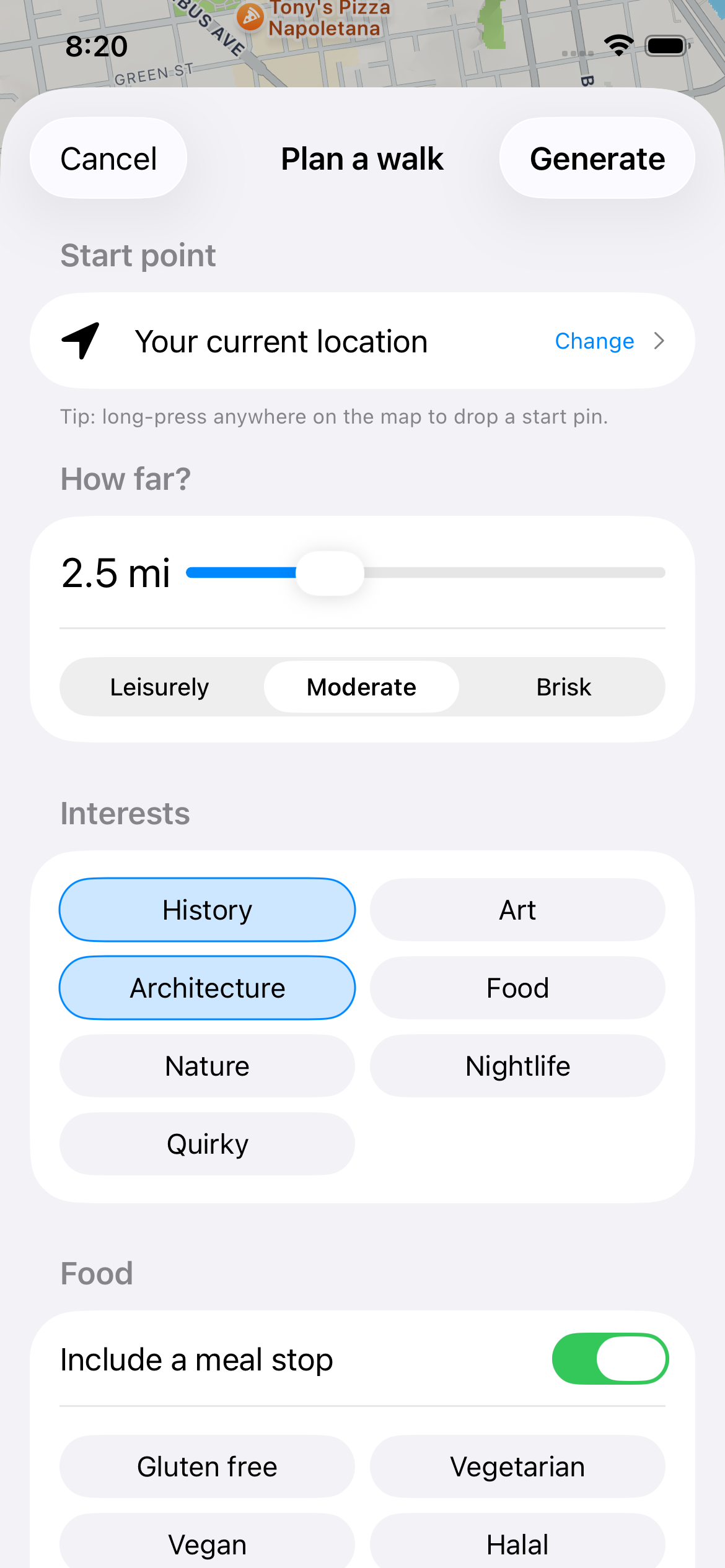
Mosey plans a walk like this one on your iPhone, starting wherever you choose.
- Set a distance or a time and pick what you're into
- Real stops in a walking order that makes sense on foot
- The story behind each stop, read aloud as you arrive
- A meal stop that fits the route

Free to download. iPhone, iOS 17 or later.
Frequently asked questions
How long does it take to walk Little Italy in San Diego?
Plan on about two and a half hours for this route, including a sit-down meal. The walking itself takes well under an hour because the neighborhood is compact and flat. Most of the time goes to the Santa Fe Depot interior, the waterfront lawn, and lunch at Filippi's.
Is Little Italy San Diego walkable?
Yes, Little Italy is one of the most walkable parts of San Diego. The streets are flat, the sidewalks are continuous, and most restaurants, shops and landmarks sit within a few blocks of India Street. You can reach it by trolley or Coaster without a car.
When is the Little Italy farmers market open?
The Mercato farmers market runs on Saturdays, typically from morning into early afternoon, on West Date Street between India and Union. It is the busiest time in the neighborhood. Check the market's current hours before you go, since schedules can change by season.
Where should I park for a Little Italy walking tour?
Use a paid garage or lot near India Street, or take the trolley to the Santa Fe Depot and start there. Street parking is metered and enforced, and Saturday market mornings fill quickly. Read posted signs for time limits and rates, since they vary by block.
Is Little Italy safe to walk at night?
Little Italy is generally lively and well lit in the evening along India Street, with restaurants open late. Side streets and the blocks near the freeway are quieter. Stay on the main commercial blocks after dark, keep valuables out of sight, and use the same common sense you would in any downtown.
More San Diego Walks Near Little Italy
Little Italy sits next to several areas that pair well with a second Mosey tour. The Gaslamp Quarter is a short trip south and trades heavily on Victorian-era commercial buildings. Balboa Park, home to the Panama-California Exposition architecture that influenced the Santa Fe Depot, is a natural follow-up for architecture fans. Point Loma and the working waterfront connect to the tuna-fishing history you touch on here.