King William was San Antonio's first suburb, laid out in the 1870s by German immigrant merchants who'd made money in dry goods, brewing, and the wool trade and wanted houses that showed it. They built in limestone and brick, imported iron fencing, and named the main street after Kaiser Wilhelm I — a name that got briefly patriotic-renamed to 'Pershing Avenue' during World War I before reverting once anti-German sentiment cooled. What's left is one of the densest collections of 19th-century residential architecture in Texas, all of it walkable in an afternoon.
This route runs along King William Street and Madison Street, the two spines of the historic district, with a detour to the river and a stop at a working bakery that's been in the same family since 1886. You'll pass Greek Revival, Victorian, and Italianate houses built for names like Steves, Norton, and Groos, most still private residences, a few open for tours. The district is flat, shaded in parts by old pecan and oak trees, and small enough that you won't need a car once you park.
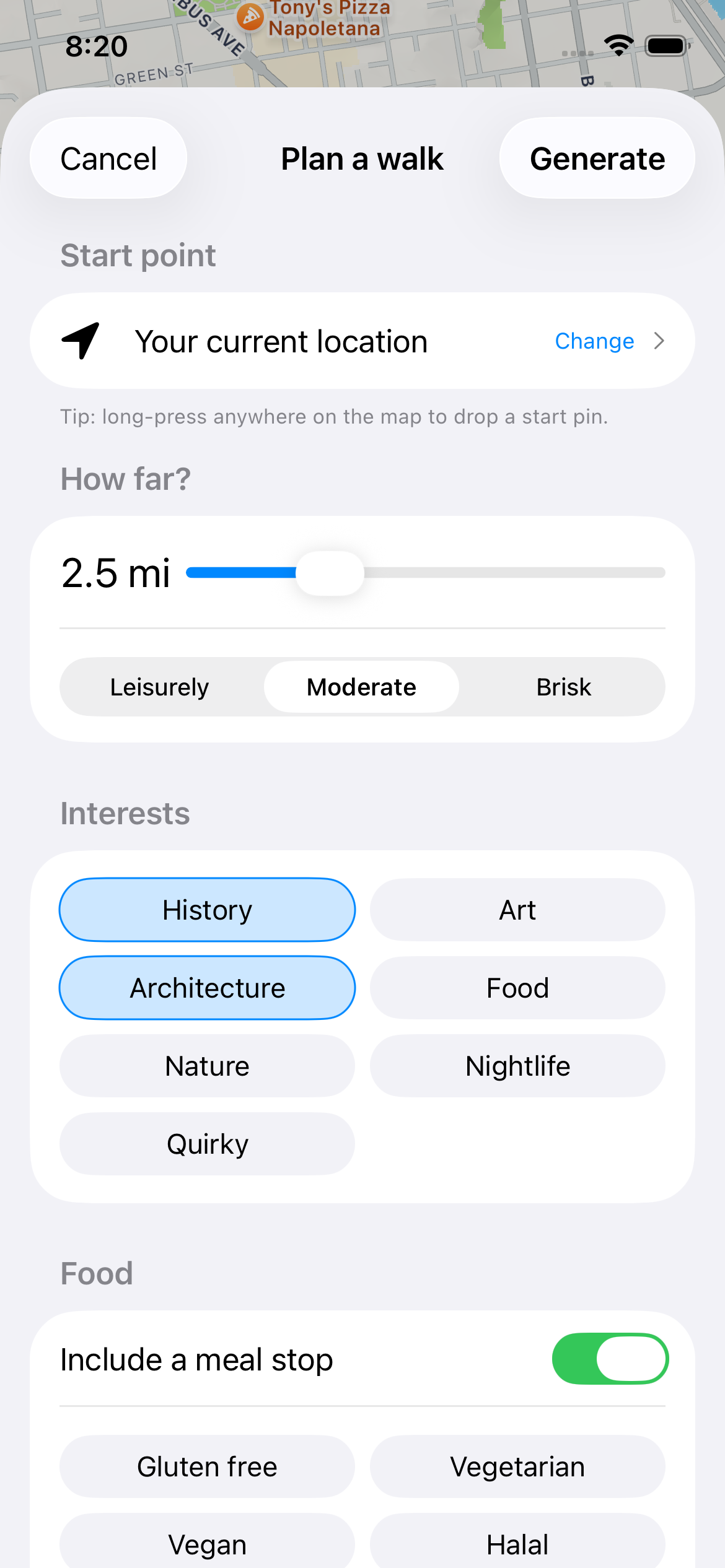
Mosey lays out the route stop by stop and surfaces the history at each address as you reach it, so you're not toggling between a map and a Wikipedia tab while standing in the street. Bring water — King William has almost no shade relief in the open stretches, and September in San Antonio still runs hot.
The Walking Route Through King William
"Carl Hilmar Guenther, a German immigrant miller, built this house in 1859 on the bank of the San Antonio River, next to the flour mill he'd founded the same year. Pioneer Flour Mills is still in operation today, one of the oldest continuously running businesses in Texas. The house itself was expanded over the decades as the Guenther family's fortunes grew with the mill."
This works as your starting orientation point or your ending meal stop, depending on which direction you walk the loop. The museum room upstairs is small and free to enter; the gift shop sells Pioneer-brand flour and mixes made a few hundred feet from where you're standing.
"Built in 1876 for Edward Steves, a lumber merchant who arrived in San Antonio from Germany in 1849, this limestone Victorian at 509 King William Street is now owned by the San Antonio Conservation Society and open for tours. The house retains much of its original interior, including a carriage house and one of the first indoor swimming pools in Texas, built around 1902. Steves made his money supplying lumber for the building boom that constructed much of King William itself."
Tours run on a set schedule through the Conservation Society, typically $10 for adults, and take about 45 minutes if you want the full interior visit. If you're short on time, the exterior and gardens are worth a slow walk-by even without paying for the tour.
"This 1876 Italianate house at 401 King William Street was later owned by preservationist Walter Mathis, who restored it and eventually gifted the property to the National Trust for Historic Preservation. Mathis spent decades buying and saving King William houses from demolition in the mid-20th century, and this district likely wouldn't exist in its current form without his intervention. It's now a National Trust Historic Site with guided tours of the interior and Mathis's art and antiques collection."
Tours require reservations and run in small groups, so book ahead if the interior interests you rather than showing up hoping to walk in. The exterior ironwork and the corner tower are visible any time, no ticket required.
"This stretch of King William Street was laid out in 1870 by the German merchant families who founded the neighborhood, and the street was named for Kaiser Wilhelm I of Prussia. Anti-German sentiment during World War I got it briefly renamed Pershing Avenue after General John J. Pershing, though the King William name was restored after the war. The blocks here mix Greek Revival, Italianate, and Victorian houses built between the 1860s and 1890s for the wool, dry goods, and brewing families who ran the local economy."
Walk the odd-numbered side going one direction and the even side coming back to catch details you'd miss on a single pass. Almost all these houses are private residences, so admire from the sidewalk and skip walking onto porches or lawns.
"The river here is the same San Antonio River that runs through downtown's commercial River Walk, but this stretch through King William stayed quieter and more residential, with backyards and gardens running down to the water. The King William neighborhood was platted specifically to take advantage of river frontage, since the water powered early mills and provided the transportation the German merchant families needed for their goods. Much of the riverside path and landscaping here dates to 20th-century restoration work rather than the original 1870s layout."
This section has almost none of the bar and restaurant crowding you'll find downtown, so it's a good spot to slow down and actually look at the water and the houses backing onto it. No entry fee, open all day, and it connects north toward downtown if you want to extend the walk.
"Madison Street runs parallel to King William and holds a similar concentration of late-19th-century houses, including several built by architect Alfred Giles, an Englishman who designed dozens of buildings across South Texas starting in the 1870s. The street escaped some of the commercial pressure that hit King William Street directly, so a number of these houses retain more of their original outbuildings and garden layouts. Many were built in the 1880s and 1890s as the neighborhood filled in behind its original founding blocks."
This street is quieter than King William proper and a good place to slow your pace. Look for original iron fencing, a detail that's disappeared from a lot of the district but survives on several Madison Street lots.
"The restaurant occupies part of the original 1860 Guenther homestead, run by the same Pioneer Flour Mills company founded by Carl Hilmar Guenther in 1859. It's known for breakfast and lunch built around the company's own flour products, including biscuits, pancakes, and King Ranch chicken casserole. The mill next door still processes flour today, making this one of the few restaurants in Texas literally attached to a working 19th-century industrial site."
Go for breakfast if you can; the biscuits and the pecan pancakes are the reason people drive across town for this. Expect a short wait on weekend mornings since it's a known spot, but the museum room and gift shop next door give you something to do while you wait for a table.
Planning Your Visit
Best time to walk: Late September in San Antonio still hits the mid-80s to low-90s by afternoon with high humidity. Walk this route in the morning or after 5pm, and carry water since shade is inconsistent along the open blocks of King William Street.
Shoes: Flat sidewalks throughout, some uneven brick and old concrete near the river paths. Regular walking shoes are fine; nothing technical about this terrain.
The narration: Mosey pulls up building dates, original owners, and architectural details for each house as you approach it, rather than dumping the whole district's history on you at the start.
Walk King William With Mosey
Get turn-by-turn guidance and the history behind every stop, right on your phone, no planning required.
Download on the App Store — FreeFrequently asked questions
How long does it take to walk the King William Historic District?
Plan on about 2 hours for a 2-mile loop covering the main houses along King William and Madison streets, including stops at the Steves Homestead or Villa Finale. Add 30-45 minutes if you tour one of the house museums, since guided visits run separately from the walking route.
Is King William safe to walk?
Yes, King William is one of San Antonio's most walked residential historic districts, with regular foot traffic from residents, joggers, and visitors heading to nearby Blue Star Arts Complex. Daytime walks are straightforward; sidewalks are consistent and well-lit near King William Street, less so on some side streets after dark.
Can you tour the inside of the King William mansions?
A few are open to the public: the Steves Homestead and Villa Finale both run guided interior tours through the San Antonio Conservation Society and the National Trust, respectively, typically $10-15 per person. Most King William houses remain private residences, so exterior viewing from the sidewalk is the norm.
Where should I park to walk King William?
Street parking near the Blue Star Arts Complex on S. Alamo Street works well and puts you close to the Guenther House end of the district. Weekends get tighter, especially during Blue Star's First Friday events, so arrive before noon or expect to circle a few blocks.
Why is King William called San Antonio's 'German Sundays' or Sauerkraut Bend?
The neighborhood earned the nickname 'Sauerkraut Bend' because German immigrant merchants concentrated here starting in the 1870s, building large houses along the river bend south of downtown. King William Street itself was named for Kaiser Wilhelm I, reflecting how openly German the community's identity was before World War I changed that calculus.
What's the best time of day to walk King William for photos?
Early morning, roughly 8-10am, gives you soft light on the limestone facades and empty streets before traffic picks up. Late afternoon around 5-6pm in fall works too, with warmer light hitting the east-facing houses on King William Street directly.
More San Antonio Neighborhoods to Walk
If King William's mansion architecture holds your interest, Mosey also maps a route through downtown San Antonio's Southtown district just across S. Alamo Street, where the historic houses give way to converted warehouses, galleries, and the Blue Star Arts Complex. For a contrast in scale and era, the Pearl District to the north follows a former brewery site through its adaptive reuse into restaurants and shops, walkable as its own self-guided loop.