Salem's Historic District carries more contradictions per block than almost any neighborhood in New England. This is a place that executed nineteen people on the word of frightened teenagers in 1692, then spent the next three centuries turning that shame into a tourist economy built on tarot cards and haunted house tours. Walking it on foot is the only way to feel both halves at once: the somber granite of the Witch Trials Memorial sits a few hundred feet from shops selling rubber bats, and that tension is the actual character of the neighborhood, not a flaw in it.
This route threads through the core of downtown Salem, from the burying ground on Charter Street down to the harbor where the city's real fortune was made in the China Trade, then back through the pedestrian mall on Essex Street. You'll pass Federal-era mansions built by shipping merchants, a cemetery with headstones dating to the 1670s, and the house that gave Nathaniel Hawthorne his most famous novel. None of it requires a car, and most of it can be seen without paying for a single haunted attraction.
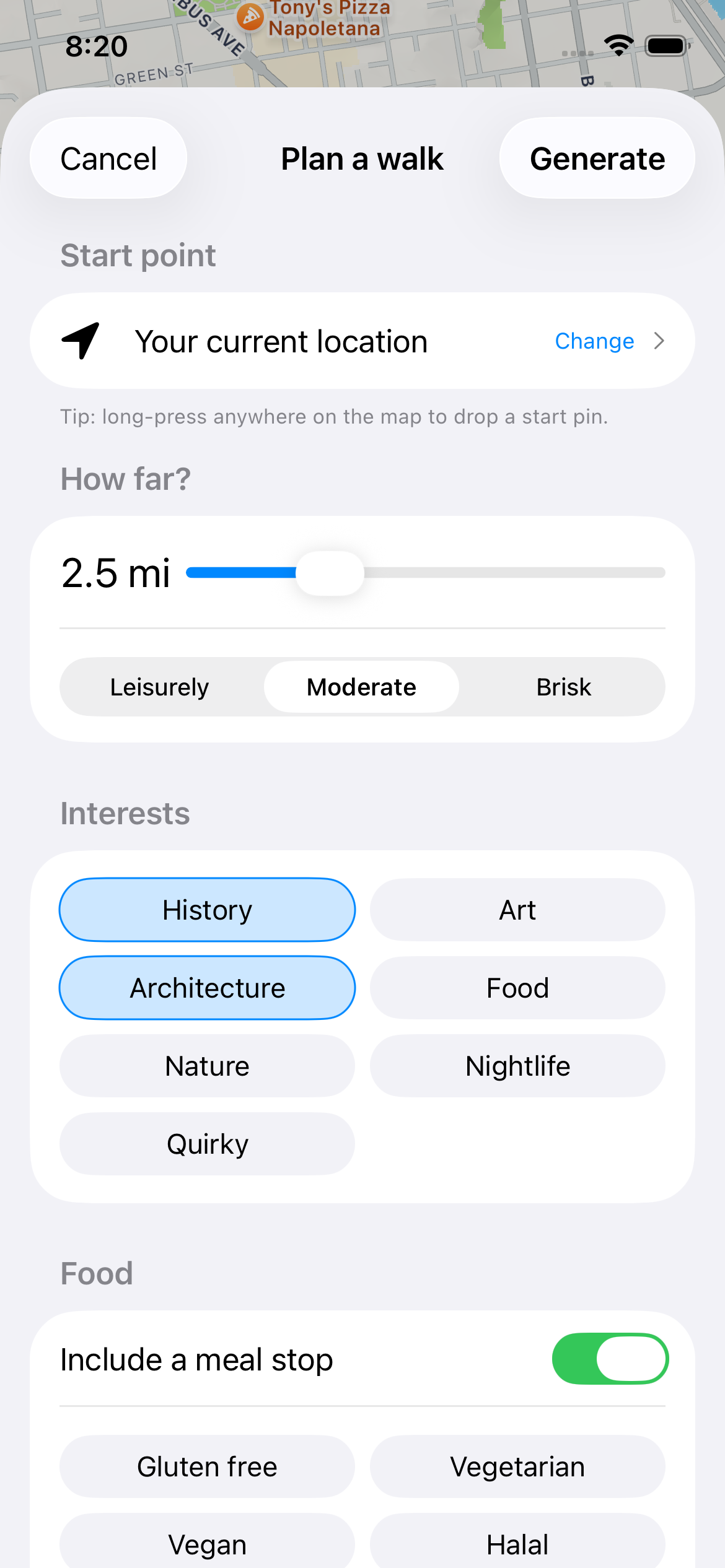
Mosey lays out the stops in order and surfaces the historical notes as you reach each one, so you're not standing on a sidewalk squinting at a plaque or juggling a guidebook. Pull up the app, follow the route, and let the context load as you walk rather than researching everything beforehand.
The Walking Route Through Salem's Historic District
"Dedicated in August 1992 on the 300th anniversary of the trials, this memorial was designed by James Cutler and Maggie Smith, with Nobel laureate Elie Wiesel speaking at the dedication. Twenty stone benches cantilever from a low wall, one for each person executed, their names and execution dates cut into the threshold at the entrance. The benches are deliberately unfinished, cut off mid-sentence, a reference to victims silenced before they could speak."
Read the threshold slabs at the entrance before you walk in — the execution dates and methods are carved right into the stone underfoot and it's easy to miss them. The memorial is small and free, best visited slowly and early before tour groups arrive from the buses on Derby Street.
"Laid out in 1637, this is the second-oldest cemetery in the country still in use for burials. Judge John Hathorne, who presided over the 1692 trials and never expressed remorse, is buried here, as is Richard More, a passenger on the Mayflower. None of the executed victims are buried here — accused witches were denied burial in consecrated ground and were interred elsewhere, some reportedly on Gallows Hill."
The slate headstones from the 1600s and 1700s carry winged skull carvings, a Puritan motif meant to represent mortality rather than anything sinister. Walk the perimeter paths rather than cutting between stones, and note that this cemetery closes at dusk, so plan your route timing around that if you're doing this walk later in the day.
"Founded in 1799 as the East India Marine Society, this is one of the oldest continuously operating museums in the country, built on collections brought back by Salem sea captains who'd rounded the Cape of Good Hope. The museum holds actual court documents from the witch trials, including original depositions and warrants, alongside its far larger collections of Asian export art and maritime paintings. The current building, expanded repeatedly since a 2003 renovation by Moshe Safdie, connects several historic structures into one campus."
Admission runs around $20 for adults; the witch trial documents are usually on view in a dedicated case rather than the whole museum, so ask at the desk where to find them if you're short on time. Budget at least half an hour if you want to see anything beyond the trial documents — the Asian export art galleries alone could eat an afternoon.
"Old Town Hall was built in 1816-1817 on land donated by the Derby family, Salem's wealthiest shipping dynasty, and served as the city's seat of government until 1837. Elias Hasket Derby, sometimes called America's first millionaire, made his fortune in the China Trade running ships out of Salem Harbor before the port silted up and shipping moved to Boston and New York. The square below the hall hosts a farmers market on Saturdays from June through November."
Look up at the building's cupola and the simple Federal lines — it's a good contrast to the ornate Victorian storefronts a block away on Essex Street. If you're walking this on a Saturday morning, the farmers market stalls are worth ten minutes even if you're not buying anything.
"Essex Street has been Salem's main commercial spine since the colonial era, and this stretch was converted to a pedestrian-only mall in the 1970s. The buildings lining it date mostly from the 1800s, built after fires and by merchants cashing in on the shipping wealth, though a few older structures survive tucked behind later facades. Today the street mixes serious history with the witch-tourism economy Salem leans into every October, including shops for tarot readings and psychic consultations alongside more conventional retail."
This stretch is where Salem's two identities collide hardest — expect crowds by early afternoon, especially close to Halloween season. Worth a slow walk rather than a destination stop; skip the paid "haunted" attractions unless that's specifically what you're after, since most add little historical substance.
"Built in 1668 for merchant sea captain John Turner, this is the oldest surviving 17th-century wooden mansion in New England still standing on its original site. Nathaniel Hawthorne, a cousin of the Turner family through marriage, visited often and used the house as the model for his 1851 novel of the same name. The house was restored to its current gabled appearance in 1908 by preservationist Caroline Emmerton, who added back several gables that had been removed over the centuries and opened it as a museum to fund settlement work for immigrants."
Admission is around $18-20 and includes a guided tour through the house, plus access to Hawthorne's actual birthplace, which was relocated to the same property in 1958. The harbor-front grounds are free to walk even if you skip the paid tour, and the view of Salem Harbor from the garden is one of the better photo spots on this route.
"Built in 1819, this is where Nathaniel Hawthorne worked as a customs surveyor from 1846 to 1849, a job he lost to political patronage and later wrote about bitterly in the introduction to "The Scarlet Letter." The gilded eagle over the entrance and the building's role in collecting maritime duties reflect Salem's peak as one of the busiest ports in the young United States, before the harbor became too shallow for larger 19th-century vessels. It's now part of Salem Maritime National Historic Site, the first National Historic Site designated in the country, established in 1938."
Entry is free and run by the National Park Service; check hours before you go since it's seasonal and sometimes only open with a ranger present. The wharf just outside is worth walking out onto for a harbor view even if the building itself is closed.
"Operating since 1806, this claims to be the oldest candy company in the United States, founded by the Spencer family who first made Gibraltars, a hard peppermint or lemon candy still sold today in the original recipe. The shop moved to its current Derby Street location and has stayed a working candy business rather than a museum piece, still hand-making its signature candies on site. It sits a few steps from the Custom House, making it a natural last stop before you loop back into downtown."
This isn't a sit-down meal, so treat it as a sweet finish and grab an actual lunch at one of the nearby spots on Essex or Front Street if you want something more substantial — Rockafellas and Bit Bar are both close by and casual. Gibraltars run a few dollars a bag and keep well if you want to take some home.
Planning Your Visit
Best time to walk: September in Salem runs mild, 60s to low 70s, but harbor wind picks up near the water. Early fall is also the start of Salem's Haunted Happenings season, so weekday mornings before 11am are far less crowded than any weekend afternoon in October.
Shoes: Flat and manageable — brick sidewalks, cobblestone patches near the harbor, and some uneven cemetery ground. Regular walking shoes are fine; skip anything with a thin sole for the burying ground's grass and slate paths.
The narration: Mosey surfaces the year, name, or document tied to each stop as you arrive, so the story of 1692 unfolds site by site instead of as one long recap.
Walk Salem With Mosey
Open the Mosey app to follow this route stop by stop, with historical context loading automatically as you arrive at each site.
Download on the App Store — FreeFrequently asked questions
How long does it take to walk the Salem Historic District?
Budget around two and a half hours for the full 1.8-mile route without museum entries, or closer to four hours if you go inside the Peabody Essex Museum and House of the Seven Gables. Add extra time in October, when crowds on Essex Street slow the pace considerably.
Is the Salem Historic District walkable without a car?
Yes, entirely. The district is compact, flat, and served by brick sidewalks throughout, with the Museum Place Garage and several lots within a five-minute walk of downtown. Most visitors park once and cover the entire historic core, harbor, and Essex Street on foot.
Are any of the accused witches actually buried in Salem's Old Burying Point?
No. Accused witches were denied burial in consecrated ground in 1692, so none of the nineteen executed victims are buried in Old Burying Point Cemetery. Some were reportedly buried near Gallows Hill or reclaimed secretly by family; exact burial locations for most victims remain unknown today.
What's the best time of day to walk Salem's Historic District?
Weekday mornings before 11am, especially outside October, when the Witch Trials Memorial and Charter Street are near empty. Essex Street and the shops get progressively busier through the afternoon, and September weekends already see heavy crowds ahead of the full Haunted Happenings season.
Do you need tickets for the House of the Seven Gables or Peabody Essex Museum?
Yes, both charge admission. The House of the Seven Gables runs about $18-20 for a guided tour, and the Peabody Essex Museum is around $20 for adults. Both are optional stops on this walk; the exteriors and grounds can be appreciated without paying.
Is Salem's Historic District safe to walk at night?
Generally yes, the downtown core stays well-lit and populated into the evening, especially near Essex Street and the harbor. Charter Street Cemetery and the Witch Trials Memorial close or feel quieter after dark, so plan those two stops for daylight hours rather than an evening walk.
More Massachusetts Walks
Once you've covered the Historic District, Mosey also maps a route through Salem's McIntire Historic District, a few blocks west, where Federal-style mansions built by shipping merchants line Chestnut Street, considered one of the best-preserved Federal streetscapes in the country. If you're extending the trip beyond Salem, Mosey's Marblehead and Portsmouth routes cover similar maritime New England history with far fewer crowds and their own distinct 18th-century architecture.