The Fan District earned its name from the way its streets splay outward like an open fan from Monroe Park, and walking it on foot is really the only way to understand why Richmond preservationists fought so hard to keep it intact. This is one of the largest contiguous collections of late-19th and early-20th century residential architecture in the country — block after block of Victorian, Richardsonian Romanesque, Colonial Revival, and Italianate rowhouses, most of them still occupied as homes rather than roped off as museum pieces. It's a neighborhood built for walking: narrow lots, deep porches, and streets that were laid out for streetcars and pedestrians long before anyone worried about parking.
This route starts near Monroe Park, cuts through the heart of Monument Avenue's contested and evolving history, and winds through the residential blocks where the density of architectural detail rewards slow walking. You'll pass Gilded Age mansions, a church with a direct line to the Confederacy's collapse, and streets that show how Richmond has argued with its own past in very public, very physical ways over the last five years. The pace is easy — this isn't a hike, it's a chance to actually look up at cornices, turrets, and stained glass that most drivers blow past at 30 miles an hour.
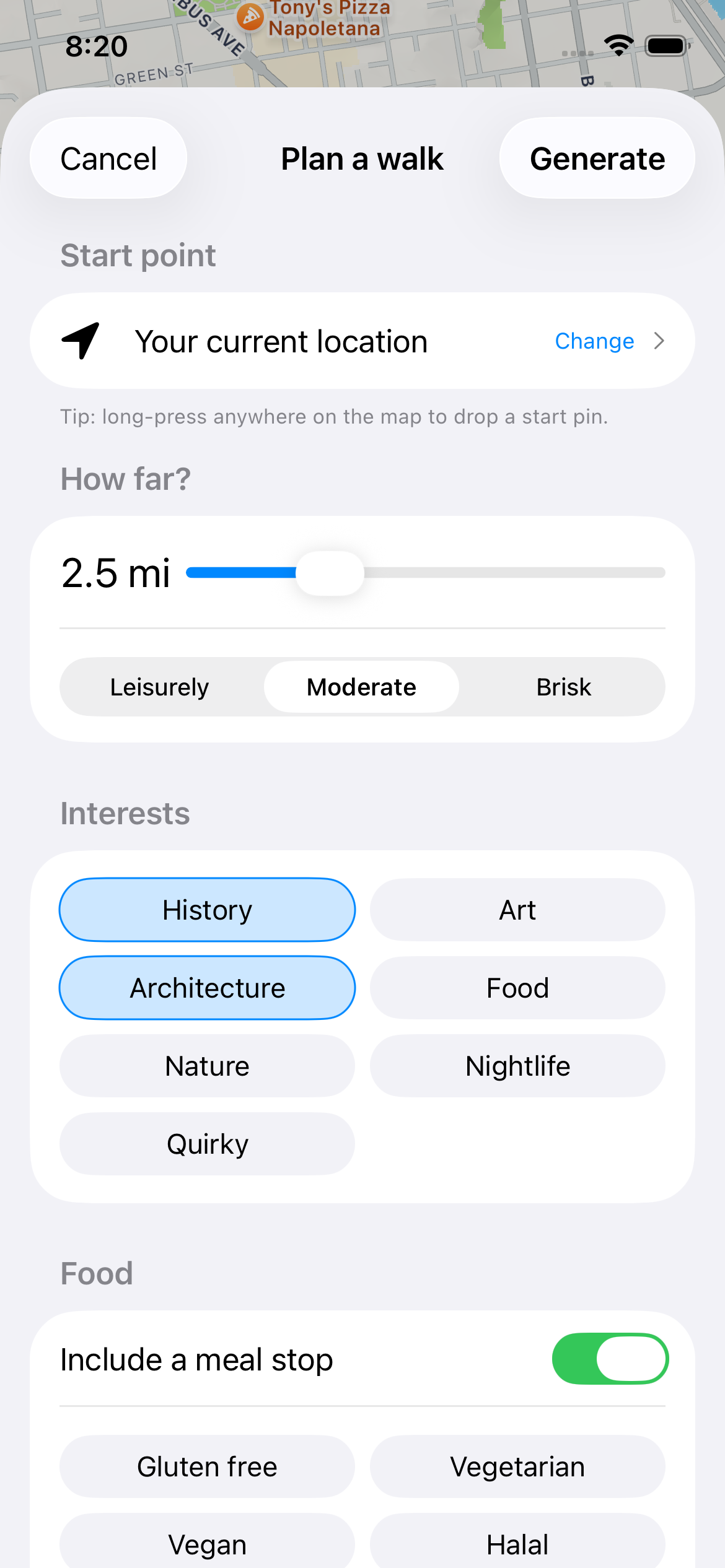
Mosey built this route to string together the stops that matter most, with historical context that surfaces automatically as you approach each one — no need to juggle a guidebook or squint at a plaque. You just walk, and the story arrives when you need it. The route ends, appropriately, with a meal at one of the Fan's longest-running restaurants, so budget time to sit down and eat before you head back.
The Full Route: Stop-by-Stop Through the Fan
"Monroe Park was established in 1851, making it one of Richmond's oldest public parks, and it originally served as a fairground and military training ground before being formally landscaped in the 1870s. Its design reflects the Victorian park movement, with curving paths and a central fountain intended to slow visitors down and encourage strolling. The park sits at the literal edge of the Fan District, marking the transition from downtown Richmond's commercial core into the residential grid that unfolds to the west."
Start at the park's central fountain and orient yourself facing west — that's the direction you'll walk for most of the tour. There's no fee, and it's a good five minutes to just sit and look at the treeline before diving into the denser blocks ahead.
"Monument Avenue was laid out in 1888 as a grand residential boulevard modeled on European examples like the Champs-Élysées, with a wide, landscaped median designed to showcase both architecture and public statuary. For decades it was lined with Confederate monuments, starting with the Robert E. Lee statue erected in 1890, which anchored the avenue's identity for over a century. Following the 2020 protests, the city removed the Lee statue and most other Confederate monuments, leaving traffic circles and empty pedestals that are now themselves part of the avenue's ongoing history. The Arthur Ashe Monument, installed in 1996, remains standing near Roseneath Road, honoring the Richmond-born tennis champion and civil rights figure."
Walk the median itself rather than the sidewalk — it's wide, tree-shaded, and gives you the best view of the mansions lining both sides. Take time at the former Lee Circle site (now just a grassy traffic circle) to see how the city has treated the empty space; there's no plaque yet, but it's one of the most talked-about pieces of ground in Richmond.
"Completed in 1919, the Branch House at 2501 Monument Avenue was designed by John Russell Pope — the architect later responsible for the Jefferson Memorial and the National Gallery of Art — for banker John Kerr Branch. At roughly 27,000 square feet, it's the largest private residence ever built in Richmond, done in a Tudor Revival style with English and French influences that set it apart from its Colonial Revival neighbors. The house now serves as home to the Virginia Center for Architecture and Design, which uses the building itself as one of its primary exhibits."
The interior is open to the public with a modest admission fee (check current hours, as they vary seasonally), and it's worth the stop if you want to see original woodwork and plasterwork up close. If you're short on time, the exterior alone — visible free from the sidewalk — tells you most of what you need to know about Pope's ambitions here.
"Stuart Circle takes its name from the equestrian statue of Confederate cavalry general J.E.B. Stuart, dedicated in 1907 as the second monument erected on the avenue. The statue was removed by the city in July 2020 along with most of the avenue's Confederate monuments, following a public reckoning that had been building for years. The circle itself, along with the surrounding Stuart Circle Hospital building (now residential), reflects how the neighborhood's built environment absorbed and outlived the political statements it was designed to permanently enshrine."
There's little to see here now beyond the traffic circle and landscaping, which is exactly the point — pause and notice what's absent as much as what remains. It's a quick stop, mostly useful as a marker of how fast a hundred years of intended permanence can unravel.
"Built in 1845 for merchant Horace Kent, the Kent-Valentine House at 12 East Franklin Street predates the Fan District proper and offers a rare surviving example of Greek Revival architecture in Richmond, complete with a two-story portico and cast-iron veranda added later in the 19th century. The house later belonged to the Valentine family, prominent in Richmond's business and cultural life, before being donated for preservation use. It's now headquarters for the Garden Club of Virginia, which maintains the property and its gardens."
The gardens are visible and worth a short detour if the gate is open, though the house itself is generally not open for casual walk-in tours — check the Garden Club's site if you want to plan around a scheduled event. Otherwise, the exterior view from the sidewalk is enough to appreciate the ironwork.
"The bulk of the Fan's rowhouses were built between 1890 and 1920, as Richmond's streetcar lines extended westward and developers subdivided former plantation and farmland into narrow residential lots. The architectural mix here — Queen Anne turrets, Italianate cornices, Colonial Revival porches, and Richardsonian Romanesque stonework — reflects a period when pattern-book design let builders mix styles freely rather than commit to one school. The neighborhood's density and consistency led to its listing on the National Register of Historic Places in 1969, and it remains one of the best-preserved late-Victorian streetscapes in the South."
Slow down along Grove Avenue between Sheppard and Meadow Streets — this stretch has some of the most ornate original ironwork and stained glass transom windows in the district. Look up, not just at the porches; a lot of the best cornice and dormer detail is at second- and third-story level and easy to miss if you're only looking at doors.
"Millie's Diner, at 2603 East Main Street just outside the Fan proper in Church Hill, is often cited alongside the Fan's own longstanding spots as part of Richmond's mid-century diner-turned-bistro tradition, but within the Fan itself, Lulu's Restaurant at 21 N. Hamilton Street has served the neighborhood since the 1980s in a building that once housed one of the district's original corner markets. These corner-store-turned-restaurant conversions are common throughout the Fan, since the neighborhood's original zoning allowed small commercial buildings at intersections to serve the surrounding residential blocks — a pattern you've likely already noticed on the walk."
Lulu's is a solid, reliable choice for a sit-down meal with Cajun-leaning Richmond comfort food, and it's an easy walk from the rowhouse blocks. If it's closed or full, Sidewalk Café on Strawberry Street is a longtime neighborhood standby with outdoor seating — either works as a satisfying way to close out the walk.
Planning Your Walk: Practical Tips
Best time to walk: Richmond summers are hot and humid — July afternoons regularly hit the 90s, so an early morning or early evening start is strongly recommended. Spring and fall offer the best walking weather, with mild temps and good light for photographing the architecture.
Shoes: Flat, wide sidewalks throughout, mostly brick or concrete with some uneven old pavers near the older rowhouses — comfortable walking shoes are fine, no special terrain concerns.
The narration: At each stop, Mosey surfaces short, sourced historical context — architects, dates, and the events tied to that specific building or block — so you get the story without breaking stride.
Walk the Fan District with Mosey
Get turn-by-turn guidance and historical context delivered automatically at every stop — open the Mosey app and start walking.
Download on the App Store — Free