College Hill is the neighborhood that made Providence a National Historic Landmark district, and it earns the designation on architecture alone. Benefit Street's so-called 'Mile of History' holds one of the largest concentrations of original colonial homes in the country, largely because Providence's economic stagnation in the 19th century meant nobody had the money to tear the old houses down and build something new. That accident of poverty became a preservationist's windfall.
This walk moves through three centuries at once: colonial merchant houses on Benefit Street, Brown University's federal-era campus at the top of the hill, and the Rhode Island School of Design's museum tucked between them. You'll climb some real grades — College Hill is not flat — and pass through the kind of streetscape where house plaques note original owners going back to the 1750s. The route is built for a slow pace, with real stops for reading historic markers and looking up at rooflines.
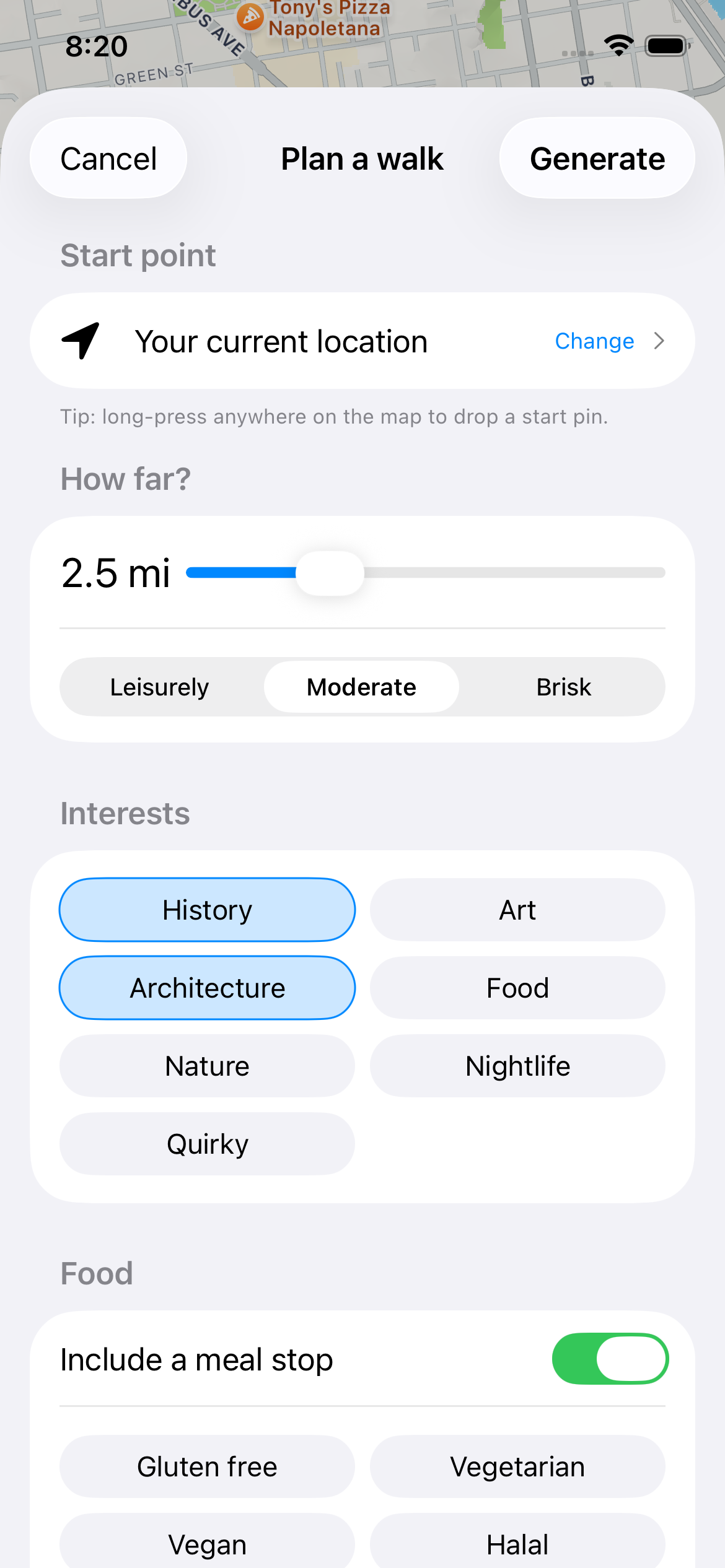
The Mosey app has this route mapped stop by stop, so you're not fumbling with a paper map or guessing which brick building matters. Pull it up on your phone, follow the pins, and let the narration at each stop fill in what the plaques leave out. It's built for people who want the substance of a guided tour without booking one.
The College Hill Route, Stop by Stop
"Built in 1773, Market House anchored Providence's colonial economy as the town's central marketplace, with merchants selling goods on the ground floor and town offices above. It witnessed the Providence Tea Party of 1775, when locals burned tea here in protest of British taxation, echoing Boston's more famous act of defiance a year and a half earlier. Brown University acquired the building in the 20th century, and it now houses university offices rather than produce stalls."
Stand across the street at the top of South Main to get the full facade in view — the building anchors the base of the hill and marks where the walk begins its climb. It's not open to casual visitors, so a few minutes here reading the exterior plaque is enough.
"Laid out in 1758, Benefit Street was created as a 'benefit' to residents who'd been navigating a chaotic web of unplanned lanes — hence the name. The street holds one of the country's densest collections of intact 18th- and 19th-century homes, largely federal and colonial revival in style, preserved in part because Providence's shipping economy declined before urban renewal could bulldoze them. Preservationists in the 1950s, alarmed at proposed demolitions, formed the Providence Preservation Society specifically to protect this stretch."
Walk north along Benefit Street and look for the small brass plaques on many houses noting original owners and build dates — some go back to the 1750s. Give this stretch real time; it's the architectural spine of the whole tour, and the details reward slow walking rather than a quick pass-through.
"Founded in 1638 by Roger Williams, this congregation is recognized as the first Baptist church in America, though the current building dates to 1775. Its 185-foot steeple was modeled loosely on a design published by James Gibbs, the London architect behind St. Martin-in-the-Fields, and it remains one of the finest wooden Georgian church interiors in New England. The building has hosted Brown University's commencement ceremonies for well over two centuries."
The church is generally open to visitors on weekdays outside of services — check posted hours at the entrance on North Main Street. Step inside if you can; the box pews and Waterford crystal chandelier are worth the five extra minutes, and there's no admission fee.
"Completed in 1788 for merchant John Brown, this mansion was described by John Quincy Adams as 'the most magnificent and elegant private mansion that I have ever seen on this continent.' Brown was a Providence merchant and one of Brown University's namesake benefactors, but he was also directly involved in the transatlantic slave trade, a history the Rhode Island Historical Society now addresses directly in its tours. The house is a textbook example of Georgian architecture, built with wealth generated by both legitimate maritime trade and its darker counterpart."
Run by the Rhode Island Historical Society at 52 Power Street, admission runs around $12 for adults with discounts for students and seniors — check current hours before arriving, as it's not open daily. The guided interior tour is worth the ticket price if you have time; otherwise the exterior and gardens can be appreciated for free from the street.
"Brown University was chartered in 1764, making it the seventh-oldest institution of higher education in the country, and the College Green has served as its central quad since the campus relocated to College Hill in 1770. University Hall, the brick building anchoring the green, dates to 1770 and briefly housed Continental Army troops during the Revolutionary War. The green's mix of 18th-century brick and later Beaux-Arts buildings reflects the university's slow expansion over two and a half centuries."
The green is open to the public and free to walk through at any hour — early morning or late afternoon avoids the thickest student foot traffic. University Hall isn't generally open to visitors, but its exterior and the surrounding lawn are the main draw here.
"Founded in 1877 alongside the Rhode Island School of Design, the museum holds a collection of roughly 100,000 objects spanning ancient Egyptian artifacts to contemporary design, with particular strength in French Impressionism and Asian art. Its Pendleton House wing, opened in 1906, was the first American museum wing dedicated entirely to American decorative arts. The building sits at the literal and cultural border between Brown's academic campus and Benefit Street's residential district."
General admission runs about $12 for adults, with free admission on the last Friday of most months and free entry always for RI residents on Sundays. Budget real time here if you're an architecture or design person — the collection is larger than the museum's modest entrance suggests.
"For a meal stop close to the route, head toward Thayer Street, College Hill's commercial spine since the streetcar era brought retail development in the early 1900s. The street has anchored student life for generations, and its current mix of cafés and restaurants replaced what were once trolley-served shopfronts serving the growing university population. It's a fitting last stop: a living commercial district rather than a preserved one, showing how College Hill kept evolving even as Benefit Street stayed frozen in time."
Grab a table at one of Thayer Street's casual spots, such as Andreas or Baja's, both long-running local favorites for an affordable sit-down meal after a couple of hours of walking. Expect $12–20 per person and no reservation needed for lunch; if you'd rather splurge, Nick's on Broadway is a short rideshare away and worth it for dinner.
Planning Your Walk
Best time to walk: Late July in Providence runs warm and humid, often into the mid-80s by early afternoon. Start this walk by mid-morning to beat the heat, and note that Benefit Street offers almost no shade cover.
Shoes: Steep brick sidewalks and cobblestone sections on College Hill demand real shoes — skip sandals, since the grades and uneven colonial-era paving can be tough on ankles.
The narration: At each stop, Mosey surfaces the specific construction dates, original owners, and architectural details that turn a nice old house into a documented piece of Providence's mercantile and academic history.
Walk College Hill With Mosey
Open the Mosey app to follow this exact route with GPS-guided stops and historical narration at every corner — no planning required, just walk.
Download on the App Store — Free