Princeton is a strange, good mix: a working Ivy League campus with buildings older than the country wrapped around a downtown small enough to cross in twenty minutes. Nassau Street is the seam between them, and most of what matters in this town sits within a few blocks of it. You don't need a campus map or a guided tour group with matching lanyards to make sense of it. You need a route that connects the university's oldest buildings to the town's commercial spine without doubling back on itself.
This walk starts at Nassau Hall, the building that briefly served as the capitol of the United States, and works through the front campus, past the University Art Museum area and Chapel, before crossing into Palmer Square and the shopping district that grew up alongside the college. It's a short walk by mileage but a dense one historically — you're covering roughly 275 years of institutional history and a good stretch of small-town New Jersey commercial architecture in the space of a couple hours.
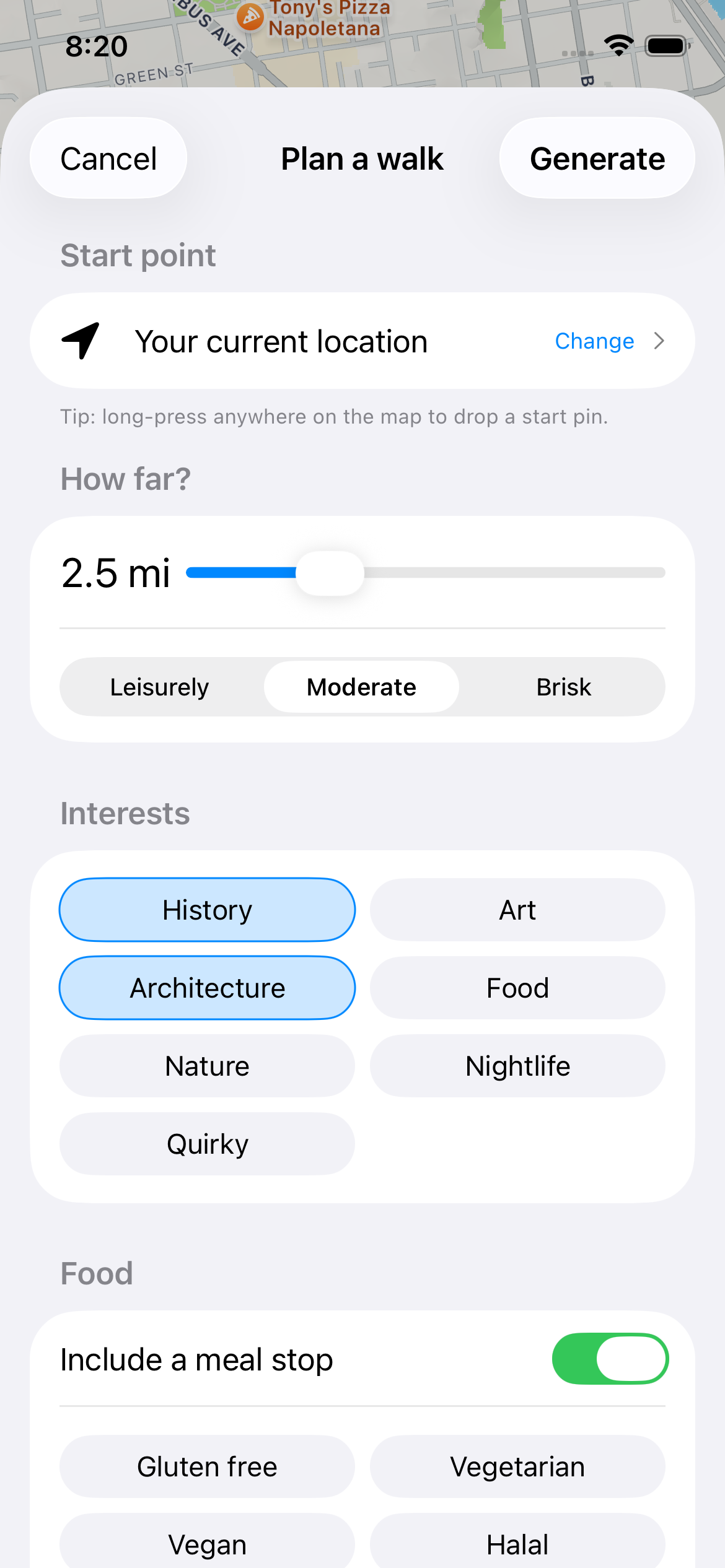
The Mosey app has this route loaded stop by stop, so you're not standing on a sidewalk squinting at a plaque trying to figure out what happened where. Pull it up, follow the pins, and the app tells you what you're looking at as you arrive. It's built for exactly this kind of walk — short distances, dense history, no car needed.
The Route: Gate to Coffee Cup
"The gate was donated in 1905 by Augustus van Wickle in memory of his grandfather Nathaniel FitzRandolph, who in 1753 donated the land Nassau Hall sits on. Designed by the firm McKim, Mead & White, the wrought-iron and stone gate was originally kept closed except for ceremonial occasions like Commencement. In 1970, amid student protests, the gate was left permanently open as a symbolic gesture, and it's stayed that way since."
Stand on the Nassau Street side to see the full gate against Nassau Hall behind it. This is the classic postcard shot of the university, and it's free and unticketed to walk through anytime campus is open.
"Completed in 1756, Nassau Hall was the largest building in the American colonies at the time and served as the sole building of the College of New Jersey (Princeton's original name) for decades. In 1783, it briefly housed the Continental Congress, making Princeton the capital of the United States for about four months. The building was damaged by fire twice, in 1802 and 1855, and rebuilt each time; architect John Notman oversaw the 1855 reconstruction, which gave the interior much of its current form."
The two bronze tigers flanking the front steps, installed in 1911, are a favorite photo spot for students before exams. You can't tour the interior without arrangement, but the Faculty Room is occasionally open during university events — check the Office of Communications calendar if timing matters to you.
"Completed in 1928 and designed by Ralph Adams Cram, the University Chapel replaced an earlier chapel that burned in 1920. Cram, a leading figure in American Gothic Revival architecture, modeled it partly on English collegiate chapels and King's College Chapel at Cambridge. The stone came largely from local quarries and Pennsylvania sandstone, and the stained glass includes windows salvaged from the earlier building alongside new work commissioned for 1928."
The chapel is free and open to visitors most days when services or events aren't in session, typically 8am to 6pm. Step inside even briefly — the vaulted ceiling and scale of the nave are more impressive than the exterior suggests from the walkway.
"Opened in 1948, Firestone was one of the first university libraries in the country built with open stacks accessible to undergraduates rather than closed archives requiring staff retrieval. It replaced Pyne Library and was funded partly by Harvey Firestone, the tire company founder, in memory of his father. A major renovation completed in 2017 rebuilt much of the interior while preserving the original 1948 facade facing Firestone Plaza."
The exterior and plaza are viewable anytime; the interior requires a Princeton ID for most of the collection, though visitors can sometimes access the main lobby exhibition space. Don't plan on getting inside without a student escort — security has tightened since the renovation.
"Built in 1756 alongside Nassau Hall, Maclean House is the second-oldest building on campus and originally served as the residence for the college president. Presidents lived here until 1878, when Prospect House became the presidential residence instead. It now houses the Alumni Association offices, and its Georgian brick facade is largely unchanged from the eighteenth century."
It's easy to walk past this one since it sits just off the main path near the gate. Worth a two-minute look for the brickwork alone — it predates most of what else you'll see on this walk by nearly two centuries.
"Palmer Square was developed starting in 1936, funded by Edgar Palmer, a Princeton alumnus and heir to the New Jersey Zinc Company fortune, as a planned redevelopment of what had been a dense working-class neighborhood called Jugtown. The colonial revival architecture was designed to complement the campus aesthetic and was built in phases through the 1930s and 1980s. It remains privately owned and managed as a commercial district rather than a municipal downtown."
This is where the walk shifts from campus gravity to town commerce. Browse the shops around the green in the center of the square, and note the Nassau Inn, part of the original 1930s development, still operating as a hotel today.
"Built around 1766, Bainbridge House on Nassau Street is one of the oldest surviving structures in downtown Princeton and was the birthplace of Commodore William Bainbridge, who later commanded the USS Constitution. The Georgian brick house was saved from demolition in the 1960s and now belongs to the Historical Society of Princeton. It's a rare surviving example of pre-Revolutionary domestic architecture on what's now a commercial strip."
Look at the brick bonding pattern and the proportions of the windows against the newer storefronts around it — it's a genuine eighteenth-century house sitting between shops. The Historical Society sometimes runs exhibits inside; check their hours before counting on entry.
"Small World Coffee opened in 1993 at 14 Witherspoon Street, started by Jessica Durrie and her father Brant Cosaboom, and has become the town's default meeting spot for students, faculty, and locals alike. It roasts its own beans on-site and was an early adopter of espresso-forward café culture in a region that, in the early 1990s, mostly offered diner coffee. A second location opened later on Nassau Street, but the Witherspoon Street original remains the flagship."
Order the Hammerhead, their signature espresso drink, and grab a seat outside if the weather holds. It gets loud and crowded between 8 and 10am on weekdays with the campus crowd, so mid-afternoon is a calmer time to end the walk here.
Planning Your Walk
Best time to walk: September in Princeton runs mild, low 70s in the afternoon, cooler mornings. Rain is possible but rarely all-day; bring a light layer for the shaded parts of campus even on a warm afternoon.
Shoes: Flat sidewalks and paved campus paths throughout, with some brick and cobblestone sections around Palmer Square. Regular walking shoes are fine — nothing technical about this terrain.
The narration: Mosey surfaces founding dates, architects, and documented events at each stop, pulled from university archives and municipal historic records rather than campus legend.
Walk Princeton with Mosey
Load this route in the Mosey app and get stop-by-stop history as you walk, no planning or plaque-squinting required.
Download on the App Store — FreeFrequently asked questions
Is Princeton's downtown and campus walkable without a car?
Yes. Downtown Princeton and the university's front campus sit within a few blocks of each other along Nassau Street, and the entire route described here covers about two miles on flat sidewalks and paved paths. Parking is limited and metered, so most visitors park once at a garage and walk everything from there.
Can you visit Nassau Hall without a university-led tour?
Yes, the exterior and grounds are open to the public daily with no ticket required. Interior access to the Faculty Room is limited and generally requires a scheduled event or arrangement through the university, so plan on viewing the building from outside unless you've confirmed access in advance.
How long does it take to walk Princeton's campus and downtown?
Plan on two to three hours for a two-mile route covering roughly eight stops, including time inside the Chapel and a coffee break. Add extra time if you want to browse Palmer Square shops or linger at the University Art Museum, which sits just off this route near McCormick Hall.
Is the University Chapel open to visitors?
Yes, generally from around 8am to 6pm on most days when services or private events aren't scheduled. Entry is free and no reservation is needed. Check the university's calendar before visiting if you're set on seeing the interior, since it does close for weddings and academic ceremonies.
What's the best time of day to walk this Princeton route?
Weekday mid-morning to early afternoon, roughly 10am to 2pm, when campus buildings and Palmer Square shops are open but before the after-class rush crowds Nassau Street. Weekends work too, though Small World Coffee gets busy between 9 and 11am.
Are there parking options near the start of the walk?
Street parking near FitzRandolph Gate is limited and metered. The Spring Street Garage, about a five-minute walk from the gate, offers hourly parking and is the most reliable option for a two-hour walk like this one without circling for a spot.
More Princeton Walks on Mosey
If this route leaves you wanting more, Mosey also maps a walk through Princeton's Battlefield State Park and the Institute for Advanced Study grounds, a quieter route heavy on Revolutionary War history and the neighborhood where Einstein lived out his later years. Closer to town, the Witherspoon-Jackson neighborhood — one of New Jersey's oldest historically Black communities, dating to the early 1800s — has its own Mosey route focused on lesser-known but well-documented local history just blocks from Nassau Street.