The Old Port is the reason Portland looks the way it does — brick warehouses, granite-block streets, and a working waterfront that survived four major fires, a shipping bust, and decades of neglect before becoming one of New England's best small-city neighborhoods to walk. This isn't a reconstructed historic district. The buildings here are original, mostly rebuilt in the 1860s and 1870s after the Great Fire of 1866 leveled much of downtown, and the cobblestones under your feet were laid for horse carts hauling molasses, lumber, and dried cod off the ships that once packed Commercial Street.
This route covers the compact core of the Old Port, starting near the waterfront and working up through the district's tightest cluster of 19th-century commercial buildings before finishing at one of the neighborhood's most established seafood spots. You'll pass the spot where the city's fire ordinance changed building codes forever, a customs house that tracked millions of dollars in maritime trade, and back alleys that still look like something out of a shipping ledger from 1880. It's a short walk — you could rush it in 40 minutes — but there's no reason to.
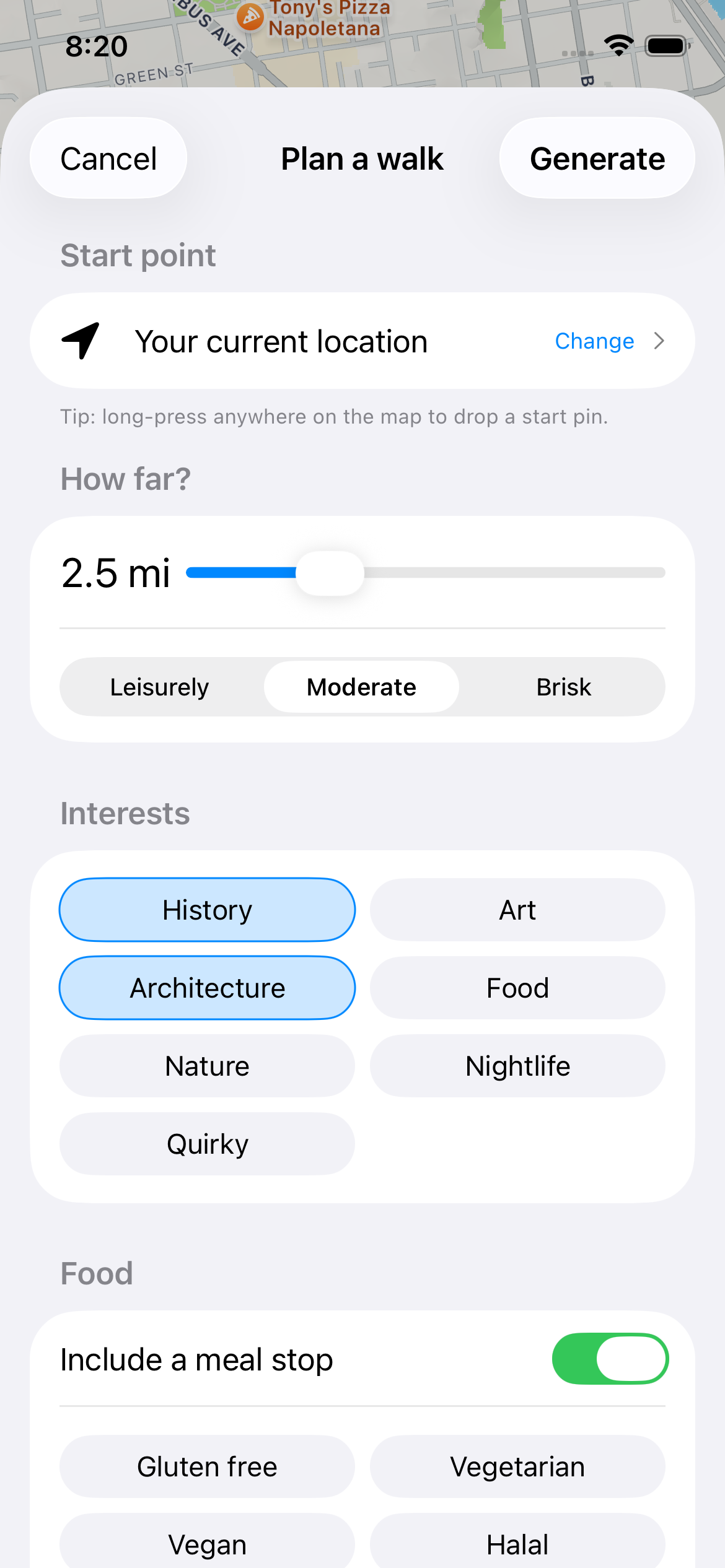
Mosey built this route to string together the stops that actually explain the neighborhood, not just the photogenic ones. Pull up the app at the corner of Fore and Exchange and it'll walk you through each stop in order, surfacing the historical context as you go so you're not standing on a street corner reading paragraphs off your phone.
The Old Port Walking Route, Stop by Stop
"This intersection sat near the heart of the fire zone in the Great Fire of July 4, 1866, which started from a firecracker and destroyed roughly 1,500 buildings across downtown Portland. The rebuilding that followed established the brick-and-granite commercial architecture that now defines the Old Port — new fire codes required masonry construction instead of the wood-frame buildings that had fueled the blaze. Exchange Street itself dates to the early 1800s and was already a commercial corridor before the fire."
Stand at the corner and look down Exchange Street toward the water — the uniform cornice heights and brick facades you see were largely built within a decade of each other. Best photographed in early morning light before shops open and the sidewalks fill up.
"Built between 1868 and 1872, this granite and marble building replaced an earlier customs house and reflects Portland's importance as a 19th-century port — at the time, it was one of the busiest harbors on the East Coast for shipping between the U.S. and Canada, particularly Montreal grain exports during winter months when the St. Lawrence River froze. The building was designed in the Second Empire style by Alfred B. Mullett, the same federal architect responsible for buildings across the country during the Grant administration. It still functions as an active U.S. Custom House today."
It's a working federal building, so there's no public interior access, but the exterior — mansard roof, granite columns — is worth circling. Located at 312 Fore Street, easy to combine with the next stop just a block away.
"This small triangular park marks one of the oldest platted spaces in the Old Port, dating to Portland's original 18th-century street grid. The surrounding buildings, mostly built in the 1870s and 80s, once housed ship chandlers, commission merchants, and import businesses tied directly to the harbor two blocks away. The square has functioned as informal public space for the neighborhood for over a century, long before Old Port became a shopping and dining destination in the 1970s and 80s."
There's usually a bench free here even during peak tourist season — a good spot to sit and read the next leg of the route before continuing. Free, no fees, always open.
"Tommy's Park occupies a lot that sat vacant after a building fire in the mid-20th century, and it became a symbolic space during the Old Port's revitalization push in the 1970s, when the neighborhood was still largely written off as a rundown warehouse district. Local preservationists fought to save the surrounding brick buildings from demolition rather than clearing them for parking lots, a battle that essentially determined whether the Old Port would survive at all. The park today anchors a stretch of Exchange Street lined with buildings that were nearly lost."
Look for the small plaques and public art pieces tucked into the corners — easy to miss if you're moving fast. This is also a good bail-out point if you need a bathroom break; there are public facilities nearby on Middle Street.
"Constructed in 1828, this building originally served sailors and dockworkers with religious services, lodging, and a reading room — a common 19th-century institution in port cities meant to keep transient maritime workers off the streets and out of the harbor-adjacent taverns. It's one of the oldest surviving structures in the district, having outlasted the 1866 fire due to its location slightly outside the worst-hit blocks. The building's granite foundation and simple Federal-style construction reflect the utilitarian architecture common to Portland's working waterfront before the commercial boom of the 1870s."
The building now houses shops and restaurants, so you can step inside without any admission fee — worth a quick look at the original wood beams still visible on the upper floors in some tenant spaces.
"This narrow cobblestone lane once ran directly behind the working wharves and warehouses that lined the harbor, and it retains more of its 19th-century character than almost any other street in the district — no chain storefronts, no widened sidewalks. Wharf Street's buildings backed directly onto the water before extensive landfill projects in the late 1800s and early 1900s pushed the actual shoreline further out, which is why you're now standing what feels like a block inland from the harbor despite the street's name."
Come at dusk if you can — string lights and low foot traffic make this the most atmospheric block on the whole route. Uneven cobblestones here are some of the roughest on the walk, so watch your footing.
"Commercial Street was built in the 1850s on landfill specifically to give the growing shipping trade a dedicated street separate from the older, narrower lanes above it — an engineering project that essentially created new land to keep up with Portland's maritime economy. By the late 19th century this stretch handled everything from Canadian grain to Caribbean sugar to dried fish bound for export, and Portland briefly rivaled Boston as a shipping hub. Fishing boats and lobster boats still use this working harbor today, one of the few East Coast waterfronts where commercial fishing and tourism operate side by side."
Walk toward the water for a clear view of active lobster boats and the ferry terminal — a good spot to see the harbor still functioning as a harbor, not just a backdrop. This is also where the smell of the sea gets noticeably stronger, a good gut-check that you're near the end of the route.
"The Porthole has operated on Custom House Wharf since 1929, making it one of the longest-running restaurants on Portland's working waterfront, and it sits literally over the water on pilings that support the wharf itself. It's survived as a no-frills fisherman's diner even as the surrounding Old Port gentrified around it, and it's still a place where working boat crews and tourists sit at the same counter. The building's weathered, informal character is original — this isn't a themed re-creation of an old wharf diner, it is one."
Order the lobster roll or the haddock sandwich — both are reliable, and portions are generous without inflated tourist pricing. Expect $15–25 per entree; go before 6pm on weekends to avoid a wait, and ask for a table on the deck for a direct view of the working wharf below.
Planning Your Walk: Practical Tips
Best time to walk: Late July in Portland runs comfortable, usually 65–80°F, but the waterfront can be breezy even on warm days — bring a light layer. Mornings before 10am are cooler and far less crowded with cruise ship foot traffic.
Shoes: Cobblestone and brick sidewalks throughout — flat, sturdy shoes are non-negotiable. Skip anything with a thin sole; the granite-block streets are uneven and can be slick if it's rained recently.
The narration: At each stop, Mosey surfaces the specific historical record tied to that address — fire insurance maps, shipping records, and building permits — rather than generic neighborhood trivia.
Walk the Old Port with Mosey
Open the Mosey app to get turn-by-turn guidance and historical narration at every stop on this route — no planning required, just start walking.
Download on the App Store — FreeMore Portland Neighborhoods Worth Walking
If the Old Port left you wanting more of Portland's waterfront history, Mosey also has routes through the West End's Victorian mansion district, the working piers of East Bayside, and Munjoy Hill, where 19th-century sea captains built homes with unobstructed views of the harbor they made their fortunes on. Each route in the Mosey app is built the same way — real addresses, real history, and a walking order that actually makes sense on foot.