Society Hill is the rare American neighborhood where 18th-century brick rowhouses, Georgian churches and a 1960s Modernist tower complex sit within a few blocks of each other, and the mix is not an accident. In the late 1950s and 1960s, city planner Edmund Bacon and a wave of preservation-minded buyers restored hundreds of decaying colonial houses while clearing other blocks for new construction. That decision is the reason this Society Hill walking tour reads as both a colonial survey and an urban-planning case study.
The route runs through the neighborhood's residential grid, starting at Old Pine Street Church, passing the Physick House, Head House Square and St. Peter's churchyard, and then working north past the Powel House, Welcome Park and I.M. Pei's Society Hill Towers. It ends with dinner at Zahav on St. James Place. Most of the walking is on brick sidewalks along narrow streets, with a few small alleys worth ducking into.
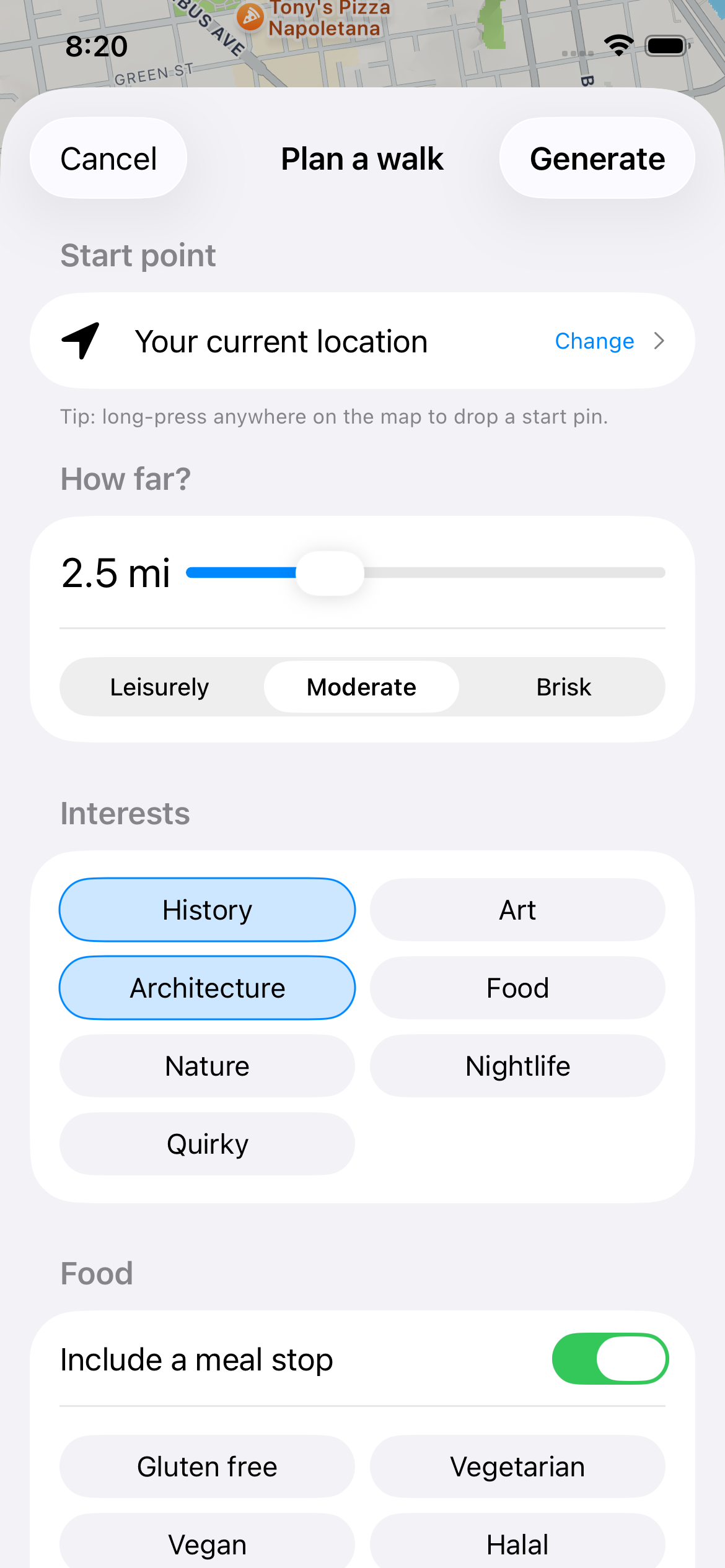
This self-guided Society Hill tour was built in the Mosey app, which plays historical narration as you reach each stop so you can keep your eyes on the cornices rather than a phone screen. Several of the interiors on this route have limited public hours, so the plan leans on exteriors, churchyards and street-level details that are always available.
The Society Hill route, from Pine Street to St. James Place
"Old Pine Street Presbyterian Church was organized in 1768 as the Third Presbyterian Church, built so that Presbyterians in the southern part of the city had a closer congregation. During the British occupation of Philadelphia in 1777 and 1778, the building was taken over and used as a hospital and stable, and the interior was stripped of its pews. The congregation later restored the church, and it is still active today. The surrounding churchyard holds burials from the Revolutionary era."
Start here and look through the fence at the churchyard, which is the most atmospheric part of the visit. Interior access depends on services and scheduled events, so check the church's current hours before counting on going inside. Entry to the grounds, when open, is free.
"The Physick House at 321 S. 4th Street was built in 1786 for Henry Hill, a Madeira wine merchant. Dr. Philip Syng Physick, often called the father of American surgery, moved in around 1815 and lived here until his death in 1837. The house is a freestanding three-story brick building, which is unusual on a block of attached rowhouses. It operates as a museum with period furnishings and a garden."
From the sidewalk you can read the building's proportions and its detached position among its neighbors. Interior tours are ticketed and offered on a limited schedule, so confirm days and prices ahead of time if you want to go in. If the schedule does not line up, the exterior is enough for this walk.
"The market at 2nd and Pine began in 1745 as the New Market, a row of open sheds where farmers sold produce and meat. The brick Head House at the north end, built in 1804, once held a meeting room and fire company space above the market stalls. The long open shed beside it is a rare surviving example of a colonial-era Philadelphia market structure. The square was restored as part of the Society Hill redevelopment of the 1960s."
The Head House Farmers Market runs on Sundays through the fall, so a Monday visit like this one will be quieter. The surrounding cobbles are rough, and the bars and restaurants on the square mostly cater to the evening crowd rather than daytime visitors. Walk the length of the shed and look up at the timber and brick detail.
"St. Peter's Episcopal Church at 3rd and Pine was built between 1758 and 1761 to a design by Robert Smith, who also worked on Carpenters' Hall. The church was built as an offshoot of Christ Church to serve the growing southern edge of the city. William Strickland added the steeple in 1842. The churchyard includes the grave of naval hero Stephen Decatur and of painter Charles Willson Peale."
The churchyard is the highlight, and it is free during daylight hours. Look for the Decatur marker and the old brick wall around the grounds. The interior is open at set times, so check ahead if you want to see the unusual pulpit and gallery layout.
"The Powel House at 244 S. 3rd Street was built in 1765 and bought in 1769 by Samuel Powel, who served as the last mayor of Philadelphia under the Crown and the first mayor after independence. The house is known for its second-floor ballroom, which is among the finest rooms of its period in the city. George Washington is recorded as a guest here. The house was saved from demolition by preservationists in the 1930s and is now a museum."
Photograph the doorway and the proportions of the facade from across the street. Tours are ticketed and offered on limited days, so confirm the schedule if you want to see the ballroom. Skip the interior if your time is tight; the street view captures most of what makes the house distinctive.
"Welcome Park, on the site of the Slate Roof House, is named for the ship Welcome that carried William Penn to Pennsylvania in 1682. Penn lived in the Slate Roof House from 1699 to 1701, and the building was demolished in 1867. The park opened in 1982 and was designed by Venturi, Scott Brown and Associates. Its paved floor is a map of Thomas Holme's 1683 plan of Philadelphia."
Walk across the marble map and find the five public squares in Holme's grid. It is a small space and takes only a few minutes, but it explains the layout of the whole city you have been walking through. It is free and always open.
"Society Hill Towers, at Locust Street between 2nd and 3rd, was designed by I.M. Pei and completed in 1964. The three 31-story concrete towers were part of Edmund Bacon's Society Hill redevelopment, which paired restoration of colonial houses with selective new construction. Landscape architect Hideo Sasaki designed the grounds. The towers are residential, and the contrast with the surrounding colonial rowhouses is deliberate."
Look at the towers from Locust Street, then walk the paths between them to see how Pei kept them from overwhelming the older blocks. The buildings are private residences, so you will not get inside. Most people either love or dislike the concrete, and this is a good spot to decide.
"Zahav, at 237 St. James Place, opened in 2008 and is led by chef Michael Solomonov and business partner Steve Cook. It earned the James Beard Foundation's Outstanding Restaurant award in 2019. The menu is built around Israeli cooking, with hummus, laffa baked in a wood-fired oven, a spread of small salads, and slow-roasted lamb shoulder. It sits on a quiet block beside the Society Hill Towers."
Reservations are essential and often fill weeks in advance, so book before you plan the rest of the day. The restaurant is pricey compared with most Philadelphia dinners. If you cannot get a table, try the bar or a nearby casual spot on 2nd Street rather than skipping a proper meal.
What to know before you walk Society Hill
Best time to walk: Late October is one of the better times to walk Society Hill: expect highs in the low 60s F, cool mornings and fallen leaves on the brick sidewalks. Sunset is around 5:50 pm after the clocks change in early November, so start by early afternoon if you want daylight for the churchyards. Summer is humid and the narrow streets hold heat. In winter, brick can ice over on shaded blocks.
Shoes: Wear flat, grippy shoes. Sidewalks are uneven brick with raised tree roots and old stoops, and Head House Square has cobbled and brick paving that is hard on thin soles. The route is flat, with no real hills.
The narration: At each stop Mosey surfaces the documented context: who built it, when, what happened there during the Revolution, and how the block changed during the mid-20th-century restoration.
Walk Society Hill with Mosey
Open the route in the Mosey app and get the history at each stop as you walk. Build your own Philadelphia walk or adjust this one to fit your time.
Download on the App Store — FreeFrequently asked questions
How long does it take to walk Society Hill?
Allow about 2.5 hours for this 1.6-mile Society Hill route, including time in churchyards and at Welcome Park. Walking alone takes under an hour. If you tour the Physick House or Powel House interiors, add another 30 to 45 minutes.
Is Society Hill walkable?
Yes, Society Hill is flat, compact and easy to walk. Its blocks are short, the sidewalks are brick, and the main sights sit within a few blocks of 2nd, 3rd and 4th Streets. Expect uneven paving and tree roots, so wear shoes with good grip.
What is the best route for a self-guided Society Hill tour?
Start at Old Pine Street Church on Pine Street, then go to the Physick House, Head House Square, St. Peter's churchyard, Powel House, Welcome Park and Society Hill Towers. End at Zahav on St. James Place. This keeps the route a loop with little backtracking.
Can you go inside the historic houses in Society Hill?
Some, but access is limited. The Physick House and Powel House run ticketed tours on set days rather than daily drop-in hours. Churchyards like St. Peter's are usually open to walk through in daylight for free. Check each site's current schedule before you go.
Is Society Hill safe to walk at night?
Society Hill is generally considered one of the safer residential areas for evening walks, especially along 2nd Street and around Head House Square. Streets are well lit and have steady foot traffic near restaurants. Side alleys are quieter, so stick to main blocks after dark.
More Philadelphia walks near Society Hill
Society Hill connects directly to Old City, where Independence Hall, Elfreth's Alley and the Betsy Ross House are an easy walk north, and to Queen Village to the south, which has a more lived-in feel with the Italian Market and Fourth Street delis nearby. Washington Square West, just west of the neighborhood, holds Pennsylvania Hospital, founded in 1751, and the Mosey app can build a route through any of them.