Old City Philadelphia earns its reputation as America's most historic square mile honestly. Within a compact grid of cobblestoned streets and Georgian brick facades, you'll find the room where the Declaration of Independence was signed, the oldest continuously inhabited residential street in the country, and a church whose steeple once towered over the entire colonial skyline. This isn't reconstructed heritage — the bones of the early republic are genuinely here, embedded in buildings that predate the nation itself.
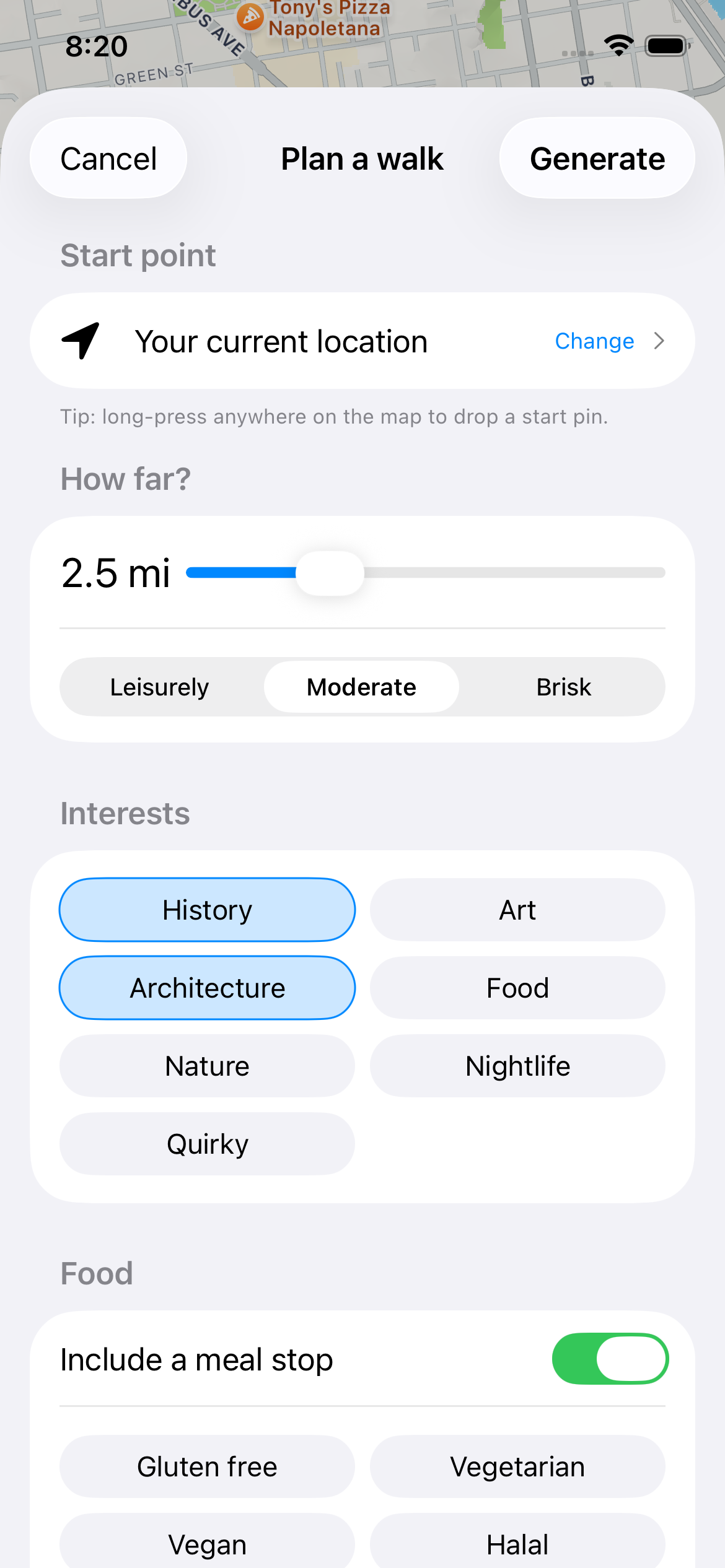
This Mosey-built route threads through Old City's core, moving from the grand civic monuments along Chestnut and Walnut Streets to the quieter, more intimate colonial streetscapes to the north. The walk balances landmark anchors — Independence Hall, the Liberty Bell — with less-visited gems like the Betsy Ross House and the narrow brick canyon of Elfreth's Alley. It closes with a meal stop at one of the neighborhood's most beloved restaurants, giving you a proper reason to sit down after a morning on your feet.
June is an excellent time to walk Old City. The neighborhood's outdoor spaces and courtyard gardens are fully alive, and the long summer evenings mean you can linger at stops without racing the light. Independence Hall fills up fast on summer days — the timed-entry ticket tip in the stops below can save you an hour of waiting. Load the Mosey app before you head out and you'll have turn-by-turn navigation and stop-level narration in your pocket the entire way.
The Old City Walking Tour Route: 7 Stops, 2.2 Miles
"Built between 1732 and 1756 as the Pennsylvania State House, Independence Hall is where both the Declaration of Independence (1776) and the United States Constitution (1787) were debated and adopted. The Assembly Room on the ground floor contains meticulous reproductions of the Windsor chairs delegates used, along with the silver inkstand — the original — from which the Declaration was signed. The building's Georgian design was the work of master carpenter Edmund Woolley, working from plans attributed to lawyer Andrew Hamilton. It was designated a UNESCO World Heritage Site in 1979, one of only two cultural sites in the United States to hold that status."
Entry to Independence Hall requires a free timed-entry ticket, available at the Visitor Center or at recreation.gov — do not skip this step in summer. Rangers lead 30-minute guided tours through the Assembly Room and the Pennsylvania Supreme Court chamber; the tour is included with your ticket and is genuinely worth the time. The tower and steeple were rebuilt in 1828 from original designs after the original rotted and was removed in 1781.
"The Liberty Bell was cast in London's Whitechapel Bell Foundry in 1752, then recast twice by Philadelphia craftsmen John Pass and John Stow after it cracked on its first test ring. The now-famous inscription — 'Proclaim Liberty Throughout All the Land Unto All the Inhabitants Thereof' (Leviticus 25:10) — was part of the original commission. The bell gained its iconic status largely through the 19th-century abolitionist movement, which adopted it as a symbol; the name 'Liberty Bell' itself was coined in an 1835 abolitionist pamphlet. The large crack visible today developed gradually over decades of use and was widened in 1846 during an attempt to repair an earlier hairline fracture."
Entry to the Liberty Bell Center is free and does not require a timed ticket. The building is designed so you can see the bell from the street through floor-to-ceiling glass panels — useful if the line inside is long. Position yourself on the south-facing window side to frame the bell with Independence Hall in the background, one of the most photographed compositions in Philadelphia.
"Founded in 1695 as the first Anglican congregation in Pennsylvania, Christ Church completed its current building in 1744 — making it one of the finest examples of Georgian ecclesiastical architecture in North America. For most of the colonial era, its 196-foot steeple was the tallest structure in all of British North America, visible from the Delaware River to ships approaching port. Among those who worshipped here: George Washington, John Adams, Betsy Ross, and Benjamin Franklin, whose marked pew (No. 70) is preserved inside. The church cemetery on Arch Street, two blocks away, holds the graves of five signers of the Declaration of Independence, including Francis Hopkinson."
Entry to the church interior is $5 suggested donation; the space is genuinely beautiful and the docents are knowledgeable. Don't miss the Palladian window above the altar — it's considered one of the finest in colonial America. If you want to visit Franklin's grave, it's actually at Christ Church Burial Ground on 5th and Arch, not at the church itself; both are worth a brief detour.
"Elfreth's Alley is widely recognized as the oldest continuously inhabited residential street in the United States, with uninterrupted occupancy dating to around 1702. The 32 surviving Federal and Georgian rowhouses were built primarily between 1728 and 1836, originally housing artisans, tradespeople, and maritime workers who served the nearby Delaware River wharves. The street takes its name from blacksmith Jeremiah Elfreth, who owned several of the properties in the early 18th century. Unlike many 'historic' streets that became commercial corridors, Elfreth's Alley has remained a private residential street — people live in these houses today, which gives the block a lived-in texture that museum reconstructions rarely achieve."
The alley itself is a public right-of-way and free to walk at any time. The Elfreth's Alley Museum at No. 126 is open most days for a small fee and gives access to two restored interiors. Walk slowly and look up — the variation in window sizes, door surrounds, and brick bonding patterns across the 32 houses is a visual record of 130 years of evolving taste. The alley is at its most photogenic in the morning before tour groups arrive.
"The Betsy Ross House at 239 Arch Street is a well-preserved Georgian rowhouse dating to around 1740, associated with upholsterer and flag-maker Elizabeth Griscom Ross Ashburn Claypoole. The story that Ross sewed the first American flag here at George Washington's request in 1776 was first publicized nearly a century after the fact, by her grandson William Canby in 1870, and historians consider the account unverifiable — but her skill as an upholsterer and flag-maker is well documented. Ross is buried in the house's small courtyard garden, having been reinterred here in 1975. The house itself is a fine example of the modest artisan dwellings that once filled this part of Philadelphia."
General admission is $6 for adults; the audio tour (included) is narrated from Ross's perspective and does a thoughtful job of acknowledging the historical uncertainties around the flag story without diminishing her genuine significance. The courtyard garden where she's buried is accessible without paying admission. Peak summer crowds arrive after 11 AM — aim to visit early or late in the day.
"The blocks of North 3rd Street and the surrounding grid between Arch and Race Streets represent one of Philadelphia's most intact 18th- and early 19th-century streetscapes. The area began transforming into a cultural district in the 1980s and 1990s as artists moved into former industrial and warehouse buildings, many of which date to the 19th-century commercial expansion of the waterfront economy. First Fridays — a monthly gallery open-house on the first Friday of each month — has made Old City a hub of Philadelphia's contemporary art scene, an unlikely counterpoint to the colonial monuments a few blocks south. The juxtaposition of Federal-style rowhouses, cast-iron commercial facades, and contemporary gallery signage is architecturally distinctive."
This stretch is best absorbed by walking slowly and looking at building datestones and facade details rather than rushing toward any single landmark. The 300 block of North 3rd Street has a particularly dense run of well-preserved early structures. If you're visiting on a First Friday (the first Friday of the month), galleries along this stretch open their doors for free from 5–9 PM — a very different experience from the daytime walk.
"Fork has been a cornerstone of Old City's dining scene since 1997, occupying a converted 19th-century rowhouse at 306 Market Street. The restaurant helped anchor Old City's transformation from a quiet historic corridor into one of Philadelphia's most vibrant dining neighborhoods, and it remains one of the city's most respected tables nearly three decades later. The menu draws on Mid-Atlantic ingredients with a French-leaning technique, and the interior — exposed brick, warm lighting, a long zinc bar — fits the neighborhood's architectural character without being precious about it."
Reservations are strongly recommended for dinner and weekend lunch; walk-ins can often find bar seats for lunch on weekday afternoons. The bar program is excellent if you want to close the walk with a cocktail rather than a full meal. Fork is at 306 Market Street, Philadelphia, PA 19106 — about a two-minute walk from the Old City streetscape section of the route.
Before You Go: Practical Tips for This Walk
Best time to walk: June in Philadelphia is warm and often humid, with highs typically in the low-to-mid 80s°F. Thunderstorms can develop quickly in the afternoon, so consider starting by 9 AM to finish the outdoor portions before midday heat peaks. Bring water — shade is intermittent along Market and Chestnut Streets.
Shoes: The route includes original cobblestone on Elfreth's Alley and uneven brick sidewalks throughout. Sturdy walking shoes or low-profile sneakers are strongly recommended. Sandals will work but may be uncomfortable on the cobblestones.
The narration: At each stop, Mosey surfaces layered historical context — from founding-era construction dates and original occupants to the architectural decisions that shaped each building's look today.
Walk Old City with Mosey
The Mosey app gives you this full route in your pocket — turn-by-turn navigation, stop-level narration, and offline access so you're not hunting for WiFi on Elfreth's Alley. Build your own tour or load this one at moseytourbuilder.com.
Download on the App Store — FreeExplore More Philadelphia Neighborhoods with Mosey
If Old City leaves you wanting more Philadelphia history and architecture, the Mosey app has routes worth exploring in several adjacent neighborhoods. Society Hill, directly south of Old City, offers a quieter, more residential version of the colonial streetscape — Federal-style rowhouses on Spruce and Pine Streets, the Powell House, and the Head House Square open-air market. Washington Square West gives you one of William Penn's original five city squares, ringed by 19th-century architecture and anchored by the Tomb of the Unknown Soldier of the American Revolution. For a complete architectural contrast, the Benjamin Franklin Parkway route northwest of Center City traces the grand Haussmann-inspired boulevard built in the early 20th century, leading from City Hall to the Philadelphia Museum of Art — a very different Philadelphia than the one you'll find in Old City's brick lanes.