Downtown Palm Springs is a compact grid of glass, steel, and stucco where you can trace the entire arc of desert modernism in under two hours. This isn't a neighborhood you need a car to understand — the buildings that made Palm Springs a design pilgrimage site are stacked along Palm Canyon Drive and its side streets, close enough to walk between in the shade of the same palm trees that have lined this route since the 1930s.
This route starts at the Palm Springs Art Museum, works south through the Village Green historic district, passes the Kimpton-run Amado hotel and the Bank of America building that architecture nerds specifically fly in to photograph, and ends at a lunch counter that's been slinging the same date shake recipe since Eisenhower was in office. Along the way you'll pass public art installations, the site of Sonny Bono's old restaurant, and at least three buildings by architects who defined an entire regional style now taught in design schools as "Desert Modernism."
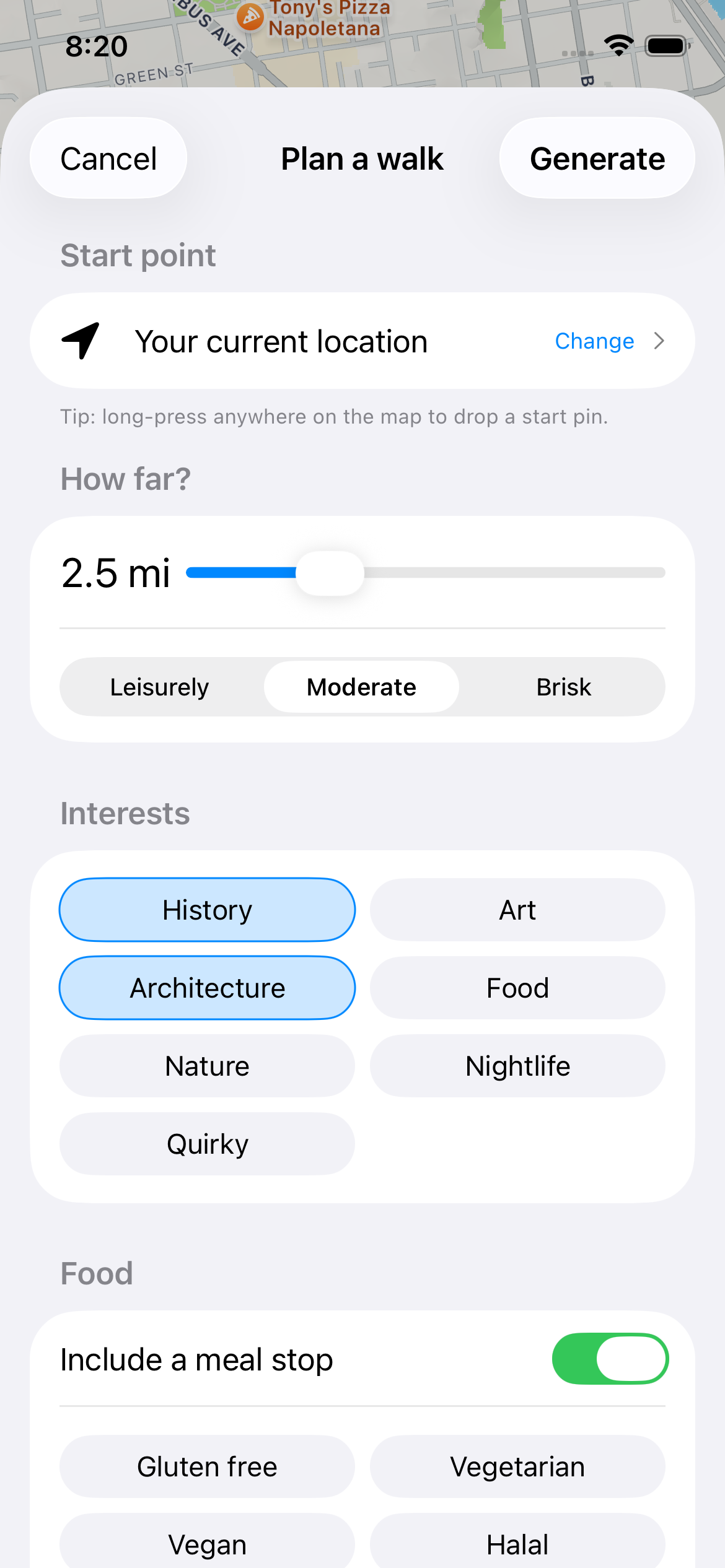
Mosey built this route to work as a self-guided loop — pull it up on your phone and it'll surface the historical context at each stop as you arrive, so you're not standing on a sidewalk squinting at a plaque. Everything here is walkable in flip-flops, but do this one early or late given the season.
The Route: Museum to Deli Counter
"Designed by E. Stewart Williams and opened in 1976, the museum's board-formed concrete and glass structure replaced the Palm Springs Desert Museum's earlier downtown building. Williams also designed the Frank Sinatra house and several Palm Canyon Drive storefronts, making him one of the three or four architects most responsible for the city's postwar look. The museum's permanent collection includes significant holdings of glass art and California modernist painting, and the building itself is often the first stop on formal architecture tours run by Palm Springs Modernism Week each February."
General admission is $14, free on the first Thursday of the month from 4-8pm during "Free Village Fest" hours. Give yourself at least 30 minutes even if you're not going in — the exterior stairs and the Faye Sarkowsky sculpture garden are worth circling on foot.
"Walk south on Palm Canyon Drive to 588 South Palm Canyon and look for the freestanding concrete arches — this is the former Bank of America branch designed by Victor Gruen in 1959, sometimes credited to Rudolph Baumfeld who worked in Gruen's office. Gruen is better known nationally as the architect who essentially invented the enclosed shopping mall, but here his firm produced a small, sculptural bank branch with parabolic concrete arches that has nothing to do with mall design at all. It's one of the most photographed buildings in Palm Springs precisely because it reads as sculpture first, bank second."
It's still a functioning Bank of America branch, so you can't tour the interior on weekends, but the arches are visible and photographable from the sidewalk any time. Best light is morning, when the sun rakes across the concrete.
"This small cluster at 219-223 South Palm Canyon Drive preserves some of the oldest structures in Palm Springs, including the McCallum Adobe, built in 1885 by John McCallum, the town's first white settler, and Miss Cornelia White's cabin, built partly from railroad ties around 1893. Both are maintained today by the Palm Springs Historical Society. It's a jarring contrast walking here from the Gruen bank — a reminder that Palm Springs' modernist boom of the 1950s and '60s was built on top of a much older, rougher settlement history tied to the railroad and the Agua Caliente Band of Cahuilla Indians, who still own much of the land downtown sits on."
The McCallum Adobe and White cabin are only open seasonally (typically October through May, weekend afternoons), so in August you're mostly viewing the exteriors — but that's enough to clock the contrast in materials and scale with everything else on this route.
"Continue to the corner of Palm Canyon and Andreas Road for another Williams building, the former Santa Fe Federal Savings and Loan, completed in 1960. Its deep concrete overhangs and screen-block walls were engineered specifically to cut direct desert sun while still admitting light — a problem-solving approach, not just a style, that shows up across nearly every building on this walk. Williams designed it the same decade he was doing residential work for Sinatra and the Edris family, moving fluidly between commercial and private commissions."
Cross to the shaded side of the street to see the overhangs actually working — stand under one at midday in August and you'll feel the temperature drop several degrees.
"Palm Canyon Drive between Amado and Baristo Roads sits on ground that was, through the 1960s and '70s, the commercial heart of Sonny Bono's Palm Springs — Bono owned a restaurant here before his run as mayor from 1988 to 1992. Much of the block has been rebuilt or renovated since, and the hotel towers you see today reflect a wave of downtown reinvestment that picked up seriously after 2010, when the city rezoned to encourage boutique hotel development along this stretch."
Nothing here requires an entry fee — just walk the block and notice how new construction is deliberately keeping the low, horizontal lines and breeze-block screening of the older buildings around it. It's imitation, but it's consistent imitation.
"Downtown Park, completed in 2014 as part of the larger Downtown Palm Springs redevelopment, hosts rotating public art including large-scale sculpture on loan through the city's Public Arts Commission program. The park sits on the former site of the Bullock's/Bloomingdale's department store block and was designed as connective tissue between Palm Canyon Drive's shops and the museum. It's also become the default site for the Palm Springs Certified Farmers Market on Saturdays and for Villagefest, the weekly Thursday evening street fair that's run since 1991."
If you're walking this on a Thursday evening, Palm Canyon Drive closes to car traffic for Villagefest starting around 6pm — great for people-watching, harder for uninterrupted architecture photos since the street fills with vendor tents.
"Sherman's opened in Palm Springs in 1963, moved to its current location at 401 East Tahquitz Canyon Way, and has operated as a New York-style deli in the desert ever since — pastrami, matzo ball soup, and a bakery case that's been a fixture for regulars for over five decades. It's a short walk east from Downtown Park, just far enough to feel like a proper endpoint rather than a tourist-trap add-on."
Get the pastrami sandwich or the matzo ball soup even in August — the dining room is heavily air-conditioned and the patio is shaded, so it works as a genuine break from the heat, not just a meal. Expect $16-22 per person for a full sandwich plate; cash and card both fine, no reservations needed for lunch.
Planning Your Walk
Best time to walk: August in Palm Springs runs 105–110°F by midday. Start this walk before 9am or after 6pm — the museum and shops give you air-conditioned breaks either way, but midday sidewalk heat here isn't a joke.
Shoes: Flat, closed-toe shoes or sandals are fine — sidewalks and paved plazas the whole way, no hills, no dirt.
The narration: Mosey surfaces the architect, year, and original commission behind each building as you reach it, plus the small stuff — like what used to occupy the lot before it, or which film crew shot there — that a walking map alone won't tell you.
Get This Route on Mosey
Pull up the full Downtown Palm Springs tour in the Mosey app for turn-by-turn walking directions and stop-by-stop historical narration as you go.
Download on the App Store — FreeFrequently asked questions
Is Downtown Palm Springs walkable without a car?
Yes. Downtown Palm Springs is laid out on a flat, compact grid centered on Palm Canyon Drive, and the major architecture, museums, and restaurants sit within a half-mile stretch. Most visitors park once near the Palm Springs Art Museum or a public garage and walk the rest of the day. Rideshare is easy to summon if the heat becomes an issue.
How long does it take to walk Downtown Palm Springs?
Plan on 2 to 2.5 hours for a 1.8-mile route covering seven stops, including museum time and a meal. Add 30 minutes if you want to go inside the Palm Springs Art Museum, and another 20 if you're visiting during Villagefest on a Thursday evening when the street fills with vendors.
What is the best time of day to walk Downtown Palm Springs in summer?
Before 9am or after 6pm, especially June through September when midday temperatures regularly hit 105-110°F. Morning gives you the best light for photographing the Bank of America building's concrete arches; evening lines up with Villagefest on Thursdays and cooler, walkable temperatures after sunset.
Do I need to pay to see the Palm Springs modernist architecture?
No. Nearly every building on a Downtown Palm Springs architecture walk — the Bank of America branch at 588 South Palm Canyon, the Village Green historic buildings, the former Santa Fe Federal Savings building — is viewable free from the sidewalk. The only admission fee on this route is the Palm Springs Art Museum, at $14 general admission.
Is Downtown Palm Springs safe to walk at night?
Yes, the downtown core along Palm Canyon Drive is well-lit, pedestrian-heavy, and patrolled, especially on Thursday evenings during Villagefest. Side streets east toward Indian Canyon Drive are quieter after 9pm. Standard city precautions apply, but it's generally considered one of the more relaxed downtown areas in Southern California after dark.
What's the best month to do a Palm Springs architecture walking tour?
February, during Modernism Week, when many private midcentury buildings open for tours otherwise closed to the public, or the shoulder months of October, November, March, and April, when daytime highs sit in the 80s. Summer walks are doable early morning or evening but require heat precautions.
More Palm Springs Routes Worth Walking
Once you've covered downtown, Mosey also maps a Twin Palms and Movie Colony walking route through Palm Springs' residential modernist neighborhoods, where you can see (from the sidewalk) private homes by William Krisel, Albert Frey, and Richard Neutra, including the Kaufmann Desert House. If you're extending the trip, Mosey's Uptown Design District tour picks up where Palm Canyon Drive's antique and design showrooms take over from downtown's restaurants and hotels.