Tremé bills itself as the oldest Black neighborhood in America, and it doesn't need to oversell the claim. This is where Congo Square drumming laid rhythmic groundwork for jazz, where free people of color built churches and mutual aid societies before the Civil War, and where brass bands still walk the same streets on Sunday second lines. Walking it on foot, rather than driving through, is the only way to catch the texture — shotgun houses with hand-lettered signs, corner bars with horns spilling out the door, and plaques that don't always tell the full story unless you know where to look.
This route runs from Louis Armstrong Park through the residential heart of Tremé along St. Philip, Governor Nicholls, and Henriette Delille streets, ending with a plate of red beans in one of the neighborhood's longest-running kitchens. It's a short walk by mileage, but it covers dense ground — Congo Square, St. Augustine Church, the Backstreet Cultural Museum, and the modest houses where musicians who shaped American music actually lived. Mosey built this route to move at a pace that matches the neighborhood: unhurried, with room to stop when something catches your eye.
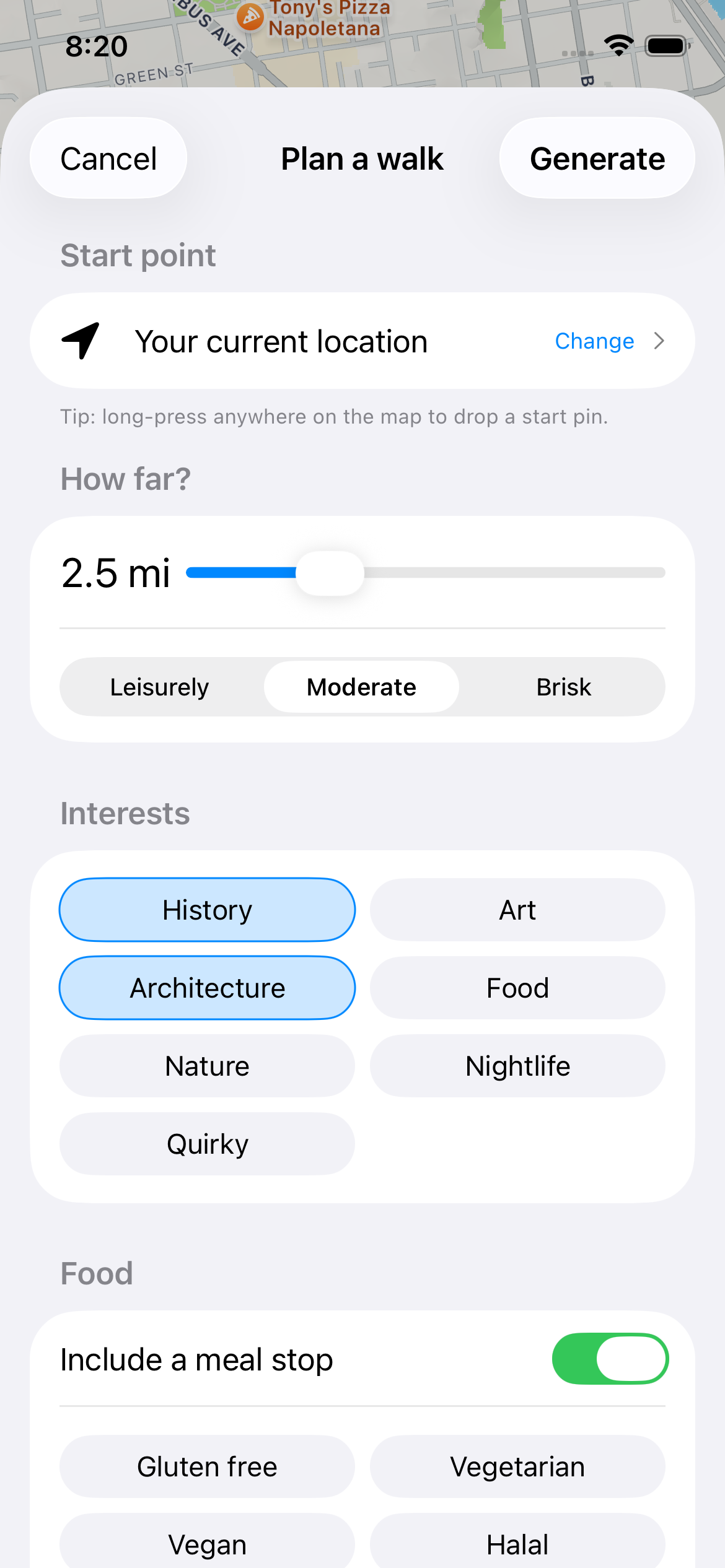
At each stop, the Mosey app surfaces historical context pulled from real record — city archives, oral histories, and the kind of detail that a passing glance at a historical marker won't give you. You don't need to research anything in advance. Just start walking, and let the app tell you what you're standing in front of.
The Tremé Route, Stop by Stop
"In the 18th and early 19th centuries, this open ground just outside the old city ramparts was where enslaved and free Black people gathered on Sundays — one of the only days off permitted under the Code Noir — to drum, dance, trade, and sing in traditions carried from West and Central Africa. Visitors and city officials documented the gatherings, and the rhythms and call-and-response patterns heard here are widely credited by musicologists as a root of American jazz, blues, and gospel. The square fell out of formal use by the later 1800s but was never forgotten by the community around it. The park surrounding it today, dedicated to Louis Armstrong in 1980, sits on the same ground."
Enter through the N Rampart St gate; the park is free and opens at 6am. Look for the informational markers near the actual square footprint, not just the Armstrong statue, and go early to avoid both heat and the homeless encampments that sometimes populate the shadier corners later in the day.
"Founded in 1841, St. Augustine is the oldest African American Catholic parish in the United States, built through fundraising by free people of color who literally out-purchased white parishioners for pews in what became known as the 'War of the Pews.' Free Black Creoles bought extra pews for enslaved people to sit with them, integrating the church from its opening. The Tomb of the Unknown Slave, a monument of chains and crosses outside the church, was dedicated in 2004 to honor enslaved people buried in unmarked graves nearby."
The church is at 1210 Governor Nicholls St; Mass schedules and occasional gospel jazz services are posted outside. If the doors are open, step in quietly to see the interior — otherwise the Tomb of the Unknown Slave memorial in the side yard is visible from the sidewalk anytime and worth the stop on its own.
"Founded by Sylvester Francis in 1999 inside a former funeral home, the Backstreet Cultural Museum holds one of the country's most complete collections of Mardi Gras Indian suits, Social Aid and Pleasure Club regalia, and jazz funeral memorabilia. Francis spent decades photographing and filming Tremé's second lines and Indian gatherings before turning his footage and collection into a public archive. The museum has moved locations more than once since Francis's death in 2020, so it's worth confirming the current address before you go."
Check the museum's current hours and address online before setting out, since it has relocated within Tremé in recent years; admission is typically a modest suggested donation. Budget real time here — the hand-beaded suits take a while to look at closely, and the staff often have stories about specific pieces if they're not busy.
"This stretch of St. Philip Street and the surrounding blocks housed generations of working musicians — sidemen, brass band members, and Mardi Gras Indian chiefs — whose names rarely made national headlines but whose playing shaped what New Orleans music sounds like today. The shotgun houses here are modest by design, built cheaply and efficiently for a working population, yet many still stand largely unchanged from the early 20th century. This isn't a block of museums or monuments; it's simply where the music was made, day to day, by people going to work."
There's no single marker here — this is a stretch to slow down and look at the architecture and porches rather than hunt for a specific address. Respect that these are private residences; observe from the sidewalk rather than lingering directly in front of any one house.
"Henriette Delille, a free woman of color born in New Orleans in 1812, founded the Sisters of the Holy Family in 1842, one of the first Catholic religious orders for women of color in the United States, dedicated to educating and caring for enslaved and free Black residents when doing so was legally and socially fraught. The street bearing her name runs through the neighborhood she served. Delille's cause for sainthood was opened by the Catholic Church, and she now holds the title 'Venerable,' a step toward canonization."
The street itself is the point of interest rather than a single building — walk a block or two and note the street signage and any parish bulletins referencing her order, which is still active today under the Sisters of the Holy Family in New Orleans.
"Run out of a modest storefront by musician and historian Al Jackson, this small, independently operated museum focuses tightly on Tremé's specific contribution to jazz's early development, using photographs, instruments, and firsthand narration rather than a large curated collection. It exists explicitly as a counterpoint to larger, more polished jazz museums elsewhere in the city, insisting that Tremé's role be told by people from the neighborhood itself. Hours are limited and often depend on Jackson's availability."
Call ahead or check current hours before planning around this stop, since it operates on a smaller, less predictable schedule than city-run museums. If it's closed when you pass, the exterior signage still gives useful context, and it's worth circling back later in your trip if the timing doesn't work today.
"Lil' Dizzy's Cafe, run by the Baquet family — part of a New Orleans restaurant lineage stretching back generations — has served Creole soul food to Tremé residents, musicians, and out-of-town visitors alike since opening in this location in 2005. It's a favorite stop for political figures and musicians passing through the neighborhood, and the fried chicken and bread pudding have built a loyal local following independent of any tourist traffic. The dining room is unpretentious, with a buffet line at lunch and table service that leans warm rather than fast."
Located at 1500 Esplanade Ave, right at the edge of Tremé; the lunch buffet (served until early afternoon) is the best value and a good way to sample several dishes at once. Go before 1pm on weekdays to avoid the heaviest crowds, and expect cash to be useful even though cards are accepted.
Planning Your Walk: Practical Tips
Best time to walk: August in New Orleans means high heat and humidity, often above 90°F with afternoon thunderstorms. Start early, before 9am, and carry water — there's little shade until you're deep into the residential blocks.
Shoes: Sidewalks are uneven in places with cracked concrete and occasional missing slabs; comfortable walking shoes are worth it over sandals.
The narration: At each stop, Mosey surfaces short historical narration drawn from city archival records, oral histories, and documented accounts of the musicians and community leaders tied to that exact address.
Walk Tremé at Your Own Pace
Open the Mosey app to follow this exact route with GPS-guided directions and on-site narration at every stop — no printouts, no guesswork.
Download on the App Store — Free