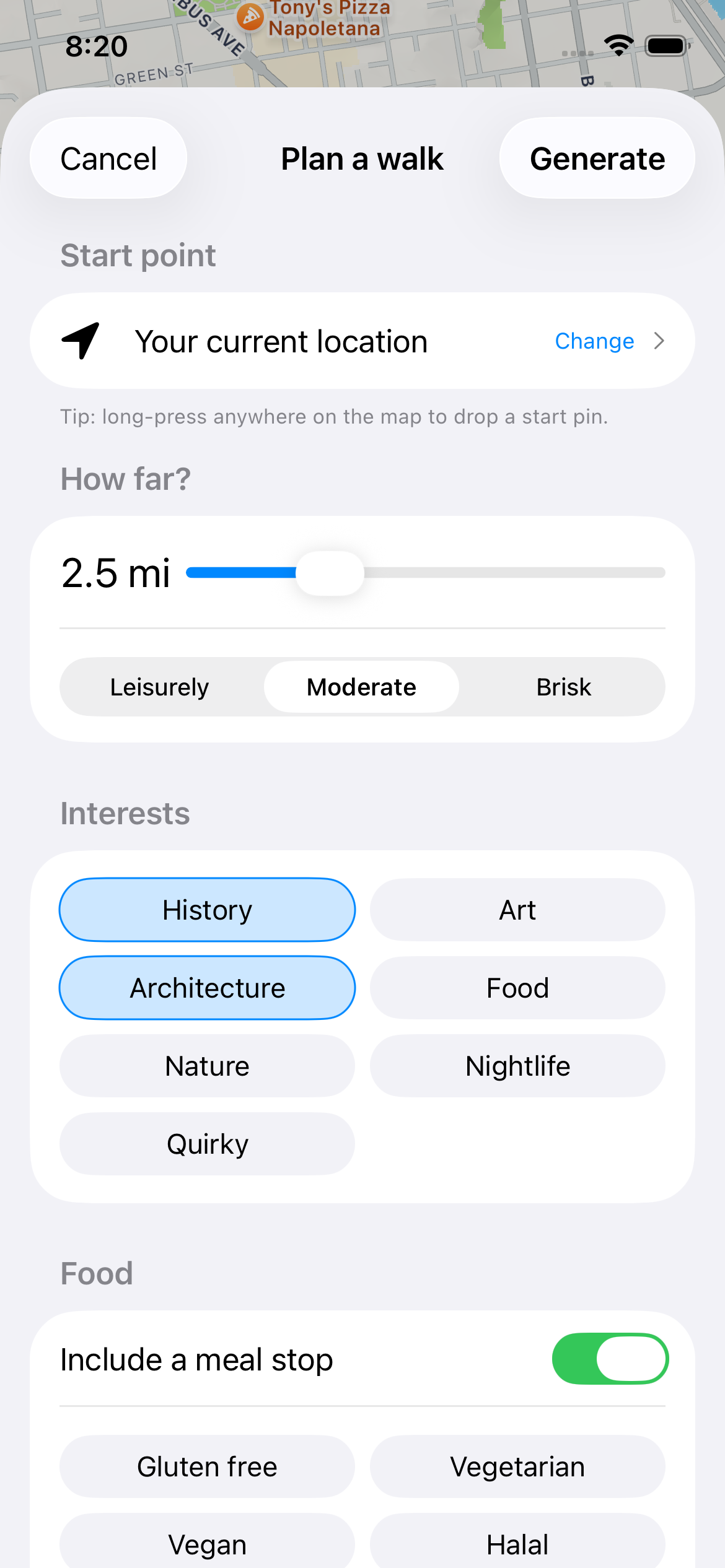
I've been to New Orleans three times and each trip I've done roughly the same thing: wandered into the French Quarter, felt overwhelmed, ducked into a bar, and left feeling like I'd only scratched the surface. Last fall I tried something different. I opened the Mosey app, set my distance to 2.5 miles, checked "History" and "Architecture," and let it plan the whole thing.
What it built stopped me at places I'd walked past a dozen times without knowing what they were. The narration played in my earbuds as I approached each stop — full Wikipedia-sourced history, not the boosterish summary you get from a tourist pamphlet. I ended with beignets and felt like I'd actually been to New Orleans for once.
Here's the exact route Mosey planned, with the narration for each stop, so you can walk it yourself with or without the app.
The Route
"Jackson Square was laid out in 1718 as the Place d'Armes, a military parade ground for the young French colony. The square takes its current name from the bronze equestrian statue at its center, cast in 1856 — one of the first equidistant bronze statues in the world, depicting General Andrew Jackson tipping his hat toward St. Louis Cathedral. The cathedral itself, rebuilt in 1794 after a devastating fire, is the oldest continuously active Roman Catholic cathedral in the United States."
The square is the natural starting point for any French Quarter walking tour. Stand with your back to the river and take in the whole scene: the cathedral straight ahead, the Cabildo on your left, the Presbytere on your right, and the Pontalba Buildings — the oldest apartment buildings in the United States — framing both sides. Mosey prompted me to look up at the wrought-iron "AP" monogram worked into the Pontalba ironwork: the initials of Micaela Almonester, Baroness de Pontalba, who commissioned the buildings in 1849.
"The Cabildo served as the seat of Spanish colonial government in Louisiana before becoming the scene of one of American history's most consequential real estate transactions. On December 20, 1803, in the Sala Capitular on the second floor, French Prefect Pierre Clément de Laussat formally transferred control of Louisiana to American commissioners William C. C. Claiborne and General James Wilkinson. The Louisiana Purchase, negotiated in Paris for approximately 15 million dollars, had effectively doubled the size of the United States."
The Louisiana State Museum runs the Cabildo now. Admission is around $9. The Napoleon death mask inside — cast from his face two days after he died on St. Helena in 1821 — is more unsettling in person than it sounds. Worth it.
"Completed around 1752, the Old Ursuline Convent is the oldest surviving building in the Mississippi River Valley and the oldest building in the continental United States to survive intact in its original form. The Ursuline nuns arrived in New Orleans in 1727 at the invitation of the French Company of the Indies, tasked with running the colony's hospital and establishing a school for girls — the first girls' school and the first institution of higher learning for women in what would become the United States. The convent's thick brick walls — remarkably, the same bricks laid more than 270 years ago — survived every hurricane, fire, and flood the city threw at them."
Walk the half-mile down Chartres Street from Jackson Square and you'll find the convent standing quietly behind its iron gate. Tours run Tuesday through Friday; the garden alone is worth the walk even if you don't go inside.
"Built sometime before 1772, this crumbling Creole cottage at 941 Bourbon Street is believed to be one of the oldest bar structures in North America still operating as a drinking establishment. The building predates the Louisiana Purchase by more than three decades. According to local legend — emphasis on legend — the pirate Jean Lafitte and his brother Pierre used the blacksmith shop as a front for their smuggling operations in the early 1800s. What's documented is that Lafitte became a complicated American hero: a privateer who helped Andrew Jackson defend New Orleans against the British in the War of 1812, then returned to piracy afterward."
This is Bourbon Street, so you'll be running a gauntlet of daiquiri bars and bachelor parties to get here. It's worth it. The interior is candlelit even in the afternoon, the walls are genuine 18th-century brick, and you can get a Hurricane for $9. Order one, find a dark corner, and consider the fact that Jean Lafitte may have stood in this exact spot.
"Royal Street served as the commercial heart of colonial New Orleans — lined with the counting houses and mansions of wealthy Creole merchants, bankers, and lawyers who preferred to conduct business in French. By the mid-19th century it had become known for antique dealers, a reputation it still holds. The ornate ironwork balconies you see on Royal Street were added during the Spanish colonial period, replacing earlier wooden galleries; New Orleans ironwork became so distinctive that architects from other cities began importing New Orleans craftsmen specifically for their decorative balcony skills."
Walking up Royal Street is the best free thing in the French Quarter. The galleries are browsable without any obligation to buy. Mosey flagged the Historic New Orleans Collection at 533 Royal — free admission, rotating exhibits, an excellent research library if you're the kind of person who wants to know more after a walking tour.
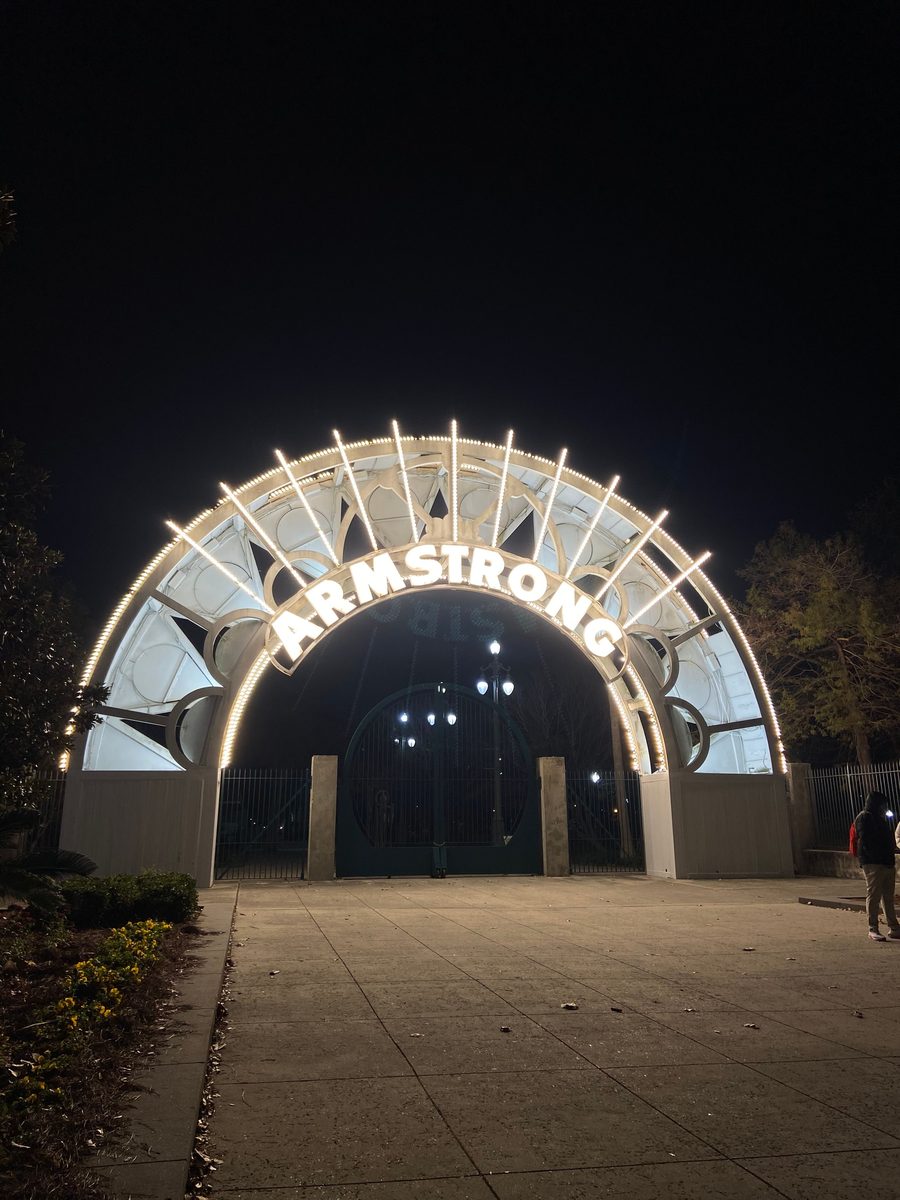
"Louis Armstrong Park sits at the edge of the French Quarter on the site of what was once the Tremé, one of the oldest African American neighborhoods in the United States. At its center lies Congo Square, where, during the French and Spanish colonial periods, enslaved Africans were permitted to gather on Sundays to sing, dance, trade, and perform music. This gathering was permitted nowhere else in North America at the time. Musicologists trace the genesis of jazz, blues, and much of American popular music to the rhythmic and cultural traditions preserved and transformed in Congo Square. The park is named for Louis Armstrong, who was born in the Tremé in 1901 and became the most influential jazz musician in history."
The park entrance is just past Rampart Street on St. Peter — a five-minute walk from the top of Royal Street. The bronze statue of Armstrong at the entrance is photogenic but the real stop is the Congo Square marker inside: a simple granite slab that carries the weight of an enormous piece of American cultural history.
"Café Du Monde has operated on this spot at the edge of Jackson Square since 1862, making it one of the oldest continuously operating coffee stands in the United States. The café serves exactly two things: café au lait — half strong chicory coffee, half scalded milk — and beignets, the pillowy French-style fried doughnuts buried under a snowstorm of powdered sugar. The café is open 24 hours a day, every day of the year except Christmas."
Mosey looped me back to the river end of Jackson Square for my meal stop, which is perfect route logic — you end where you started, you're already hungry from 2+ miles of walking, and there is genuinely no better way to close a French Quarter tour than with beignets and an iced café au lait under the green-and-white awning while street performers work the square. Powdered sugar will destroy your shirt. This is expected and accepted.
What to Know Before You Go
Best time to walk: Early morning (8–10 AM) is dramatically better. The French Quarter gets brutally crowded and loud by noon, especially on weekends. The light is also better for photos and it's significantly cooler in summer months.
Weather: New Orleans summers are genuinely brutal — high humidity, heat indexes above 100°F by midday. If you're visiting June through September, start early and bring water. The route is entirely flat (New Orleans is very flat) and mostly shaded by buildings, which helps.
Shoes: The French Quarter's sidewalks are notoriously uneven — buckled by tree roots, patched decades ago and never re-patched. Wear comfortable shoes and watch your step.
The narration: All six narration blocks above are what Mosey read to me through my earbuds as I approached each stop. It pulls from Wikipedia and synthesizes it into something useful — not just what a place is, but why it matters. Having that context in your ears right when you're standing in front of a building changes the experience.
Generate Your Own French Quarter Tour
Mosey builds personalized walking tours wherever you are. Set your distance, pick your interests, and it handles the rest — real venues, historical narration, and a meal stop included.
Download on the App Store — FreeOther French Quarter Walking Tours Worth Knowing
If you want more depth on specific topics, these itineraries complement the Mosey route well:
- The Garden District is a 30-minute streetcar ride away and deserves its own half-day — antebellum mansions, above-ground cemeteries, and Magazine Street. Mosey builds a great route there too.
- The Tremé (just across Rampart from the French Quarter) is the oldest African American neighborhood in the country and the cradle of jazz. A separate Mosey tour through Tremé unlocks a completely different side of the city.
- If you want a ghost tour or crime history angle, Mosey's "Hidden Gems" interest filter tends to surface the darker history naturally — the LaLaurie Mansion on Royal Street, for instance, didn't come up on my History+Architecture filter but shows up prominently on Hidden Gems.
The French Quarter is dense enough that you could walk it a dozen times with different interest filters and get a different tour each time. That's sort of the point.