New Haven's Downtown and Yale campus sit on top of each other in a way few American college towns manage. You can stand on the New Haven Green, laid out in 1638, and see a Gothic Revival tower built in the 1930s to look 300 years older than it is, next to a Beinecke Library that looks like it landed from another century entirely. This walk threads the two together: the Puritan grid of the original nine squares, the university's collegiate Gothic building boom of the 1920s and 30s, and the Brutalist experiments the city and Yale both tried out mid-century.
The route starts at the Green, cuts through the Old Campus and Yale's central quads, passes the Beinecke and Sterling Memorial Library, and finishes at Louis' Lunch, the tiny brick building that claims to have invented the hamburger sandwich in 1900. None of it requires a car. Sidewalks are wide, crossings are well marked, and almost everything sits within a few blocks of Chapel and College Streets.
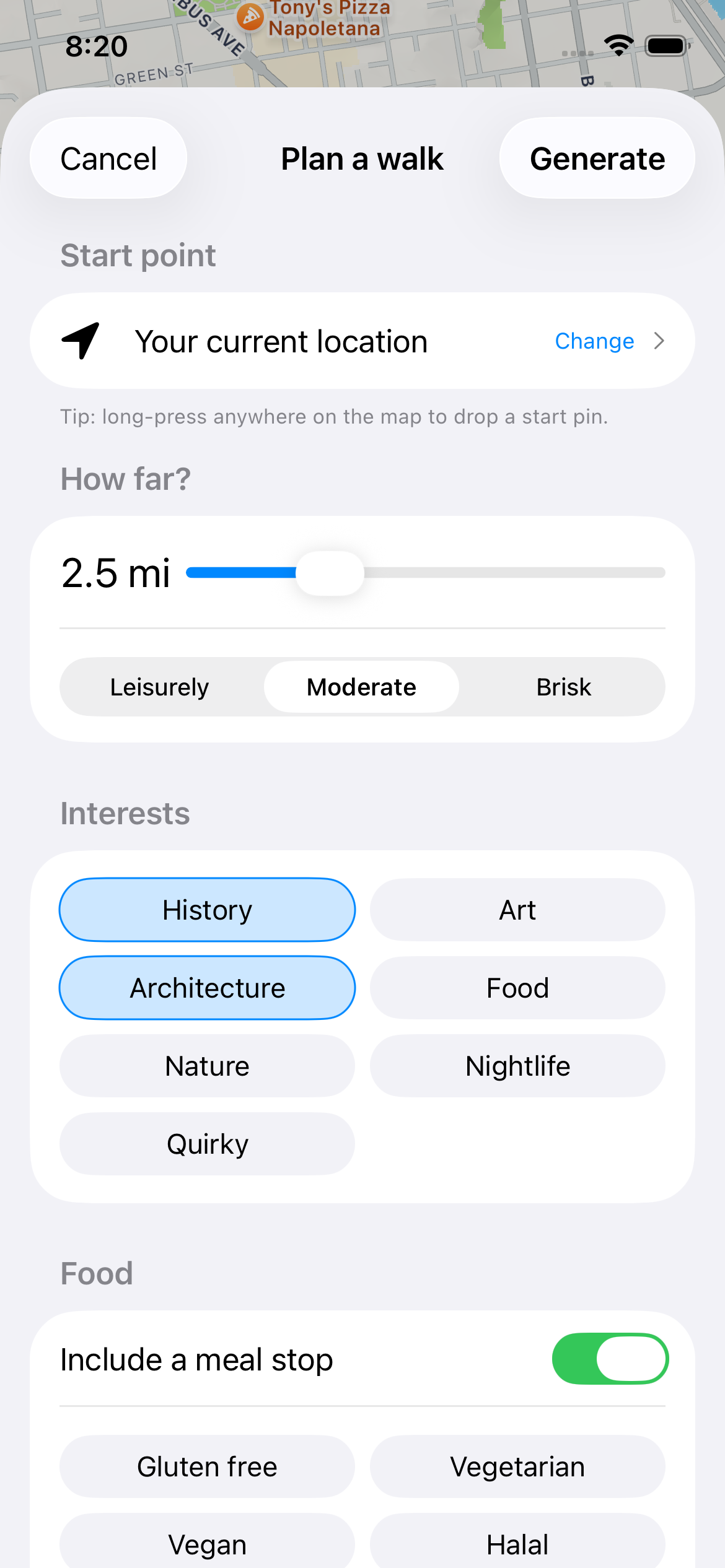
Mosey lays out the stops in order and surfaces the historical context as you reach each one, so you're not standing on a corner squinting at a plaque or scrolling through a PDF walking-tour brochure. It's built for exactly this kind of walk: dense with buildings that have real dates and real architects attached, close enough together that you can do the whole thing in an afternoon.
The Route: Green to Gothic to Grill
"Laid out in 1638 by the Puritan founders of the New Haven Colony as the center square of a nine-square grid, the Green is one of the oldest planned public spaces in the country. Three churches from the early 1800s still stand on it: Center Church (1814), Trinity Episcopal (1816, one of the first Gothic Revival buildings in America), and United Church (1815). Beneath Center Church sits a crypt with roughly 137 gravestones dating back to the 1680s, remnants of the colony's original burying ground."
Walk the perimeter before cutting across — the three churches line up along Temple Street and are easy to miss if you cross diagonally. The Center Church crypt is open for tours seasonally for a small fee; check the schedule before counting on it.
"Old Campus is where Yale housed its earliest classes and still houses first-year students today. Connecticut Hall, completed in 1752, is the oldest surviving building on campus and one of the few Georgian college buildings left in New England; Nathan Hale lived in it as a student. The rest of the quad is a patchwork of late-19th and early-20th century construction, including Wright Hall (1912) and Vanderbilt Hall (1894), giving the yard a mix of Victorian Gothic and Beaux-Arts detail rather than one uniform style."
Enter through the Phelps Gate arch on College Street — it's the most photographed entrance and gives you the full sightline down the quad. Connecticut Hall is not generally open to the public, but you can walk right up to it.
"Built in 1921 and designed by James Gamble Rogers, Harkness Tower rises 216 feet and was deliberately built to look centuries old, using a technique Rogers called 'Collegiate Gothic' — new stone carved and weathered to mimic Oxford and Cambridge. It was funded by Anna Harkness in memory of her son Charles, a Yale graduate and Standard Oil heir. The 54-bell carillon inside is still played by student guilds today."
Stand in Branford Courtyard, just off High Street, for the best view straight up the tower. You can't go inside without a student escort, but the carillon is sometimes audible from the courtyard around class-change times.
"Completed in 1963, the Beinecke was designed by Gordon Bunshaft of Skidmore, Owings & Merrill and is sheathed in translucent Vermont marble panels just over an inch thick, which glow amber from sunlight and go dark gray on overcast days. The building holds a Gutenberg Bible and one of the largest Audubon 'Birds of America' collections in the country. Its below-ground book stack, visible through glass in the central tower, holds roughly 180,000 volumes."
Free and open to the public most days; check hours before you go since it closes for university holidays. The exterior alone is worth the stop even if the reading room is closed — walk the sunken courtyard around it to see the marble from different angles.
"Sterling Memorial opened in 1930, also designed by James Gamble Rogers, and was built to resemble a cathedral — the main entrance hall is nicknamed the 'nave.' It was funded by a bequest from John William Sterling, an 1864 Yale graduate and corporate lawyer whose estate also paid for Sterling Law Building and Sterling Hall of Medicine. The library holds over 4 million volumes and is Yale's largest library building."
Walk into the entrance hall to see the ceiling murals and the circulation desk, styled like an altar. It's a working library with students studying, so keep voices down — this isn't a museum stop.
"Founded in 1832, it's the oldest university art museum in the Western Hemisphere. The 1953 addition, designed by Louis Kahn, was his first major commission and introduced the tetrahedral concrete ceiling technique he'd reuse throughout his career. The collection includes van Gogh's 'The Night Café' and one of the country's better collections of American decorative arts."
Admission is free, every day it's open. Go straight to the Kahn wing (the newer-looking concrete building on Chapel Street) even if you only have twenty minutes — the ceiling and staircase are the real draw architecturally.
"Chapel Street between College and Church has been New Haven's main commercial strip since the 19th century, and much of the building stock dates from the 1870s through 1920s — cast-iron storefronts, pressed-tin cornices, a mix of Italianate and early 20th-century commercial styles. The Shubert Theatre, opened in 1914 a block south on College Street, was known as 'the birthplace of the nation's greatest hits' for hosting pre-Broadway tryouts of shows like 'Oklahoma!' and 'A Streetcar Named Desire.'"
Look up — most of the architectural detail on this stretch is above the storefront signage, at cornice level. It's a good stretch for browsing bookstores (Atticus Bookstore & Café has been here since 1975) if you want a break before the last stop.
"Louis' Lunch opened in 1895 and moved to its current brick building at 261-263 Crown Street in 1975. The Lassen family, who still runs it, has claimed since the early 1900s that Louis Lassen invented the hamburger sandwich here in 1900 by pressing ground beef trimmings between two slices of toast for a customer in a hurry. The Library of Congress has recognized the claim, though it's disputed by other cities with their own origin stories. Burgers are still cooked in the original vertical cast-iron grills, some of which date to the early 1900s."
Cash or local checks only, no credit cards, and don't ask for ketchup — it's not on the menu and the staff will tell you so. Cheese, tomato, and onion are the only toppings offered. It closes early (usually mid-afternoon) and is shut Sundays and Mondays, so check hours before you plan your walk around it.
Planning Your Walk
Best time to walk: New Haven falls in September is mild, usually 55–75°F, with occasional rain off Long Island Sound. Early fall is peak season for campus visits, so weekday mornings before 11am are noticeably less crowded than weekend afternoons.
Shoes: Flat and paved throughout — brick sidewalks and cobblestone sections around the Old Campus courtyards are the only uneven ground. Regular sneakers are fine.
The narration: At each stop, Mosey surfaces the specific year, architect, and documented history behind the building in front of you, rather than generic background on Yale or New Haven as a whole.
Walk Downtown New Haven and Yale with Mosey
Get turn-by-turn stops and historical context delivered right when you need it — no PDF maps, no guesswork about which gate to walk through.
Download on the App Store — FreeFrequently asked questions
Is Downtown New Haven and the Yale campus walkable?
Yes. Downtown New Haven and the Yale campus form a compact, flat grid where nearly every landmark sits within a few blocks of the New Haven Green. Sidewalks are wide, crossings are signaled, and most visitors can cover the core sights — Old Campus, Harkness Tower, the Beinecke, Sterling Library — in under three hours on foot.
How long does it take to walk a self-guided tour of Yale and Downtown New Haven?
Plan on 2 to 3 hours for a 2-mile route covering 8 stops, including time inside the free Yale University Art Gallery and Beinecke Library. Add 30 minutes if you're eating at Louis' Lunch, which can have a short wait around noon.
Can you go inside Yale's buildings without being a student?
Some, yes. Sterling Memorial Library, the Beinecke Rare Book Library, and the Yale University Art Gallery are all open to the public free of charge. Residential colleges and dorms, including Connecticut Hall and the interior of Harkness Tower, are generally restricted to students and require an escort or campus tour.
Is parking difficult near the New Haven Green?
Metered street parking exists on Chapel, Church, and College Streets but fills up on weekdays. The Temple Street Garage and the Crown Street garages are the most reliable options within walking distance of the Green and both Yale and downtown restaurants.
What is the best time of day to walk this route?
Weekday mornings, roughly 9 to 11am, before student foot traffic peaks and before tour groups arrive at the art gallery and library. Late afternoon light works well for photographing the Beinecke's marble panels, which shift color with the sun.
Did the hamburger really get invented in New Haven?
That's Louis' Lunch's claim, dating to 1900, and the Library of Congress has credited Louis Lassen with the invention. Other cities, notably Hamburg, New York and Athens, Texas, dispute this. What's not disputed is that Louis' Lunch has operated continuously since 1895 and still grills burgers vertically in cast-iron grates.
More New Haven Neighborhoods to Explore
New Haven rewards more than one walk. The Wooster Square neighborhood, a few minutes east of downtown, pairs Greek Revival rowhouses from the 1830s with the city's Little Italy and its long-running bakery rivalry over coal-fired pizza. East Rock offers a steeper, more residential walk up to the East Rock Park summit for a skyline view over the whole city and harbor. Mosey can lay out either as its own self-guided route with the same kind of stop-by-stop historical context used here.