The Gulch is Nashville's most dramatic urban turnaround story. What is now a dense grid of boutique hotels, galleries, and restaurants was, for most of the twentieth century, a working rail yard and light-industrial corridor wedged between downtown and the emerging neighborhoods to the south. The Louisville & Nashville Railroad operated through this corridor for decades, and the land sat largely vacant or derelict well into the 1990s. The neighborhood's renaissance began in earnest in the early 2000s and accelerated fast enough that in 2011 The Gulch became the first LEED-ND Platinum certified neighborhood in the United States — a designation recognizing sustainable, walkable urban design. That combination of industrial bones, rapid reinvention, and genuine commitment to public art makes it one of the most rewarding walks in the city.
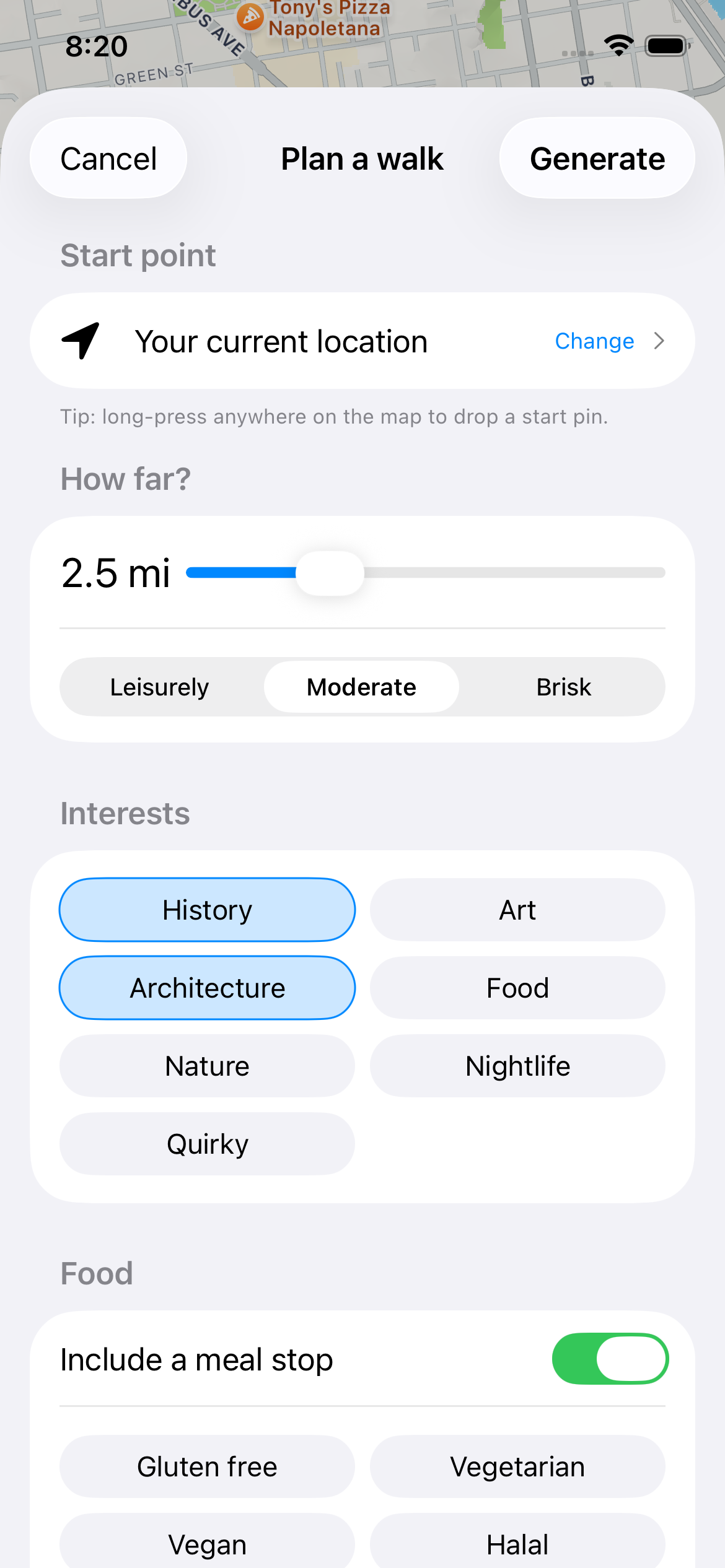
This self-guided tour, built with Mosey, moves through the heart of the neighborhood in roughly 1.5 miles. You'll start at the iconic Wings mural on Pine Street, work through the micro-grid of streets where murals appear on nearly every blank wall, pause at the historic rail infrastructure that explains where all of this came from, and finish with a meal at one of the neighborhood's anchor restaurants. The route is compact and flat, which means you can move at a genuine stroll and spend real time at each stop rather than rushing between them.
The Gulch rewards visitors who look up, look down, and look around corners. The density of commissioned public art here is genuinely unusual for a neighborhood this young — it didn't happen by accident, and Mosey surfaces the stories behind both the artists and the property owners who made wall space available. Come hungry, and plan to linger.
The Route: 6 Stops Through The Gulch
"The angel wings mural on Pine Street is among the most photographed pieces of public art in Tennessee. It was created by Nashville-based artist Kelsey Montague in 2015 as part of her #WhatLiftsYou series, a global project placing interactive wing murals in cities from New York to Hong Kong. Montague's signature style fills the wings with intricate illustrative detail — hummingbirds, flowers, musical notes — all of it specific to Nashville's identity as a music city. The mural is interactive by design: standing between the wings completes the image, which is why the line for photos rarely disappears entirely."
Position yourself dead center between the wings and have your photographer step back about 15 feet for the full effect. The mural faces east, which means morning light hits it directly — ideal for photos before 10am. There's no fee to visit and no ticketing; the wall is on private property but publicly accessible at street level.
"Cummins Station at 209 10th Avenue South is one of the oldest surviving structures in The Gulch and one of Nashville's finest examples of industrial-era commercial architecture. Built in 1907 as a produce warehouse and cold-storage facility serving the adjacent rail yards, the building is a massive Romanesque Revival brick structure covering nearly a full city block. It was designed to receive, store, and distribute goods arriving by rail from across the South. By the late twentieth century it had been converted to office and creative-industry use, and it now houses music industry companies, tech firms, and studios — a fitting transition for a neighborhood that traded freight for culture."
Walk the full perimeter if you have time — the building's scale only becomes clear from the 11th Avenue side. The ground-floor lobby is generally accessible during business hours and worth a quick look for the original exposed brick and timber framing. You're not paying to enter, and nobody will stop you from walking through.
"The cluster of murals around 10th Avenue South and Pine Street represents the organic accumulation of commissioned work that has defined The Gulch's identity as Nashville's de facto outdoor gallery. Unlike a formal public art program, much of the work here was commissioned directly by building owners and developers as part of a broader neighborhood branding effort that began accelerating after The Gulch received its LEED Platinum certification in 2011. Artists including local Nashville muralists and nationally recognized figures have contributed work here, and the walls turn over occasionally as new commissions replace older pieces — meaning the specific murals you see may differ from any photograph taken more than a year or two ago."
Walk slowly and check the narrow passages between buildings, not just the main-street walls — some of the most interesting work is tucked into alleys. Bring your phone charged; this is the densest photo opportunity on the route. None of the murals are behind any kind of barrier or entry point.
"The aging rail infrastructure visible along the southern edge of The Gulch is a direct remnant of the Louisville & Nashville Railroad operations that defined this corridor for roughly a century. The L&N Railroad, chartered in 1850 and completed between Louisville and Nashville by 1859, was one of the most strategically important rail lines in the Civil War South — Union forces prioritized capturing and holding it, and Confederate forces repeatedly attempted to sabotage it. After the war the line became a major freight artery, and the rail yards that occupied what is now The Gulch were a hub for agricultural and manufactured goods moving through Middle Tennessee. The surviving trestle and trackage serve as the neighborhood's most tangible connection to that industrial past."
You can view the trestle from street level along the southern edge of the neighborhood without any special access. It's not a formal attraction — no signage, no entry point — but it's worth pausing here to understand the physical reason The Gulch exists where it does. The contrast between the weathered infrastructure and the surrounding new construction is stark.
"Icon in the Gulch, the mixed-use residential tower at 600 12th Avenue South, was one of the first major residential developments to signal that The Gulch was becoming a genuine live-work neighborhood rather than just an entertainment district. Completed in 2008, it was developed by MarketStreet Enterprises, the firm most responsible for the neighborhood's LEED Platinum certification and the coordinated public art program that followed. The building's ground-floor retail and plaza level were designed explicitly to activate street life — a deliberate choice at a time when Nashville had limited experience with urban mixed-use development at this scale."
The plaza level is publicly accessible and worth a slow circuit to see the commissioned art installations at grade. The surrounding blocks on 12th Avenue South have become the neighborhood's most walkable retail corridor — independent boutiques and coffee shops cluster here and are worth exploring if you have time before or after the meal stop.
"Whiskey Kitchen at 118 12th Avenue South opened in 2010 as one of the earliest full-service restaurants to anchor The Gulch's transition from a desolate rail corridor to a dining destination. The restaurant is operated by M Street Entertainment Group, a Nashville hospitality company that recognized The Gulch's potential before most of the neighborhood's current development existed. The menu is built around Southern American comfort food and, as the name suggests, an extensive American whiskey program — Tennessee and Kentucky bourbons feature prominently on a list that runs well over a hundred selections. The space itself occupies a ground-floor commercial unit in a purpose-built structure and has a covered patio that faces 12th Avenue."
The patio is the move in good weather — it puts you directly on the neighborhood's main pedestrian corridor and is a fine place to watch the Gulch in motion. Reservations are accepted and recommended for dinner; lunch is generally walk-in friendly. The burger and the pimento cheese are menu staples that have been there since opening and remain worth ordering.
Planning Your Gulch Walk
Best time to walk: Nashville summers are hot and humid — June temperatures routinely reach the low 90s°F with high dewpoints. Start this walk before 10am or after 5pm to avoid peak heat. The route is almost entirely exposed, so bring water and sunscreen. The Gulch has no significant shade canopy.
Shoes: The Gulch is flat, paved, and pedestrian-friendly throughout. Sneakers or comfortable walking shoes are all you need — no uneven terrain or elevation.
The narration: Mosey surfaces neighborhood history, artist biographies, and architectural context at each stop, so you arrive knowing what you're looking at and why it matters.
Walk The Gulch with Mosey
Mosey turns this route into a guided experience in your pocket — tap each stop for deeper history, artist context, and neighborhood stories as you walk. Build your own tour or follow this one at moseytourbuilder.com.
Download on the App Store — FreeOther Nashville Neighborhoods Worth Walking
If The Gulch leaves you wanting more Nashville on foot, Mosey has routes for several neighboring areas worth exploring. 12 South, immediately south of The Gulch along 12th Avenue, offers a lower-key strip of independently owned shops, coffee roasters, and restaurants in a residential context that feels like a different city entirely from the Gulch's high-rise density. Downtown Nashville and the Printer's Alley district are a short rideshare north and cover the city's entertainment history from honky-tonks to the original Grand Ole Opry location. Germantown, across the Cumberland River to the north, is Nashville's oldest neighborhood and offers a quieter, more residential walk with excellent restaurants and a farmers market anchoring the weekend experience.