The Historic Third Ward is Milwaukee's old warehouse district, and it still looks like one. Five- and six-story brick buildings with heavy timber frames and loading docks line streets that were laid out for freight wagons, not tourists. What makes it worth walking isn't a single monument — it's the density of intact commercial architecture from the 1880s and 1890s, almost all of it built after a fire wiped out the previous neighborhood in 1892, and almost all of it converted since the 1980s into galleries, studios, restaurants, and condos without losing the bones of what it was.
This route runs from the edge of the district near the river down through its commercial spine on Milwaukee and Broadway Streets, into the Milwaukee Public Market, and out toward the RiverWalk. You'll see cream city brick, cast-iron storefronts, and the scale shift from wholesale grocers' warehouses to the tanneries and light-industrial buildings that anchored this part of town for a century. It's a walk best done slowly, looking up — most of what's interesting here is on the upper floors, in the cornices and the painted ghost signs, not at street level where the storefronts have all changed.
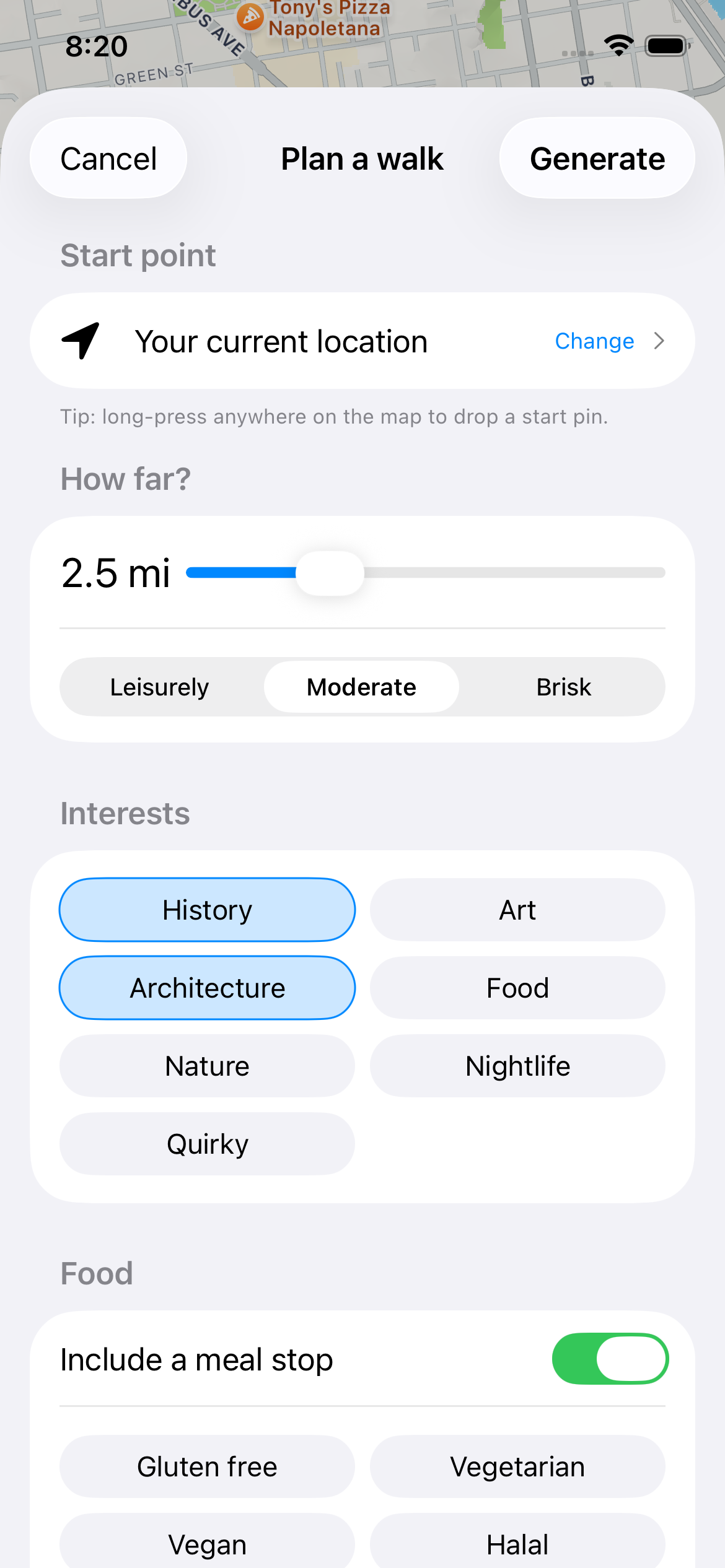
Mosey built this route to move you through the district in a logical loop rather than a straight line, so you're not backtracking on the same block twice. Each stop below includes the kind of context — building dates, architects, what a place used to be before it was what it is now — that the app surfaces when you're standing in front of it, so you're not guessing at what you're looking at.
The Route: Brick Warehouses to the River
"The Third Ward burned almost entirely in the Great Third Ward Fire of October 1892, which destroyed roughly 440 buildings in a neighborhood then packed with Irish immigrant tenements and small businesses. What rebuilt over the following two decades was different: brick and stone warehouses for the wholesale grocery, dry goods, and produce trade, since the area sat close to the rail lines and the harbor. The district was added to the National Register of Historic Places in 1984, which is what protected the building stock you're about to walk through."
Start here to get oriented before the architecture gets dense a block south. There's no formal marker plaque at every corner, so use this stop as a mental baseline for the fire-and-rebuild story that explains the uniform late-19th-century look of the whole district.
"Technically just outside the Third Ward's southern edge on Michigan Street, the Mackie Building at 225 E. Michigan St. is worth the short detour for its cast-iron front, a rare surviving example in Milwaukee of the prefabricated iron facades popular in the 1870s and 80s. It was built in 1879 and originally housed the Chamber of Commerce, with an elaborate iron colonnade cast to look like carved stone. Cast iron was cheaper and faster to install than masonry, which is why grain and produce merchants favored it for street-level storefronts."
Stand across the street to see the full iron front — up close it's easy to miss that the columns and cornice detail are metal, not stone. This is a quick five-minute look before doubling back into the core of the district.
"Broadway between Chicago and St. Paul Streets is the most intact stretch of Cream City brick warehouse architecture in the district, built largely between 1890 and 1910 for wholesale grocers, produce dealers, and the tanning trade that gave nearby streets their industrial character. Cream city brick, made from a clay deposit unique to the Menomonee River valley, fires to a pale yellow rather than red, and it's the material that gives so much of 19th-century Milwaukee its distinct look. Many of these buildings have segmental-arch windows and heavy loading bays at street level, evidence of their original use for freight rather than foot traffic."
Walk slowly here and look above the storefronts — the ground floors have all been remodeled for retail, but the upper three or four floors are largely original brickwork and window openings. Late morning on a weekday gives the best light for photographing the brick without heavy shadow.
"The Marshall Building at 207 E. Buffalo St. was built in 1912 for the Germania Publishing Company's press operations and later used for light manufacturing before sitting mostly vacant by the 1970s, a common fate for Third Ward warehouses once wholesale trade moved out of downtown. Developer redevelopment beginning in the late 1980s converted buildings like this one into studio and gallery space, which is part of why the Third Ward became Milwaukee's arts district starting in that era. Its heavy timber-and-brick construction, built for the weight of printing presses, is now load-bearing for artist studios instead."
You can usually walk into the lobby during business hours to see the original freight elevator and timber columns; there's no fee. Check the ground-floor gallery listings posted near the entrance, since several rotate monthly.
"The Milwaukee Public Market opened in 2005 at 400 N. Water St., built new but designed to echo the district's warehouse forms, with steel trusses and large industrial windows referencing the buildings around it. It houses around a dozen permanent vendors selling everything from Wisconsin cheese to fresh seafood to coffee, modeled loosely on public markets like Seattle's Pike Place. It sits at the edge of the RiverWalk, on the site of former rail and produce-market land that connected the Third Ward to river shipping in the 19th century."
Go for a snack or coffee here rather than a full sit-down meal — vendors are counter-service and it gets crowded on weekend afternoons, especially around noon. St. Paul Fish Company inside the market is a reliable stop for a smoked fish sandwich if you want something quick before continuing the walk.
"This stretch of the RiverWalk follows the Milwaukee River along the eastern edge of the Third Ward, part of a citywide RiverWalk system developed in phases starting in the 1990s to reconnect downtown to a river that industrial-era buildings had turned their backs on. The Ward's warehouses originally used this stretch of river for barge access to unload grain, produce, and dry goods directly into loading docks, several of which are still visible from the water side of buildings along Water Street. The public path opened here in the early 2000s alongside the broader redevelopment of the district."
Walk south along the water rather than back up Water Street — it's flatter, quieter, and gives you the back sides of the warehouse buildings, which often show more original industrial detail than their street-facing facades.
"Catalano Square, at the corner of N. Broadway and E. St. Paul Ave., is a small park created in the 1990s as part of the district's residential conversion, named for the Catalano family who ran a produce business in the neighborhood for decades. It's a rare open green space in a district defined by dense building coverage, and it sits surrounded by former warehouses now converted to condominiums. The square hosts the district's Wednesday farmers market in summer, running roughly June through October."
A good short rest before the final stretch — there are benches and usually shade from mature trees, unusual for this part of downtown. If you're walking on a Wednesday between June and October, time this stop for the farmers market.
"Anodyne Coffee Roasting Co. has operated at 224 W. Bruce St. in a converted warehouse space since 1995, one of Milwaukee's earliest specialty coffee roasters and a fixture of the Third Ward's transition from industrial to creative-economy district. The building retains exposed brick, timber ceiling beams, and large factory-style windows typical of the neighborhood's original warehouse stock. Anodyne roasts its own beans on site and has expanded to several Milwaukee locations since, but the Bruce Street shop remains the original."
Order at the counter — coffee, pastries, and simple breakfast sandwiches are the strength here, not a full lunch menu. It's a solid finishing point for the walk: grab a coffee, sit at one of the communal tables, and let your legs recover before heading back into the district or over to the Public Market lot if that's where you parked.
Planning Your Walk
Best time to walk: September in Milwaukee is generally mild and dry, with highs in the upper 60s to low 70s and occasional wind off Lake Michigan that gets noticeably cooler near the RiverWalk. A light jacket is worth carrying even if it's warm at the start.
Shoes: Flat, paved sidewalks throughout with old brick and cobblestone sections near the river that get slick when wet — comfortable walking shoes are enough, no need for hiking gear.
The narration: Mosey surfaces building dates, original tenants, and the district's post-fire construction history at each stop, so you know what you're looking at rather than just admiring it generically.
Walk the Third Ward with Mosey
Get turn-by-turn guidance and the full historical narration for every stop, right on your phone, so you can look at the buildings instead of your map.
Download on the App Store — FreeFrequently asked questions
How long does it take to walk the Historic Third Ward in Milwaukee?
Plan on roughly two to two and a half hours to walk the Historic Third Ward at a comfortable pace, covering about 1.8 miles with stops. That includes time inside the Milwaukee Public Market and a coffee or lunch break — add extra time if you plan to browse galleries or shop along Broadway and Milwaukee Streets.
Is the Historic Third Ward walkable without a car?
Yes, the Third Ward is entirely walkable and one of the most pedestrian-friendly districts in downtown Milwaukee. Sidewalks are wide, blocks are short, and the RiverWalk connects it directly to the Historic Milwaukee River and downtown proper, so you can easily combine this walk with the Deer District or East Town without needing to drive.
Why is it called Cream City brick?
Cream City brick gets its name from its pale yellow color, produced by a unique clay deposit found along the Menomonee River valley near Milwaukee. Brickmakers began firing it commercially in the 1830s and it became the dominant building material in the city through the late 19th century, which is why so many Third Ward warehouses share that same light-toned facade.
What caused the Third Ward to become a warehouse district?
A fire in October 1892 destroyed roughly 440 buildings in what was then a densely packed immigrant neighborhood, mostly Irish. Rebuilding coincided with Milwaukee's growth as a rail and shipping hub, so developers replaced tenements with brick warehouses for wholesale grocery, produce, and dry goods trade, close to the harbor and rail lines that made the location valuable for freight.
Is the Milwaukee Public Market worth visiting on a Third Ward walking tour?
Yes, it's a natural midpoint stop. Opened in 2005 at 400 N. Water St., it has about a dozen permanent food vendors, from Wisconsin cheese counters to fresh seafood, and sits right on the RiverWalk. It's best for a quick snack or coffee rather than a sit-down meal, since it gets busy with counter-service crowds on weekend afternoons.
What's the best time of day to walk the Third Ward for photography?
Mid-morning on a weekday, roughly 9 to 11 a.m., gives the clearest light on the cream city brick facades along Broadway and Milwaukee Streets without heavy shadow from the buildings across the street. Weekend afternoons are more crowded, especially near the Public Market and RiverWalk, which makes wide architectural shots harder to frame.
More Milwaukee Neighborhoods to Explore
If the warehouse architecture and river access of the Third Ward appeal to you, Mosey also has routes through Milwaukee's East Town and Walker's Point neighborhoods, both of which share the city's cream city brick building stock but tell different stories — East Town through its early skyscrapers and Walker's Point through its immigrant industrial history and current food scene. Both pair naturally with a Third Ward walk if you're spending a full day downtown.