Beale Street is only a few blocks long, but it carries more American music history per block than almost anywhere else in the country. Laid out in the 1840s and designated a National Historic Landmark district in 1966, it was the commercial center of Black Memphis, the place where W.C. Handy turned Delta and street sounds into published blues. This Beale Street walking tour in Memphis is built for people who want the story behind the neon, not just the neon.
The route starts at the quiet east end near Robert R. Church Park, works west past Handy's relocated house, the Smithsonian-affiliated Rock 'n' Soul Museum, Handy Park and the oldest dry goods store on the street, then ends at the Orpheum and a sit-down meal at B.B. King's Blues Club. Walking east to west, you finish where the street is loudest and the food is.
This self-guided Beale Street tour was assembled with the Mosey app, which gives you the context at each stop as you arrive. You will do plenty of standing and reading signs, so plan around two and a half hours. The first three Mosey tours are free.
Walking Beale Street from Church Park to the Orpheum
"Robert R. Church Sr., often described as the South's first Black millionaire, opened a park and auditorium here in 1899 at a time when Memphis offered Black residents almost no public gathering space. The auditorium hosted major speakers and large community events, and the grounds anchored Beale's role as a civic center for Black Memphis. The original auditorium is gone, and the park you see today is a later reconstruction of the site."
Read the markers first, then look west down Beale to take in the whole street before the crowds. This is the quietest stop on the route, so it is a good place to get oriented. Free, and there is no reason to rush.
"W.C. Handy, a trumpeter and bandleader, moved to Memphis in 1905 and wrote the 'Memphis Blues' in 1912, a piece that began as a campaign tune for mayoral candidate E.H. Crump. His 'St. Louis Blues' followed in 1914, and he became known as the Father of the Blues for publishing and arranging the music he heard in the South. The small shotgun-style house at 352 Beale Street was Handy's home and was moved here from another part of Memphis to become a museum."
The house is tiny, so the visit is short, and there is an admission fee. Hours are limited and can be shorter on Mondays, so check before you commit your time slot. Look for the piano and the memorabilia, then move on.
"The museum at 191 Beale Street opened in 2000, developed with the Smithsonian Institution, and tells the story of how Black and white musicians in the Memphis region shaped blues, gospel, rock and soul. The exhibits connect Sun Studio's early rock and roll to Stax Records' Southern soul. It is a good bridge between Beale's blues roots and the sound Memphis later sent around the world."
This is the one stop worth paying for and giving a full hour, especially for the audio guide that plays recordings as you move. If your time is tight, it is the one to keep. It sits beside FedExForum, so game or concert days will be busier around the entrance.
"Handy Park at 200 Beale Street is named for the composer and serves as the street's open-air stage, with a statue of Handy holding his trumpet. Beale Street itself dates to the 1840s and was a place where Black entrepreneurs ran theaters, shops and clubs through the early twentieth century. The area declined badly by the 1960s and 70s, and later revival efforts brought the music clubs back."
Live music in the park is typically free, but schedules vary by day and season, and a Monday afternoon may be quiet. Stand near the statue for the standard photo, then keep moving. Do not expect the full Beale Street sound this early in the day.
"A. Schwab opened at 163 Beale Street in 1876, founded by Abraham Schwab, and has stayed in business through yellow fever, decline and the street's reinvention. In Beale's early commercial era, dry goods stores like this one served customers from across the Mid-South. The building is one of the few places on the street that carries the long working-class and mercantile past, not just the entertainment one."
Go in and walk the creaky floors; browsing is free. Expect novelty items and souvenirs rather than the old inventory, so treat it as a look at the building, not a shopping destination. Skip the upstairs if it is closed.
"Lansky Bros., founded by Bernard Lansky and his brother Guy in the 1940s, outfitted Memphis musicians, and the shop is closely tied to Elvis Presley, who shopped there as a young man. A short walk west, the Orpheum Theatre at 203 S. Main Street opened in 1928 on the site of an earlier theater that burned. It was restored and reopened in the 1980s and still runs touring shows and a classic film series."
Peek inside Lansky for the photographs and the clothes, which are real menswear, not costumes. The Orpheum interior usually needs a ticket or a tour, so check the box office schedule. From the sidewalk you can still see the marquee and the old vertical sign.
"B.B. King's Blues Club at 143 Beale Street opened in 1991 and named itself for Riley B. King, who worked and performed in Memphis in the late 1940s and early 50s, when he became known on local radio as the Beale Street Blues Boy. The nickname was later shortened to B.B. The club keeps the connection to the street's blues past in daily live music."
Order Southern plates like ribs or catfish and ask about the day's live set. Expect tourist-level pricing and a busy room on weekends, so a weekday late lunch is easier. If you want better barbecue than a club kitchen offers, ask staff where locals go off Beale.
What to Know Before You Walk Beale Street
Best time to walk: Mid-November in Memphis is usually mild, with daytime temperatures often in the 50s and low 60s and chilly evenings. Rain is common in fall, so pack a light shell rather than an umbrella. Your date falls on a Monday, when the street is quieter and some museum hours are shorter, so confirm opening times before you go.
Shoes: Flat, easy walking on sidewalks and the closed-to-traffic section of Beale. Surfaces are even, but sticky and littered late at night. Comfortable sneakers are plenty.
The narration: At each stop, Mosey surfaces dated, checkable context: who built it, when, and how it fit into Beale Street's rise, decline and revival.

Walk Memphis' Beale Street with Mosey
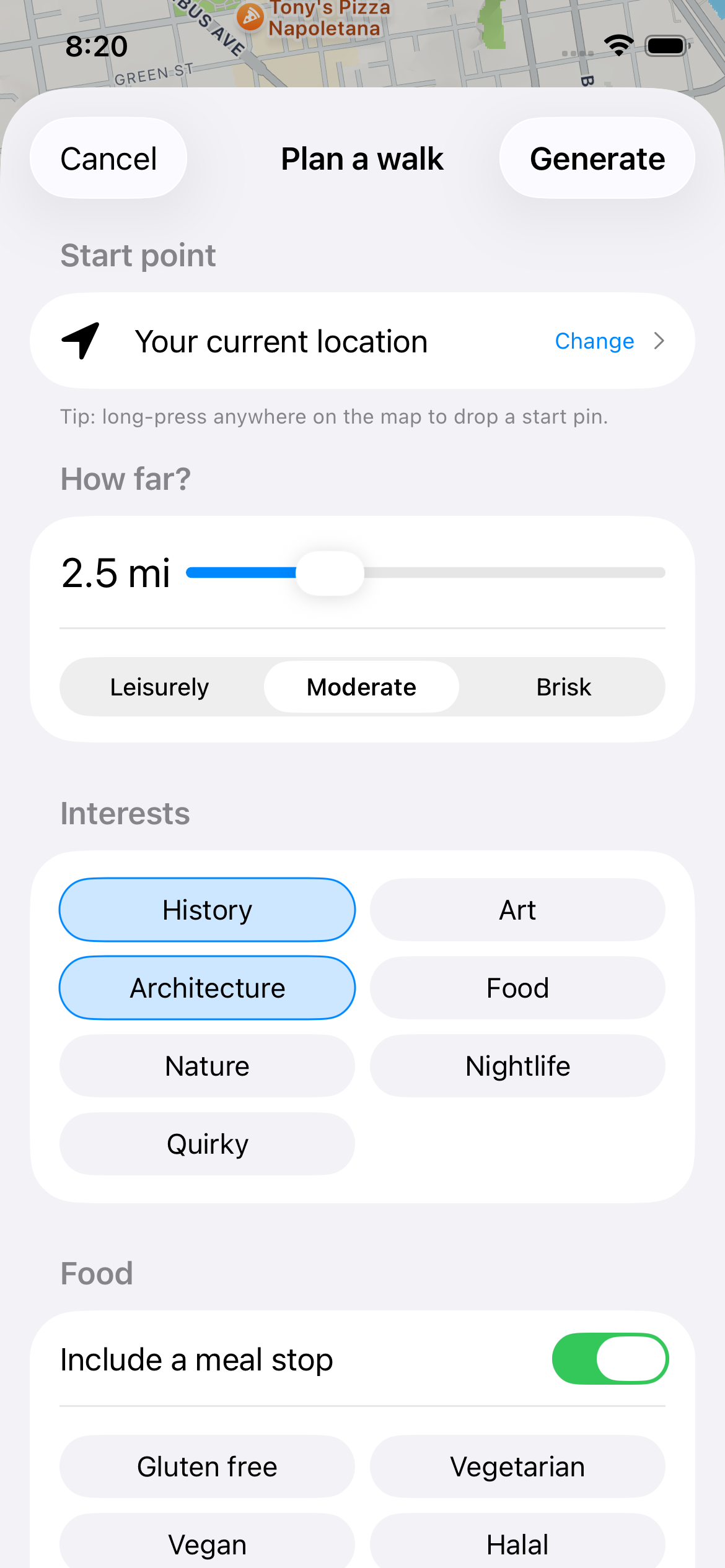
Mosey plans a walk like this one on your iPhone, starting wherever you choose.
- Set a distance or a time and pick what you're into
- Real stops in a walking order that makes sense on foot
- The story behind each stop, read aloud as you arrive
- A meal stop that fits the route

Free to download. iPhone, iOS 17 or later.
Frequently asked questions
How long does a Beale Street walking tour take?
Plan on about 2.5 hours for this route. The walking itself is roughly 1.5 miles round trip along a few short blocks, but museum time at the Rock 'n' Soul Museum and a sit-down meal add most of the hours.
Is Beale Street walkable?
Yes. Beale Street is flat, short and mostly closed to cars in its main entertainment stretch, so you can see it entirely on foot. Most of the museums, clubs and landmarks sit within about three blocks between Main Street and 4th Street.
Is Beale Street safe to walk at night?
Beale Street is heavily policed and lively on weekend evenings, but crowds and alcohol make it rowdier after dark. Stay on the main lit stretch, keep valuables close, and be more cautious on side streets and when walking back to parking late.
What is the best time of day to walk Beale Street?
Late morning to mid-afternoon is best for history, since museums are open and the street is calm. Come after sunset only if you want live music and neon. Weekday afternoons are the quietest, and weekends fill up by evening.
Is Beale Street free to walk?
Walking Beale Street is free, and Handy Park, Church Park and the sidewalk views of the Orpheum and Schwab's cost nothing. You pay for museum admission, club cover charges on some nights and meals. Check each venue for current fees before your visit.
What are the must-see historic stops on Beale Street?
Prioritize W.C. Handy's home at 352 Beale, the Memphis Rock 'n' Soul Museum at 191 Beale, Handy Park at 200 Beale and A. Schwab at 163 Beale. Robert R. Church Park at 4th Street and the Orpheum at 203 S. Main round out the history.
More Memphis Music and History Walks
Once you have covered Beale, Mosey can take you to other Memphis music sites. South Main Arts District is a short ride or walk from the Orpheum, with converted warehouses, the Lorraine Motel and the National Civil Rights Museum nearby. Downtown along Front Street and Court Square gives you river bluffs and older commercial blocks, and Mud Island and the riverfront add a different side of the city. Sun Studio and the Stax Museum sit a drive away, but each deserves its own half day.