Greenwich Village does not follow the Manhattan grid. West of Sixth Avenue the streets bend, cross each other at odd angles and sometimes change names within a block, because they trace older lanes and property lines from before the 1811 Commissioners' Plan. That is the first reason this is a good neighborhood to walk: you cannot navigate it by numbers, so you pay attention to where you are. The second reason is the density of American music and political history packed into a few blocks, from the folk revival to the 1969 Stonewall uprising.
This self-guided Greenwich Village tour runs about 2 miles and links seven stops. It starts at the arch in Washington Square Park, passes the old Judson Memorial Church and the Stonewall Inn, then follows the club and coffeehouse streets: MacDougal, Bleecker and West 3rd. It ends with a sit-down meal at a Village institution. Plan roughly three hours with stops, or less if you skip the interiors.
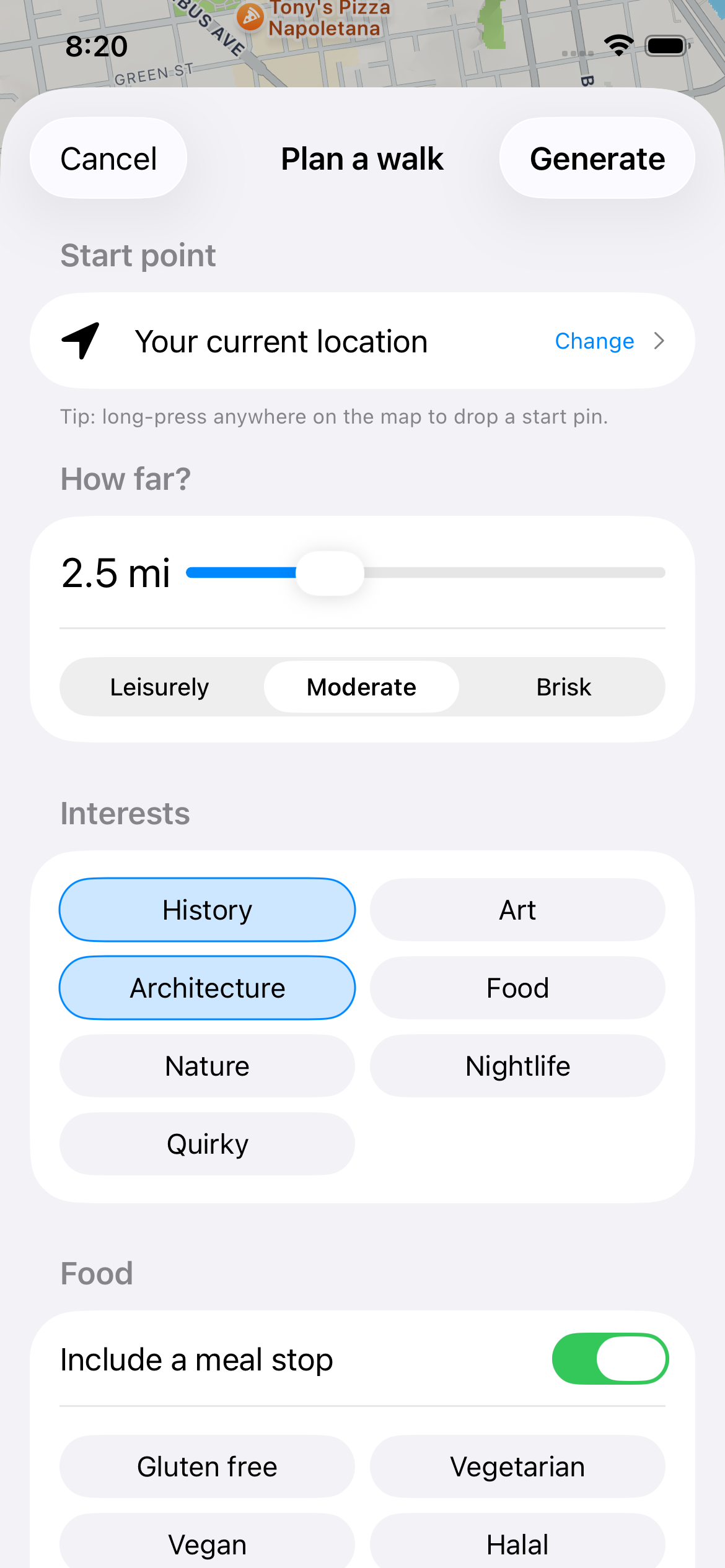
The route was built in the Mosey app, which surfaces short historical notes as you reach each stop, so you can keep your phone in your pocket between corners. Because this is a residential neighborhood with narrow sidewalks, the notes are written to be read in a minute or two, standing out of the way of foot traffic. The walk suits a weekday morning or early afternoon best, before Bleecker and MacDougal fill up.
From the Arch to Stonewall: Seven Stops Through the Village
"The park sits on land that served as a potter's field in the late 1700s and early 1800s, and it became a public parade ground in 1826. The marble arch, designed by Stanford White, was completed in 1892 to replace a temporary plaster arch built for the centennial of George Washington's inauguration in 1889. The park is also where folk musicians held informal Sunday gatherings around the fountain in the 1950s and 60s, until a 1961 city ban on unpermitted performance led to a protest."
Stand under the arch and look north up Fifth Avenue for the classic view, then walk to the fountain in the center, where buskers still play. Entry is free. Skip the chess tables unless you want to watch: the hustlers on the southwest side play for money.
"The brick Greek Revival houses on Washington Square North, many dating to the late 1820s and 1830s, form one of the best-preserved rows of that era in the city. Washington Mews, the gated lane just behind them, was originally lined with stables serving those houses. Today most of the buildings along the Mews are owned by New York University."
Walk in from the Fifth Avenue gate if it is open; the lane is short and quiet, and the cobbles are uneven. This is a residential and university space, so keep your voice down and do not wander into courtyards.
"Judson Memorial Church, at 55 Washington Square South, was designed by McKim, Mead and White, with Stanford White the lead designer, and was completed in 1893. Its Romanesque Revival design includes a campanile and stained glass by John La Farge. In the early 1960s the church became a center for experimental dance, theater and art, and it hosted the Judson Dance Theater, a landmark of postmodern dance."
The exterior is the main event, and it is best seen from the park side. The sanctuary is not open for general visits at set hours, so treat any interior look as a bonus, not a plan.
"MacDougal Street was the center of the Village's coffeehouse and folk scene in the 1950s and 60s. The Cafe Wha? at 115 MacDougal Street opened in 1959, and performers associated with its stage include Bob Dylan, who arrived in New York in January 1961. The Gaslight Cafe, a basement venue on MacDougal Street, was another key folk room of the period, though its original location is no longer in operation."
Cafe Wha? still runs live music, with a cover charge that varies by night, so check its schedule if you want to come back after dark. In daylight the block is plain, with some tourist-trap bars, so move through at a steady pace. Skip the souvenir shops.
"Bleecker Street runs diagonally through the Village and, in the 1960s, hosted a dense run of folk clubs and coffeehouses near MacDougal. Nearby, Le Poisson Rouge at 158 Bleecker Street occupies the space once home to the Village Gate, a famed jazz and cabaret club that operated from 1958 until 1993. Performers who played the Village Gate included Nina Simone, Miles Davis and John Coltrane."
The Le Poisson Rouge listing changes nightly, so check ahead if you want a show. The street itself is best walked in the daytime. West of the music blocks, Bleecker becomes quieter and more residential.
"The Stonewall Inn, at 53 Christopher Street, was the site of the uprising that began on June 28, 1969, after police raided the bar. The protests that followed over several nights are widely seen as a turning point in the American gay rights movement. In 2016 President Obama designated the Stonewall National Monument, which includes Christopher Park across the street, the first national monument dedicated to LGBTQ history."
The Stonewall Inn is a working bar, so go in only if you want a drink, and expect it to be busy at night. The monument grounds in Christopher Park are free and open, with sculptures by George Segal. Late afternoon is a good time to see both.
"Joe's Pizza, at 7 Carmine Street, has been a Greenwich Village staple since 1975, founded by Joe Pozzuoli, who came to New York from Naples. It is known for the plain New York slice, with a thin foldable crust, and the shop sits at the corner of Carmine and Bleecker, close to the old Italian South Village blocks. Our Lady of Pompeii Church stands nearby on Carmine Street, a reminder of the neighborhood's Italian-American community."
Order a plain cheese slice and eat it standing or on the curb; seating inside is minimal. Lines move fast but swell at lunchtime and late night. If you want a sit-down meal, walk a couple of blocks to one of the Bleecker Street restaurants instead.
Before You Go: Crowds, Cover Charges and Crooked Streets
Best time to walk: October is ideal: daytime temperatures usually sit in the 50s to 60s Fahrenheit, and the park's trees turn color in the second half of the month. Bring a light jacket for evening, since the narrow streets funnel wind. Summer is humid and crowded; January and February are cold but the walk is manageable with layers. Check the forecast on rainy days, because most of the stops are outdoors.
Shoes: Flat, comfortable shoes with real soles. Many Village sidewalks are uneven, with raised tree-pit edges and old bluestone slabs, and there are cobbled stretches near Washington Mews. The route is flat overall, with no real hills.
The narration: At each stop Mosey surfaces the dated, checkable background: who built it, what happened there, and which musicians or movements passed through.
Walk Greenwich Village With Mosey
Load this route into Mosey and get dated, stop-by-stop history as you walk. Build your own version and add the clubs you want to see after dark.
Download on the App Store — FreeFrequently asked questions
How long does it take to walk Greenwich Village?
Plan about three hours for this 2-mile Greenwich Village route with seven stops and a meal. Walking alone takes around 45 minutes. Add time at Washington Square Park, the Stonewall monument and lunch, and more if you want to see a live show or tour a venue.
Is Greenwich Village walkable?
Yes, Greenwich Village is one of the most walkable neighborhoods in Manhattan. The terrain is flat, sights are close together, and subway stations at West 4th Street and Christopher Street are within a few blocks of the route. The main challenge is the irregular street layout, so use a map.
What is the best time of day to walk Greenwich Village?
Weekday mornings and early afternoons are best, before crowds gather on Bleecker and MacDougal Streets. Washington Square Park is lively all day. If you want live music, plan to return after dark, since most clubs, including Cafe Wha?, run evening shows with cover charges.
Is Greenwich Village safe to walk at night?
Yes, Greenwich Village is generally busy and well lit at night, especially around Washington Square Park, MacDougal Street and Christopher Street. Use normal city precautions: stay on active streets, watch your belongings in crowded bars, and avoid empty side streets late at night.
Where does a Greenwich Village walking tour start?
Start at the Washington Square Arch, at the foot of Fifth Avenue on Washington Square North. The nearest subway stops are West 4th Street-Washington Square (A, B, C, D, E, F, M) and 8th Street-NYU (N, R, W). The arch is a clear meeting point and a good first photo.
What music history can you see in Greenwich Village?
The Village was the center of the 1950s and 60s folk revival, with sites on MacDougal and Bleecker Streets. You can see the exteriors of Cafe Wha? at 115 MacDougal and Le Poisson Rouge at 158 Bleecker, which occupies the former Village Gate jazz club space.
More Manhattan Walks Near the Village
If you enjoyed Greenwich Village, try the East Village, just east across Broadway, for its punk and theater history around St. Marks Place. SoHo, to the south, has cast-iron architecture from the 1800s, and the West Village and Meatpacking District to the west are good next walks in Mosey.