State Street is the eight-block spine connecting the Wisconsin State Capitol to the University of Wisconsin-Madison campus, and it's done that job since the city was platted in 1836. It's a strange, good mix: bars that have poured beer since Prohibition ended, co-ops that trace back to the 1970s food movement, and a Frank Lloyd Wright-adjacent performing arts complex a few blocks off. Because it's closed to most car traffic, it's one of the few Madison streets where you can walk down the middle and read the buildings without dodging bumpers.
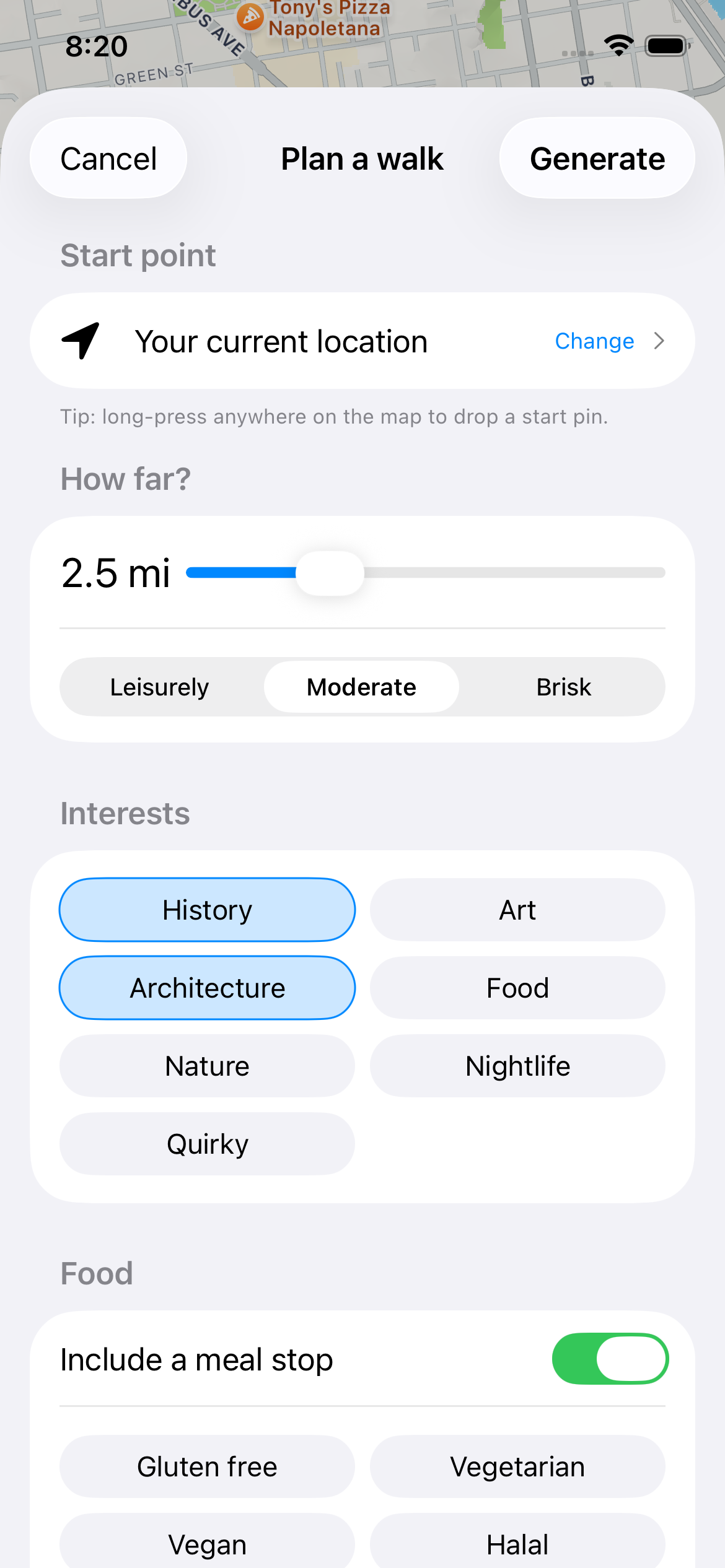
This route runs from the Capitol Square down to the edge of Bascom Hill, hitting the landmarks that explain how a swampy isthmus became a state capital and a Big Ten town at the same time. You'll pass the building where a 1978 tenants' fight helped shape Madison's co-op culture, a plaza where student protests happened during the Vietnam War era, and storefronts that have changed names but kept their bones since the 1900s. The Mosey app plots the stops so you're not guessing which building is which — just follow the route and let the narration fill in what you're looking at.
Plan for a little under two and a half hours if you stop to read plaques, browse a shop or two, and sit down for food. State Street is flat, paved, and entirely walkable, so this isn't a workout — it's a chance to actually look up at the cornices and read the old signage instead of walking past it on the way to class or a bar.
The Route: Capitol Square to Bascom Hill
"The current Capitol was built between 1906 and 1917 after the previous statehouse burned down in 1904, designed by architect George B. Post. Its dome is topped by Daniel Chester French's gilded bronze statue 'Wisconsin,' and at 284 feet, it's taller than the U.S. Capitol dome — the only state capitol allowed that height due to a since-relaxed federal rule. The building uses 43 kinds of stone from around the world, including Vermont granite and Italian marble."
Entry is free and the rotunda is open weekdays and weekends with security screening at the door. Free guided tours run on the hour most days — check the desk in the rotunda for the current schedule. Don't skip the fourth-floor museum on the history of the building; it's small but explains the 1904 fire in more detail than any plaque outside.
"The Dane County Farmers' Market has circled the Capitol Square since 1972, and it's the largest producer-only farmers' market in the country, with growers required to sell only what they raise themselves. Saturday mornings from April through November, the sidewalk here fills with cheese curds, brats, and produce stands that wrap all four sides of the square. It's also where State Street effectively begins, at the corner of State and Mifflin."
If you're walking on a Saturday morning, this stretch will be thick with people and stroller traffic — budget extra time or come back on a weekday to move faster. On weekdays outside market season, this corner is just a quiet transition point into State Street proper.
"The buildings on the 100 block of State Street mostly date from the 1890s through 1920s, built as State Street became Madison's main shopping corridor for downtown workers and, later, university students. Many retain their original cast-iron storefront frames and upper-floor window patterns even though the ground-floor tenants have turned over dozens of times. The street was converted to a pedestrian-and-bus mall in 1974, one of the earlier car-free retail conversions in the Midwest."
Look up past the modern signage at street level — the upper stories are where the 19th-century brickwork survives. This is a good stretch to browse independent shops rather than chains, since State Street has historically resisted big-box retail more than other Madison commercial strips.
"Overture Center opened in 2004, funded largely by a $205 million gift from local businessman W. Jerome Frautschi, and designed by Argentine-American architect César Pelli. It replaced the old Civic Center and consolidated Madison's symphony, ballet, and theater companies under one roof at 201 State St. The building's curved glass facade and terra-cotta panels were meant to signal a break from the boxier civic architecture that preceded it downtown."
The lobby and Playhouse Gallery are free to walk through during business hours even without a ticket to a show. If you have time, check what's on at the Wisconsin Union Theater-adjacent listings — Overture hosts touring Broadway shows, the Madison Symphony Orchestra, and free lunchtime concerts on some weekdays.
"This stretch of State Street carries the imprint of Madison's 1960s and '70s counterculture, when the university's proximity made the street a center of Vietnam-era protest and, later, the co-op and fair-trade movements that still show up in shop names today. The 1970 bombing of Sterling Hall, just blocks north on campus, remains the most extreme event tied to that era, though its effects rippled through State Street businesses and student politics for years after."
There's no single building to point a camera at here — this stop is more about context for why State Street still leans independent and activist in its retail mix compared to a typical downtown strip. Read the plaques if you see them; several storefronts post short histories in their windows.
"State Street dead-ends at the base of Bascom Hill, the original heart of the University of Wisconsin campus chartered in 1848. Bascom Hall, at the top of the hill, was completed in 1859 and has been rebuilt after a 1916 fire that gutted its dome. The statue of Abraham Lincoln seated in front of Bascom Hall, installed in 1909, has been a rallying point for campus protests for over a century, including major Vietnam War demonstrations in the late 1960s."
Climbing the hill adds a short uphill stretch, worth it for the view back down State Street toward the Capitol dome, especially near sunset. It's free and open to the public year-round; students study on the lawn in warm weather, so expect company if you're walking through in late August during welcome week.
"Babcock Hall, at 1605 Linden Dr., is UW-Madison's working dairy plant and food science building, and its ground-floor store has sold ice cream and cheese made on-site since the 1950s. The university's dairy science program dates back to the 1890s under professor Stephen Babcock, whose butterfat testing method — the Babcock test, developed in 1890 — made Wisconsin's dairy industry commercially viable and is still taught here. The ice cream is made from milk produced by the university's own herd."
This is a short detour off State Street itself, up near the agricultural side of campus, but it's the most Madison-specific food stop you can make on this walk. A single scoop runs a few dollars, cash and card both accepted, and flavors rotate — ask what's fresh from that week's batch. It gets a line during summer session and matches, so early afternoon on a weekday is your best bet for a quick counter.
Planning Your Walk
Best time to walk: Madison summers run warm and humid; late August afternoons can hit the mid-80s, so mornings or early evenings are more comfortable. Winters are genuinely cold and State Street gets icy, so if you're walking December through March, budget extra time and wear boots with grip.
Shoes: The whole route is flat brick and concrete pedestrian mall — sneakers or walking shoes are all you need, no hiking boots required.
The narration: Mosey surfaces the year each building went up, who built it, and the specific events — protests, fires, business openings — that happened on that exact block.
Walk State Street with Mosey
Open the Mosey app to follow this route stop-by-stop with GPS-triggered narration, so you get the history exactly where it happened, not just in a list.
Download on the App Store — FreeFrequently asked questions
How long does it take to walk State Street in Madison?
Walking State Street start to finish takes about 20-30 minutes without stopping, since it's roughly eight blocks between the Capitol and Bascom Hill. Budget two to two and a half hours if you're stopping at the landmarks, browsing shops, and adding the short detour to Babcock Hall for ice cream.
Is State Street in Madison walkable?
Yes — State Street has been closed to most private car traffic since 1974, making it one of the few fully pedestrian-and-bus corridors in Madison. It's flat brick and concrete the entire length, with buses running down the center, so foot traffic has the sidewalks and much of the street itself.
Is State Street safe to walk at night?
State Street is generally well-lit and busy with students and bar traffic into the late evening, especially near campus, but like any nightlife strip it gets rowdier on weekend nights after 10 p.m. Stick to the main stretch rather than side alleys, and expect heavier crowds on UW football game weekends.
What is the best time of day to walk State Street?
Weekday mornings before 11 a.m. are quietest, good for photographing the Capitol and storefronts without crowds. Saturday mornings from April to November bring the Dane County Farmers' Market to the Capitol Square, which is worth seeing but slows walking pace considerably along that block.
Can you park near State Street and walk it?
Yes — the State Street Capitol Ramp at 214 N Carroll St and the Overture Center Parking Ramp at 316 W Mifflin St both sit within a block or two of the street and charge hourly rates, typically $2-3 per hour as of recent posted rates. Metered street parking on side streets is another option but fills fast on weekdays.
What food should I try on a State Street walk?
Babcock Hall Dairy Store on the UW campus end is the standout for something specific to Madison — ice cream made from the university's own dairy herd, a tradition tied to the school's dairy science program founded in the 1890s. State Street itself also has long-running spots for cheese curds and Wisconsin supper club-style bar food.
More Madison Walks Worth Taking
If you've got another afternoon in Madison, Mosey also maps a walk through the Williamson Street (Willy Street) corridor on the east side, where 1970s co-op culture and current-day breweries sit a mile from the Capitol, or a loop around the Vilas neighborhood and Henry Vilas Zoo for a slower, residential walk with lake access at Wingra Park. Both routes pair well with a State Street morning if you're spending a full weekend in Madison.