Downtown's Historic Core is where Los Angeles built its first real skyline, mostly between 1893 and 1931. Within a few blocks you get a Beaux-Arts hotel, a Goodhue library with a pyramid on top, a movie palace that premiered a Chaplin film, and a skylit office atrium that has appeared in more movies than most actors. If you are searching for a Los Angeles Downtown Historic Core walking tour that rewards looking up, this is the one.
This self-guided Downtown Historic Core tour starts at Pershing Square, climbs briefly toward the Biltmore and the Central Library, then drops east to Broadway's theater row and the Bradbury Building. It ends at Grand Central Market, where you eat. Six stops, mostly flat apart from a short grade on the way to the library, and nearly all of it free.
Mosey built this route to link the buildings in a logical loop and to surface the dates, architects and materials behind each facade as you reach it. Your first three Mosey tours are free. The route suits a Thursday like November 5, 2026: weekday business hours mean the Bradbury and the library are both open, and the market is busy but manageable if you arrive before the lunch peak.
The Route: From Pershing Square to Grand Central Market
"Los Angeles set aside this block as a public plaza in 1866, making it the city's oldest park. It was renamed Pershing Square in 1918 to honor General John J. Pershing, commander of the American Expeditionary Forces in World War I. The current design dates to a 1994 renovation by architect Ricardo Legorreta and landscape architect Laurie Olin, which is where the purple bell tower and the bright walls come from."
Stand at the Hill Street side and look across at the Biltmore's rear wing and the older towers around the square. The park itself is a fine place to orient yourself, but do not plan to linger: it is more a hub than a destination, and its programming varies. Free.
"The Biltmore opened in October 1923 and was designed by the New York firm Schultze & Weaver, who were behind a number of grand hotels of the era. It was the largest hotel in the West when built. The interior is known for its Italian and Spanish Renaissance detailing, including ceilings painted by the Italian artist Giovanni Smeraldi. The Academy of Motion Picture Arts and Sciences was organized at a banquet here in 1927."
Walk in through the Olive Street side and go up to the Gallery Bar and the Rendezvous Court. Lobby areas are open to the public, and you can look without buying anything. Look at the painted ceilings and the carved stonework rather than the modern furniture. A drink here is pricey, so treat it as a look-in, not a stop for a meal.
"The Central Library opened in 1926 and was designed by Bertram Goodhue, who died in 1924 before it was finished; Carleton Winslow completed the project. Its tiled pyramid tower is topped with a hand holding a torch of knowledge, a sculpture by Lee Lawrie. Dean Cornwell painted the rotunda murals, finished in 1933, on California history. An arson fire on April 29, 1986 damaged much of the collection, and the library reopened in 1993 after a renovation that added the Tom Bradley Wing."
Enter on the 5th Street side, then step into the Goodhue Building's rotunda and look up at the Cornwell murals. Walk the Maguire Gardens on the south side too, a quieter landscape that gives you a good view back at the tower. Entry is free; the library offers docent-led tours on a schedule you can check ahead of time.
"The Los Angeles Theatre opened in January 1931 with the premiere of Charlie Chaplin's film City Lights, and Chaplin attended. Architect S. Charles Lee designed it in a French Baroque style, and it was the last and most lavish of the big theaters built along Broadway. Its lobby is known for a crystal fountain and for a grand staircase intended to make moviegoers feel like royalty."
The vertical blade sign and marquee at 615 S Broadway are the part you can see from the sidewalk. The interior is generally open only for special events, film screenings and scheduled tours, so check ahead if you want to go inside. If not, look across the street for a better angle on the facade.
"The Bradbury Building at 304 S Broadway was completed in 1893 for mining millionaire Lewis Bradbury, who died before it opened. Draftsman George Wyman got the commission after Bradbury rejected another architect's design, and Wyman's plan put a skylit atrium behind a fairly plain brick exterior. Inside are ornamental ironwork, Belgian marble stairs, glazed brick, and open-cage elevators. It was a filming location for Blade Runner in 1982."
Visitors can enter the ground-floor lobby and view the atrium during daytime hours, which vary, so check before you go. The upper floors are working offices and are off-limits. Go in the morning or midday when light comes through the skylight. Free to enter; photography is generally allowed but tripods are not welcome.
"Grand Central Market opened in 1917 on the ground floor of the Homer Laughlin Building, an 1897 structure designed by John Parkinson. It is one of the oldest continuously operating public markets in Los Angeles, and it has changed with the city, moving from produce and butchers toward a wide food-stall lineup. The building sits across Hill Street from the Angels Flight railway."
Eggslut draws the longest line, so if you do not want to wait, try Sarita's Pupuseria for Salvadoran pupusas or one of the taco counters. Go before noon or after 2 pm for shorter waits, and bring a patient plan for finding seating. Walk through the Broadway entrance first, then out the Hill Street side. Stall menus and hours change, so check what is open.
Before You Go: Hours, Timing and What to Skip
Best time to walk: November is one of the better months: daytime highs are typically in the 60s to low 70s F and rain is uncommon, though a storm can roll in. Santa Ana wind days are dry and gusty. Morning light is good for the Broadway facades, which face across the street, and the afternoon sun hits the Biltmore side of the route. Bring a layer for shaded canyon-like blocks.
Shoes: Sidewalks are flat and paved throughout, with one gentle uphill stretch toward Grand Avenue and the library. Comfortable walking shoes are enough. Expect some uneven pavement and sidewalk grime on Broadway, and be aware of street-level activity near Pershing Square and Hill Street. Walk with normal city awareness, stay in the open, and keep phones tucked away at crossings.
The narration: At each stop, Mosey surfaces the architect, opening year, materials and documented events behind the building so you can match what you read to what you are looking at.

Walk Los Angeles' Downtown Historic Core with Mosey
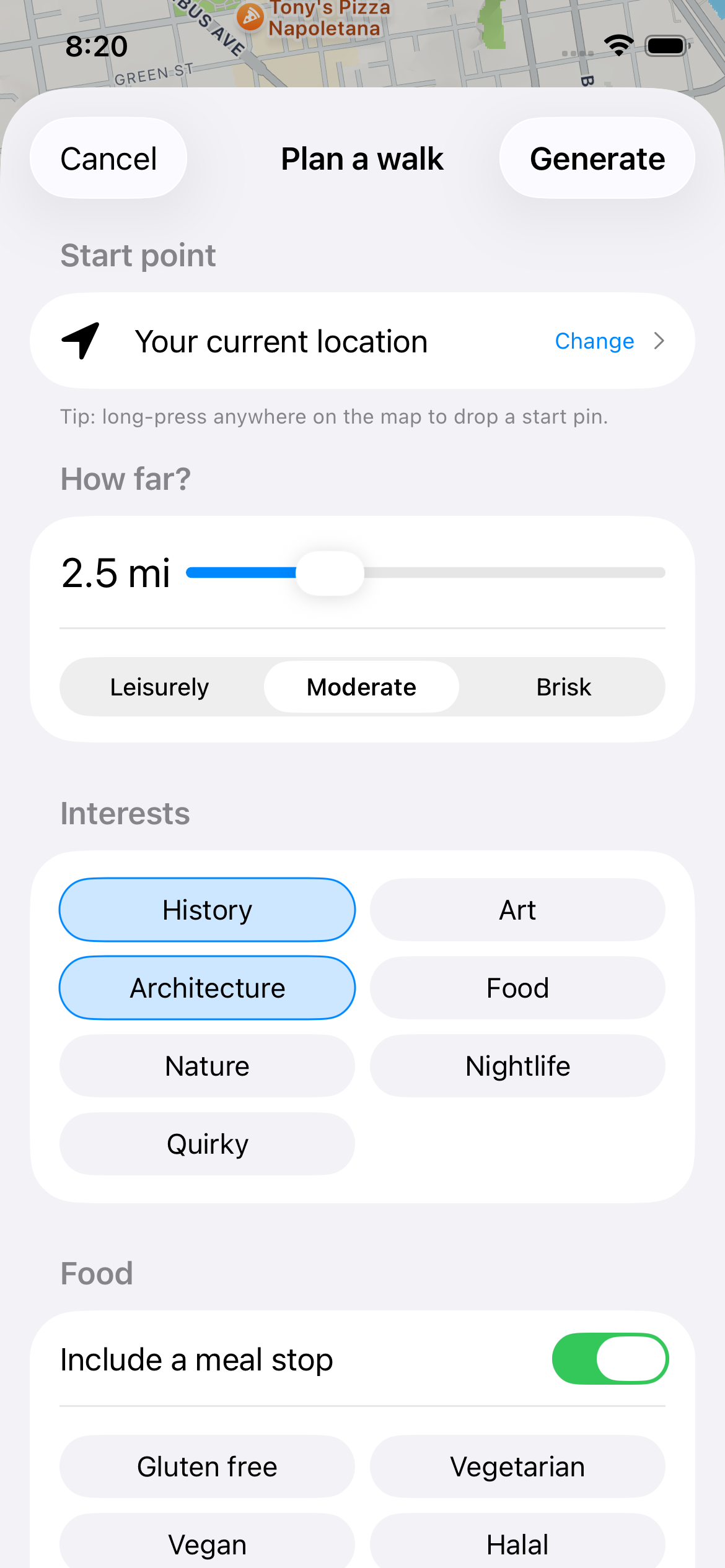
Mosey plans a walk like this one on your iPhone, starting wherever you choose.
- Set a distance or a time and pick what you're into
- Real stops in a walking order that makes sense on foot
- The story behind each stop, read aloud as you arrive
- A meal stop that fits the route

Free to download. iPhone, iOS 17 or later.
Frequently asked questions
How long does it take to walk Downtown LA's Historic Core?
Plan on about three hours for this route, which covers roughly 2 miles and six stops. Walking time alone is under an hour. The rest goes to the Biltmore lobby, the library rotunda, the Bradbury atrium, and a meal at Grand Central Market, where lines can stretch at lunch.
Is Downtown LA walkable?
Yes, the Historic Core is compact and flat enough to walk comfortably, and the stops on this route are within a few blocks of each other. The main climb is the short slope toward Grand Avenue and the library. Beyond the core, distances between neighborhoods grow quickly, so use Metro for those.
Is the Bradbury Building free to visit?
Yes, you can enter the ground-floor lobby and see the skylit atrium for free during daytime hours at 304 S Broadway. Upper floors are private offices. Hours can vary, and the building sometimes closes for filming or events, so check before you go rather than assuming it will be open.
Is it safe to walk Downtown LA's Historic Core?
Daytime walking is generally fine on the main streets of this route, which are busy with commuters, shoppers and visitors. Streets near Pershing Square and Broadway can feel rough, so keep belongings secure and stay aware. Walk the route in daylight; after dark, many blocks empty out and you should use rideshare.
What is the best time of day to walk the Historic Core?
Late morning is the best window. The Bradbury and the Central Library are open, Broadway is active but not packed, and you reach Grand Central Market just before the noon rush. Weekdays are quieter inside the buildings, while weekends bring larger crowds at the market.
How do I get to Pershing Square without driving?
Take the Metro B Line (Red) or D Line (Purple) to Pershing Square station, which opens directly under the park at Hill and 5th Street. Other options include several bus lines through downtown. Driving means paying for a private garage, and street parking is limited and tightly enforced.
More Downtown Los Angeles Walks
Once you have finished the Historic Core, Mosey can build routes through nearby areas that run on a different scale. Bunker Hill sits directly above this walk and covers the Walt Disney Concert Hall, MOCA and the Broad. Little Tokyo and the Arts District sit east, and Olvera Street and El Pueblo, where the city began in 1781, sit north near Union Station. Chinatown, a short ride away, makes a good half-day of its own.