Downtown Lexington doesn't announce itself the way Louisville or Nashville do. It's a compact grid of 19th-century commercial blocks, a former slave-trading square turned public plaza, and a skyline punctuated by exactly one 30-story tower. What it has instead of scale is density of fact: this is where Kentucky's legal and political history got made, where Henry Clay practiced law, and where the bluegrass horse-and-bourbon economy built its bank buildings and hotels. Walking it slowly is the only way to catch most of it.
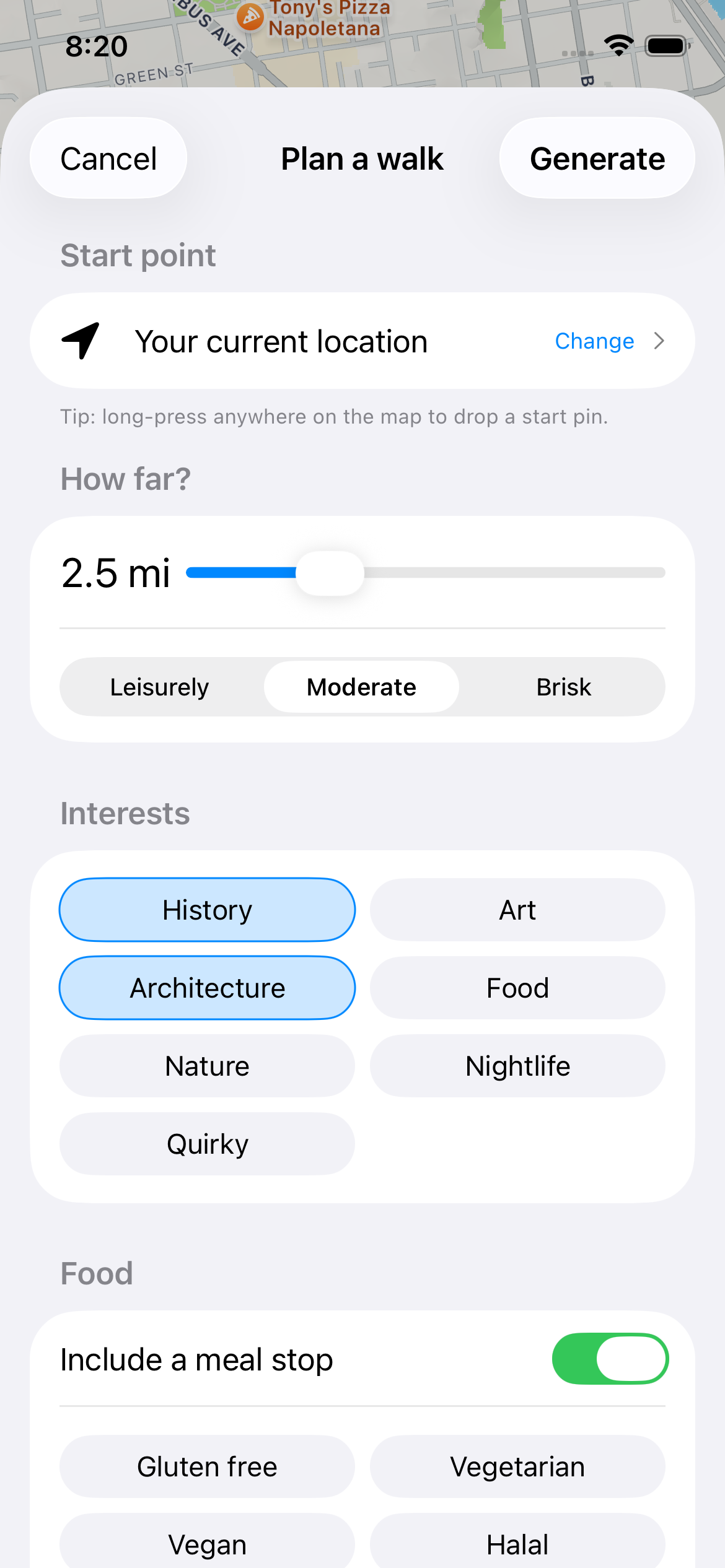
This route runs from the old Fayette County Courthouse through Gratz Park's antebellum houses, down Short Street's gallery row, and into Cheapside Park, before finishing at a lunch counter that's been feeding this block for decades. It's flat, entirely on sidewalk, and short enough to do before the heat sets in on a warm September afternoon. Mosey built the route so you're not staring at a phone map — it prompts the history at each stop as you arrive, so you can keep your head up and actually look at the buildings.
Give it two and a half hours if you want to go inside places that allow it and read the historical markers rather than skim them. Fewer if you're just after the architecture. Either way, start at the old courthouse — everything downtown radiates from that square.
The Route: Courthouse Square to Cheapside
"This Richardsonian Romanesque courthouse was completed in 1900, the fourth courthouse to stand on this site since Fayette County's founding in 1780. It was designed by local architect Herman L. Rowe and built with Bowling Green limestone. The building served as the county's courthouse until 2001, when the county government relocated and the structure sat vacant for over a decade amid long debate about its future."
The building has been redeveloped as a museum and event space; check current hours before assuming walk-in access. Stand across the street at the corner of Main and Upper for the best full view of the clock tower and turret. This is also the site of a 1920s courthouse-square lynching memorialized nearby — worth reading the historical marker on the grounds.
"Gratz Park is Lexington's oldest planned green space, laid out in the early 1800s on land once occupied by Transylvania University's original campus, which burned in 1829. The park is named for Benjamin Gratz, a Lexington hemp manufacturer whose 1820s Federal-style house still stands on the square. The surrounding blocks hold one of the best-preserved collections of antebellum residential architecture in the city, including homes built for lawyers and merchants tied to Transylvania's law and medical schools."
Walk the perimeter rather than cutting across — the house facades on Market Street and Mill Street are the point. The Hunt-Morgan House at 201 N Mill St, built around 1814 for John Wesley Hunt, is open for guided tours seasonally through the Blue Grass Trust; check ahead since hours are limited.
"Chartered in 1780, Transylvania is one of the oldest universities west of the Allegheny Mountains and predates Kentucky statehood by twelve years. Its early law and medical departments drew students from across the South and Midwest in the early 1800s, and alumni include Jefferson Davis and a string of U.S. senators and vice presidents. Old Morrison, the university's signature Greek Revival building fronted by six columns, was completed in 1833 and designed by architect Gideon Shryock."
You can walk the small campus quad freely during daylight hours; Old Morrison's interior isn't generally open to visitors. The columned facade photographs best from the sidewalk on North Broadway in mid-morning light.
"This stretch of Short Street holds a run of 19th-century commercial storefronts, several dating to the 1870s and 1880s when Lexington's downtown was a wholesale and dry-goods hub tied to the hemp and tobacco trade. Many of the cast-iron and brick facades survive above modern storefronts at street level, a common pattern in Kentucky river and rail towns of the period. The block has been repopulated over the last two decades with galleries and studios, part of a broader downtown arts push."
Look up — the second and third stories keep their original cornices and window hoods even where ground-floor businesses have turned over. Lexington Art League and a handful of small galleries here often have free walk-in hours on weekday afternoons.
"Cheapside was one of the largest slave auction and trading sites in Kentucky before the Civil War, with sales conducted on this square into the 1860s. A Confederate monument stood on the plaza from 1911 until it was removed in October 2017 following a Lexington city council vote, part of a broader reckoning with the site's history. The park sits directly beside the old courthouse and today functions as a farmers' market site and public gathering space."
Read the historical marker near the plaza's edge, which addresses the auction history directly. The Lexington Farmers Market runs here Saturday mornings through late fall — worth timing your walk around if you want produce stalls and food vendors as a backdrop.
"Main Street's early 20th-century bank buildings reflect Lexington's role as the financial center for the Bluegrass region's horse and tobacco money. Several of these buildings feature Beaux-Arts and Classical Revival detailing typical of American bank design between 1900 and 1920, when institutions used columned facades and heavy stone to signal solvency after repeated bank panics. Ground-floor banking halls in this stretch often retain original marble and brass fittings even where the buildings have been converted to other uses."
Most of these lobbies are only viewable from the sidewalk unless the ground floor is currently occupied by a business that stays true to its original use. Cross to the opposite side of Main Street to get the full facade in frame without traffic signs cluttering the shot.
"Rupp Arena opened in 1976 as home to University of Kentucky basketball, named for longtime UK coach Adolph Rupp, and has seated crowds above 20,000 for games since. The arena sits within the larger convention center complex that anchors this end of downtown and has been through multiple renovation phases, most recently in the 2020s. It's a hard architectural pivot from the 19th-century blocks you've just walked, and useful for seeing how downtown Lexington's scale changes at its edges."
There's not much to see inside without an event ticket, so this stop is really about the exterior plaza and the contrast in scale. Don't linger long here — it's more a waypoint than a destination on this route.
"For a downtown lunch with some history behind it, head to Lexington institutions like the counter-service diners and bars scattered through the Chevy Chase and downtown core, or, closer to this route, Bourbon n' Toulouse or the sandwich counters along Main Street that have served the courthouse and bank crowd for decades. A dependable, well-known choice within walking distance is deSha's American Tavern near the corner of Vine and Broadway, housed in a converted early 20th-century train depot building, or Coles 735 Main for a more contemporary Kentucky menu in a historic Main Street storefront."
Coles 735 Main is a solid pick if you want a sit-down meal with a Kentucky-forward menu inside a preserved storefront; expect $15–$25 entrees and a wait at peak lunch hours. If you're short on time, grab a quicker counter meal instead and save the sit-down spot for dinner.
Planning Your Walk
Best time to walk: Late September in Lexington runs mild, typically 60s to low 80s, but the sidewalks and courthouse square have almost no shade at midday. Mornings can be humid. Check for rain — there's little cover between stops if a storm rolls through.
Shoes: All paved sidewalk and brick plaza, flat throughout — regular walking shoes or sneakers are fine, no need for anything rugged.
The narration: At each stop, Mosey surfaces short, sourced historical context — court records, architects' names, and dates — rather than generic plaque text, so you know what you're actually looking at.
Walk Downtown Lexington with Mosey
Open the free route in the Mosey app and get the history at each stop as you arrive, no planning required.
Download on the App Store — FreeFrequently asked questions
How long does it take to walk Downtown Lexington?
Plan for about two to two and a half hours to cover the main historic core, including stops at the old courthouse, Gratz Park, Transylvania University, and Cheapside Park. The route itself covers roughly 1.8 miles of flat sidewalk, so the time is mostly spent reading markers and looking at buildings, not walking.
Is Downtown Lexington walkable without a car?
Yes. Downtown Lexington's historic core is compact and gridded, and the main sites — the old courthouse, Gratz Park, Cheapside, and Short Street — are all within a few blocks of each other. Street parking or the Central Bank Center garage on Main Street makes a good single base for a walking loop.
What is the significance of Cheapside Park in Lexington?
Cheapside was one of Kentucky's largest sites for slave auctions before the Civil War, with sales held on the square into the 1860s. A Confederate monument stood there from 1911 until Lexington's city council voted to remove it in October 2017. The plaza now hosts the weekly farmers market and public events.
Can you tour the old Fayette County Courthouse?
Access depends on current programming — the 1900 courthouse, designed by architect Herman L. Rowe, served as the county courthouse until 2001 and has since been redeveloped for museum and event use after years of vacancy. Check current hours before your visit, since access has changed multiple times over the past two decades.
What's the best time of day to walk Downtown Lexington?
Weekday mornings or early afternoons work best, since the courthouse square and bank district have little shade and can feel hot by midday in warmer months. Saturday mornings are worth targeting if you want to catch the Cheapside farmers market alongside the historic sites.
Is Transylvania University open to the public?
The campus quad and exterior of Old Morrison, the 1833 Greek Revival building designed by architect Gideon Shryock, are accessible to walk through during daylight hours. Building interiors are generally reserved for students and staff, so plan on an exterior visit unless you arrange something in advance.
More Lexington Walks
If courthouse squares and antebellum architecture worked for you, Lexington's Chevy Chase neighborhood offers a similar walk through early 20th-century residential streets and a small commercial district built around the same horse-and-bourbon money. Mosey also has routes through Lexington's Distillery District, following the bourbon warehouses along Manchester Street, and through the Woodland Park area near UK's campus for a different mix of Victorian homes and green space.