Old Town Key West packs more oddity per block than almost anywhere in Florida. This is the end of US-1, the place where wreckers got rich hauling cargo off sunken ships, where Cuban cigar rollers built an industry before Tampa stole it, and where Hemingway kept six-toed cats in a Spanish Colonial house he barely paid for. The streets are narrow, the architecture is a mix of ship-carpenter Victorian and conch-shell vernacular, and the whole district sits barely above sea level, which explains a lot about the local attitude toward rules and permanence.
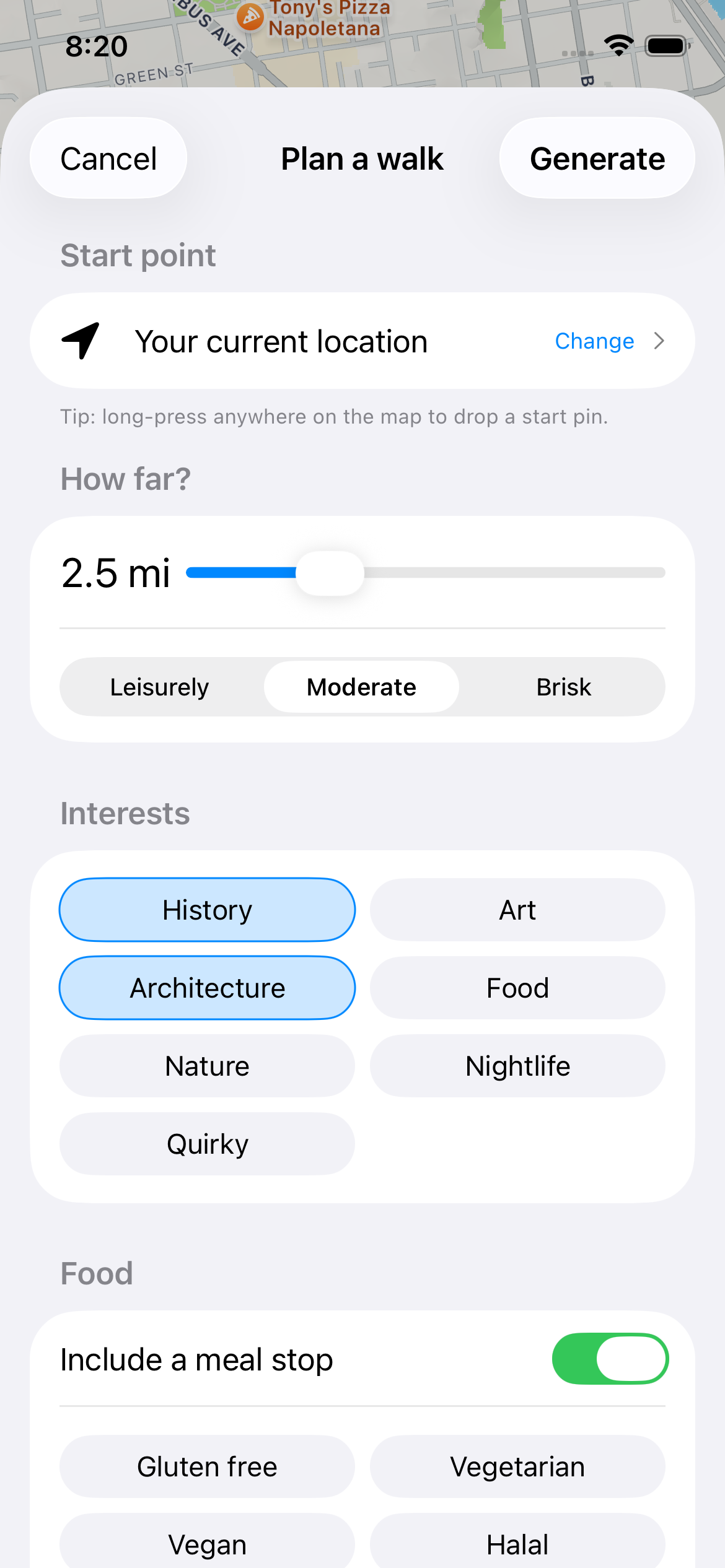
This route runs from the harbor at Mallory Square down through the residential lanes of Old Town, past the cemetery, and onto Duval Street, ending with a meal at a spot that's been feeding locals and writers since the 1950s. Along the way you'll pass widow's walks, hurricane-scarred churches, and at least one building that used to be something far stranger than it is now. The Mosey app runs this as a self-guided audio route, so you can walk at your own pace and let the narration catch you up on what you're looking at without staring at a phone screen the whole time.
Budget around two and a half hours if you stop to read plaques and poke into shops. Old Town is flat and compact, so this isn't a workout, it's a slow unspooling of a town that's spent 200 years being weird on purpose.
The Route: Harbor to Duval
"Named for Stephen Mallory, a Key West customs official and U.S. Senator who later served as Secretary of the Navy for the Confederacy. In the 19th century this stretch of waterfront was ground zero for the wrecking industry, where salvagers auctioned off cargo pulled from ships that ran aground on the reef offshore. By the 1850s, wrecking had made Key West the wealthiest city per capita in the United States. The square still functions as the town's gathering spot, now built around nightly sunset crowds rather than cargo auctions."
Go early before the cruise ship tenders unload, or skip the sunset celebration entirely if you dislike street performers working a captive crowd. The free Boathouse Museum nearby has actual wrecking-era artifacts if you want context beyond the plaza itself.
"Built in 1848 after a hurricane destroyed the original 1825 tower, this lighthouse stands 86 feet tall and once guided ships away from the reef that made the wrecking industry so profitable in the first place. Keeper Barbara Mabrity ran the light for 32 years, raising children in the attached keeper's house while surviving multiple hurricanes. The light was decommissioned in 1969 once surrounding buildings grew tall enough to obscure its beam."
Admission runs about $15 for adults. Climb the 88 cast-iron steps for a view over Old Town's rooftops; it's one of the only elevated vantage points in the district and worth the ticket for that alone. The keeper's quarters museum at the base is small but well organized.
"Hemingway bought this Spanish Colonial house at 907 Whitehead Street in 1931 for $8,000, using money from his wife Pauline's uncle. He wrote 'A Farewell to Arms,' 'To Have and Have Not,' and most of his Key West-era short stories in the carriage house studio out back. The in-ground swimming pool, installed in 1938 at a cost of $20,000, was reportedly the first in Key West and the most expensive construction project on the island at the time. The polydactyl cats roaming the grounds today descend from Hemingway's original six-toed cat, a ship captain's gift named Snow White."
Entry is around $17 for adults and lines build fast by midmorning. Go right at the 9am opening if you want the studio and pool area without a crowd. Skip the guided tour if you're short on time; the self-paced walk through with posted placards covers the essentials.
"Established in 1847 after an earlier burial ground washed out in a hurricane, this 19-acre cemetery sits on some of the highest ground in Key West, roughly 12 feet above sea level. Because digging deep graves in coral rock is brutal work, many of the dead are interred above ground in stacked concrete vaults. The cemetery holds a memorial to the 270 sailors killed in the 1898 USS Maine explosion, along with the famously deadpan headstone reading 'I Told You I Was Sick,' belonging to Pearl Roberts."
Free to enter, gates open daily from 7am to 6pm. The Margaret Street and Passover Lane entrances are both easy to find. Bring water; there's little shade and the white coral gravel reflects heat hard by midday.
"Founded in 1871 by Cuban exiles, the San Carlos Institute served as a school, meeting hall, and political base for the Cuban independence movement. José Martí delivered speeches here rallying support for Cuban independence from Spain, and the current Cuban Revival building on Duval Street was rebuilt in 1924 after earlier structures were destroyed by fire and hurricanes. At its peak, Key West's cigar industry employed thousands of Cuban immigrants, making this the center of a community that briefly rivaled Havana's political influence."
The building functions today as a small museum and cultural center, often free or low-cost depending on current exhibits. It's easy to walk past without noticing on busy Duval Street, so look for the ornate tiled facade a few blocks up from the Hemingway House.
"Named for William Pope Duval, Florida's first territorial governor, this mile-long street was laid out in the 1820s and has functioned as Key West's commercial spine ever since. Sponging, cigar rolling, and shrimping money built the Victorian storefronts that still line parts of the street, even as most ground-floor businesses today sell T-shirts and frozen daiquiris. The phrase 'Duval crawl,' referring to a bar-hopping route down the street, has been in local use since at least the 1980s."
Walk the stretch between Front Street and Truman Avenue to see the older building stock; the section nearer the cruise port is the most commercialized and least interesting historically. Avoid it entirely after 9pm if bar crowds aren't your scene.
"Built around 1829 by ship captain Francis Watlington, this wood-frame house at 322 Duval Street is the oldest surviving residence in Key West, built in a style brought by ship carpenters from the Bahamas. Watlington, a wrecker and sea captain, raised seven daughters here while running salvage operations off the reef. The house survived the hurricanes of 1846 and 1909, along with repeated fires that leveled other wooden structures nearby, largely due to its elevated construction and separate cookhouse built apart from the main structure to reduce fire risk."
Admission is free, though donations are encouraged. It's a quick stop, maybe 15 minutes, but worth it for the construction details alone, especially the ship-lap siding and widow's walk typical of Bahamian builders.
"This restaurant at 729 Thomas Street occupies a lot with a genuinely strange past: it once hosted cockfights, and Hemingway reportedly refereed boxing matches here in the 1930s when the space operated as a bar and gathering spot for the neighborhood known as Bahama Village. The current restaurant opened in 1992, keeping the open-air courtyard seating under the same old tamarind trees. Free-range chickens, descendants of the island's long-standing feral chicken population, still wander the dining area during service."
Go for the shrimp and grits or the Key lime pie, both consistently the best-reviewed items on the menu. No reservations for small groups, so expect a wait at peak lunch or dinner hours; arriving right at opening or mid-afternoon avoids the line. Cash and card both accepted, entrees mostly fall in the $18 to $34 range.
Planning Your Walk
Best time to walk: October is still hurricane season and deep into Key West's hot, humid stretch. Expect afternoon downpours and temperatures in the high 80s. Start early morning or after 4pm to avoid the worst heat and sun.
Shoes: Flat, uneven sidewalks and old brick in places. Comfortable walking sandals or sneakers are fine; nothing technical required.
The narration: Mosey surfaces short audio context at each stop drawn from documented local history, including ship salvage records, hurricane damage reports, and property records tied to the Hemingway estate.
Walk Old Town Key West with Mosey
Open the Mosey app to get turn-by-turn audio narration for every stop on this route, so you can keep your eyes on the architecture instead of a map.
Download on the App Store — FreeFrequently asked questions
How long does it take to walk Old Town Key West?
Plan on two to two and a half hours for the roughly 2-mile route covering Mallory Square, the lighthouse, Hemingway House, the cemetery, and Duval Street. Add 30 to 45 minutes if you tour the Hemingway House or lighthouse interior, since both involve ticketed, self-paced exploration beyond the walk itself.
Is Old Town Key West walkable without a car?
Yes, Old Town is flat, compact, and built before cars existed, so nearly everything sits within a 20-minute walk. Parking is expensive and limited near Mallory Square, so most visitors park once at a hotel or garage and walk the entire district on foot or rent a bike for longer trips.
What is the best time of day to walk around Old Town Key West?
Early morning, between 8 and 10am, avoids both the heat and the cruise ship crowds that flood Duval Street and Mallory Square by midday. October afternoons regularly hit the high 80s with sudden rain, so a sunrise or late-afternoon start works better than midday.
Is the Hemingway House worth the admission fee?
Most visitors find it worth the roughly $17 ticket for the writing studio, the 1938 pool, and the six-toed cats alone. Arrive right at opening to avoid long lines, since tour buses and cruise groups tend to fill the courtyard by late morning.
What should I skip in Old Town Key West?
Skip the lower, cruise-port end of Duval Street near Front Street unless you want T-shirt shops and chain bars; it's the least historically interesting stretch. Evening 'Duval crawl' bar hopping also isn't essential if you're walking the route for history rather than nightlife.
Is Key West Old Town safe to walk at night?
Yes, Old Town is generally safe for walking at night, including around Duval Street and the cemetery area, due to steady foot traffic and police presence. Standard city caution applies: stick to lit streets, and be aware Duval Street gets loud and crowded with bar traffic after 9pm.
More Florida Neighborhoods to Explore
Mosey also maps self-guided routes through Bahama Village, the historically Black neighborhood just west of Duval Street with its own Caribbean-influenced architecture and food, and the waterfront stretch around the Historic Seaport, where shrimp boats and old ship chandleries tell a different side of Key West's maritime story. If you're extending the trip north, Mosey's Miami and Fort Lauderdale neighborhood tours cover similarly walkable historic districts worth exploring on foot.