The Crossroads Arts District is what happens when a warehouse district full of empty brick buildings gets slowly, stubbornly reclaimed by artists instead of developers with a wrecking ball. This stretch of Kansas City, roughly bounded by Southwest Boulevard, Baltimore Avenue, and 20th Street, was once the freight and manufacturing backbone of the city — a place of rail spurs, printing houses, and produce warehouses. Today those same buildings hold gallery after gallery, studio spaces, and some of the best-preserved industrial architecture in the Midwest, most of it still bearing the ghost signs and loading docks of its working past.
This walk covers a tight loop through the district's core, hitting the buildings and public art that best explain how Crossroads went from industrial decline to First Fridays institution. You'll pass cast-iron storefronts, converted freight houses, and some of the murals that have made this neighborhood a destination for street art photography — plus one of the more architecturally significant Brutalist buildings in the city. Mosey built this route to keep the walking tight and the stops dense, so you're not backtracking across empty blocks between things worth seeing.
Plan for a couple of hours if you want to actually go into a gallery or two, longer if you're visiting during First Fridays (the first Friday of every month, when the whole district turns into an open-air art walk with extended gallery hours). Outside of that event, most galleries keep limited weekday hours, so a Thursday through Saturday afternoon visit is your best bet for actually getting inside the buildings on this list rather than just admiring them from the sidewalk.
The Route: Crossroads Arts District Stop by Stop
"The 1900 block of Baltimore Avenue sits in what was once the district's produce and wholesale corridor, where multistory brick warehouses stored dry goods and produce moved by rail. Many of these buildings date to the 1900s–1920s, built with heavy timber framing and oversized freight windows designed to pull natural light onto factory floors. Artists began renting these spaces cheaply in the late 1980s and early 1990s, when the buildings sat largely vacant, setting the pattern that defines the neighborhood today. The exposed brick, cast-iron columns, and loading docks you see now are original — not retrofitted decoration."
Walk slowly here and look up — most of the character is in the cornices and window lintels above street level. This stretch is free to walk any time of day, and it's the best place to photograph the district's ghost signs in morning light.
"This building originally housed light manufacturing tied to the garment and button trade that gave the Crossroads part of its early 20th-century economy — small factories producing hardware and notions for the Midwest's textile industry. Like much of the district, it fell into disuse by the 1970s as manufacturing moved out of downtown cores nationally. Its adaptive reuse as gallery and studio space in the 2000s is typical of the district's redevelopment model: minimal exterior alteration, maximum reuse of existing structure."
Check posted hours before assuming you can get inside — many Crossroads buildings operate on artist schedules rather than retail hours. The exterior alone is worth the stop for the original signage still visible near the roofline.
"The Crossroads' mural tradition grew informally through the 2000s and 2010s as building owners allowed local and touring artists to paint exterior walls, partly as a low-cost way to activate blank facades left over from the warehouse era. Many of these murals rotate every few years, making the district's outdoor art collection genuinely temporary — what you see photographed online from five years ago may already be painted over. The scale of these walls, often two or three stories, comes directly from the buildings' industrial proportions."
Best photographed in late afternoon when the sun angles across Baltimore rather than washing the wall out. This is a good spot to slow down if you're interested in street art specifically — check nearby side streets too, since murals extend past the main corridor.
"This is one of several Crossroads buildings built for wholesale grocery and dry goods storage in the early 1900s, when Kansas City's position on rail lines made it a major Midwest distribution point. The heavy masonry construction and minimal ornamentation reflect pure function — these were built to hold weight and survive fires, not to impress. Renovation for gallery and event use in the early 2000s largely preserved the original wood floors and brick party walls, which is part of why the interiors photograph so well for the events and art shows now held there."
You likely won't get inside without an event happening, but the exterior loading dock and freight door on the alley side are worth walking around the block to see. This is a good midpoint to check your remaining time if you're keeping the walk under two hours.
"Nonprofit gallery spaces like this one were central to the Crossroads' identity through the 1990s and 2000s, when organizations offered artists production support and exhibition space at a scale commercial galleries couldn't match. This model — nonprofit and commercial galleries operating side by side in converted industrial space — is part of what distinguishes Crossroads from more purely commercial arts districts in other cities. Rotating exhibitions here have historically featured Kansas City-based and regional artists alongside occasional national names."
Admission to most Crossroads galleries is free; donations are welcome but never required. Weekday afternoons are quiet enough to actually talk to gallery staff, who are usually happy to explain current shows in more depth than the wall text.
"Visible from this stretch of the walk, the old Western Auto Supply Company building — with its rooftop sign still lit — anchors the southern edge of downtown near the Crossroads and dates to 1914, built originally as the company's national mail-order headquarters and warehouse. Converted to residential lofts in the early 2000s, it's one of the clearest examples of the adaptive reuse wave that pulled downtown Kansas City back from decades of population loss. The illuminated rooftop sign, restored during the conversion, has become an unofficial nighttime landmark for the whole district."
You don't need to walk all the way to the building itself — this stop is about the skyline view and how it frames the Crossroads' industrial scale against downtown's taller towers. Best seen at dusk when the rooftop sign lights up.
"Char Bar sits in a converted industrial space typical of the Crossroads' reuse pattern, serving Kansas City-style barbecue in a neighborhood better known for galleries than pitmasters — a pairing that's become common as the district has filled in with restaurants since the 2010s. The building's exposed brick and open patio reflect the same warehouse-conversion aesthetic seen throughout the walk. It's a reliable, well-reviewed stop for a proper Kansas City barbecue meal without leaving the arts district."
Located at 4050 Pennsylvania Ave in Westport, a short rideshare or 15-minute walk from the Crossroads core if you want to extend the day — alternatively, stay in the neighborhood and try Pigwich or Voltaire on Southwest Boulevard for something closer to the route's endpoint. Expect a wait on weekend evenings; weekday lunch is far less crowded and lets you finish the walk without rushing.
Planning Your Crossroads Walking Tour
Best time to walk: July in Kansas City runs hot and humid, often into the low 90s by early afternoon — start the walk in the morning or after 5 p.m. when the light softens and the brick facades stop radiating heat. Sidewalks offer little shade, so sunscreen and water are worth carrying even for a short loop.
Shoes: Flat, wide sidewalks and old loading-dock ramps throughout — comfortable walking shoes are fine, but watch for uneven brick pavers and curb cuts near the older warehouse entrances.
The narration: At each stop, Mosey surfaces the building's original industrial use, the year it was converted, and the specific artists or architects tied to it — the kind of detail that turns a brick facade into a story.
Walk the Crossroads with Mosey
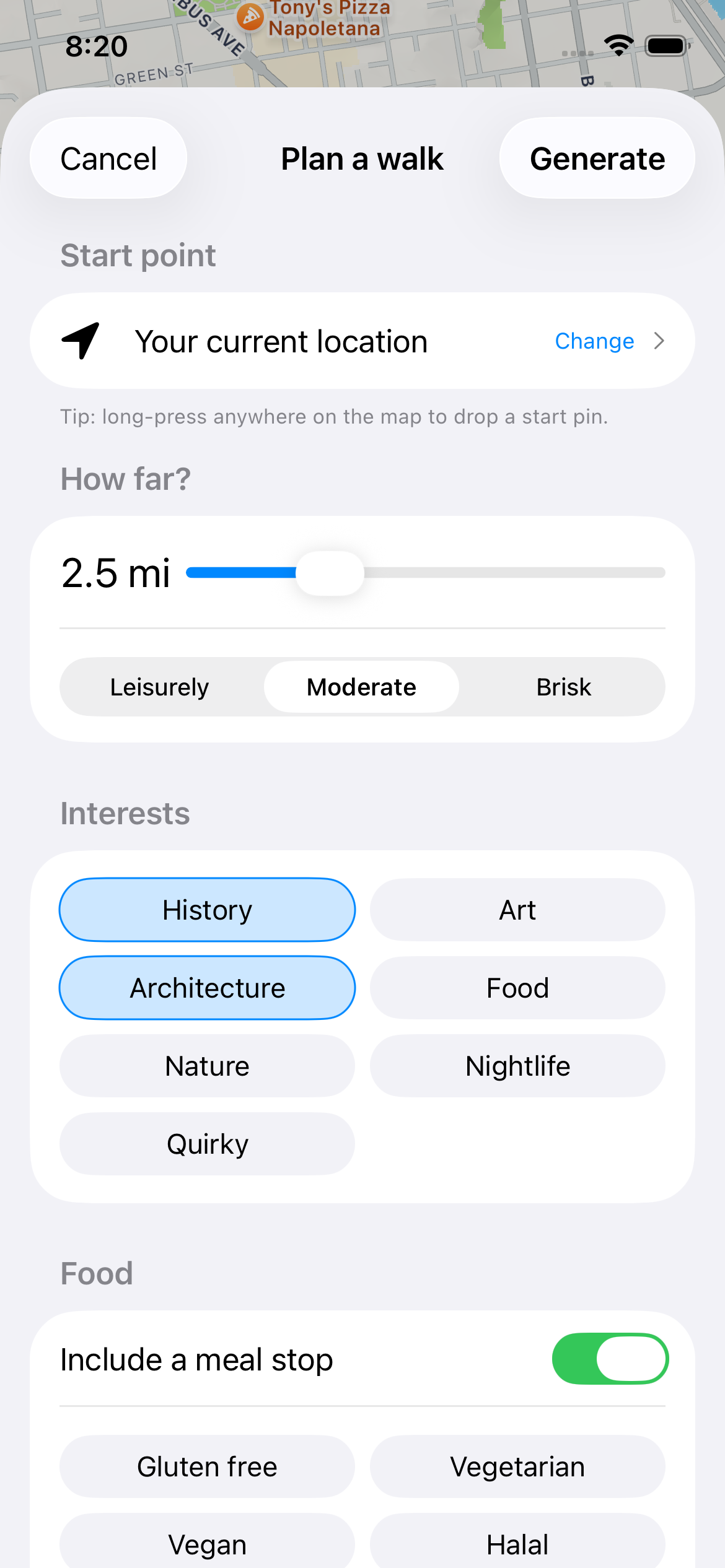
Open this route in the Mosey app for turn-by-turn navigation, stop-by-stop audio context, and offline maps — no planning required, just walk.
Download on the App Store — Free