The Heights is one of the few Houston neighborhoods where walking is the best way to see it. Developer Oscar Martin Carter's company laid it out in 1891 on higher ground northwest of downtown, and the original plan still shapes the streets: a wide boulevard, tight residential blocks, and a main commercial strip on 19th Street. If you want a Houston Heights walking tour built around architecture and food, this is a compact loop that covers both.
The route runs 2.2 miles over five stops. It begins on the Heights Boulevard esplanade, moves through the residential blocks where Queen Anne cottages and 1910s-1920s bungalows sit side by side, then turns to 19th Street for the Heights Theater and the antiques-and-boutique row. It ends with a sit-down meal at Harold's, so you finish fed rather than limping toward a parking spot.
This self-guided Heights tour was built with the Mosey app, which pulls the history for each stop as you arrive, and the first three tours are free. Plan on about two and a half hours with the meal. The walking is flat, but Houston weather decides how pleasant it is, so read the tips below before you pick a start time.
Heights Boulevard to 19th Street: The Route
"Heights Boulevard was the spine of the planned community that Oscar Martin Carter and his Omaha and South Texas Land Company began selling in 1891. Carter's idea was a suburb on higher ground with its own utilities and a streetcar link to downtown, and the wide, landscaped boulevard was the showpiece. The Heights incorporated as its own city in 1896 and was annexed by Houston in 1918. The esplanade you walk on today is a descendant of that original plan."
Walk the center path instead of the sidewalks so you can see the houses on both sides. The esplanade is free and open all day. Early morning is quietest, when you'll mostly share it with joggers and dog walkers.
"The Heights is now divided into three city-designated historic districts, which is why so many early houses survive despite Houston's reputation for tearing things down. The oldest homes are Queen Anne and folk Victorian cottages from the 1890s and 1900s, recognizable by turned porch posts, gingerbread trim, and steep, multi-gabled roofs. Later blocks shift to the Craftsman bungalows of the 1910s and 1920s, with deep front porches and low-pitched roofs. The two styles often stand side by side because lots were sold and built out over decades."
These are private homes, so stay on the public sidewalk and keep photos from the street. Look at the porches first: the change in porch columns from slender turned wood to thick tapered Craftsman piers is the quickest way to date a house. Some newer houses imitate the older styles, so check rooflines and trim for signs of recent construction.
"The Heights Theater at 339 W 19th Street opened in 1929 as a neighborhood movie house, built when the Heights was a fully developed streetcar suburb with its own commercial district. Its location on 19th Street reflects how the neighborhood's shopping and entertainment centered on that corridor. The building has been a cinema and a live-music venue at different times, which is typical of surviving single-screen theaters in Texas."
The exterior is the main draw for this walk, and it's free to look at. If you want to go inside, check the venue's calendar in advance, since access depends on what's scheduled that day. Don't count on walking in unannounced.
"West 19th Street was the Heights' original main street, and many of the low brick storefronts along it date to the early twentieth century, when the neighborhood was still its own city. After annexation in 1918 it continued to serve residents as a local shopping district. Today the street mixes antiques dealers, independent boutiques, and restaurants in those older commercial buildings. The scale is what gives it away as a pre-mall street: small lots, shallow storefronts, and parking on the curb."
Antiques and boutique shops mostly open late morning and vary in hours, with many closed Mondays, so a weekday morning start can leave you looking at shuttered doors. Browsing is free, and prices in the antique shops can be steep, so treat it as a museum visit unless you have a specific item in mind. Weekend afternoons get crowded and parking tightens.
"Harold's sits at 350 W 19th Street, on the same commercial strip that anchored the Heights after Carter's company founded it in 1891. It is one of the better-known sit-down restaurants on 19th and serves a Southern-leaning menu. Eating here puts you in the part of the neighborhood that was built for gathering long before it was a dining destination."
Check current hours and whether it takes reservations before you go; weekend lunch and dinner can run busy. Weekday lunch is the easier time to get a table. Look at the current menu online first, since dishes change and this guide cannot confirm what is being served this season.
Before You Go: Timing, Parking, and What to Skip
Best time to walk: Mid-November is a good time for this walk: highs are typically in the 70s, and the humidity that makes summer walking miserable has mostly lifted. Cold fronts can bring a sharp drop and wind, so a light layer helps. In summer, start before 9 a.m. or skip the afternoon. Houston rain can arrive quickly, and there is little covered walking outside the 19th Street shops.
Shoes: Flat sidewalks and a packed-dirt or paved esplanade path. Comfortable sneakers are enough. Some residential sidewalks are cracked or heaved by oak roots, so watch your footing, especially after dark.
The narration: At each stop, Mosey surfaces the documented context: who built it, when, what it was used for, and how it changed after the Heights was annexed by Houston in 1918.

Walk Houston's Heights with Mosey
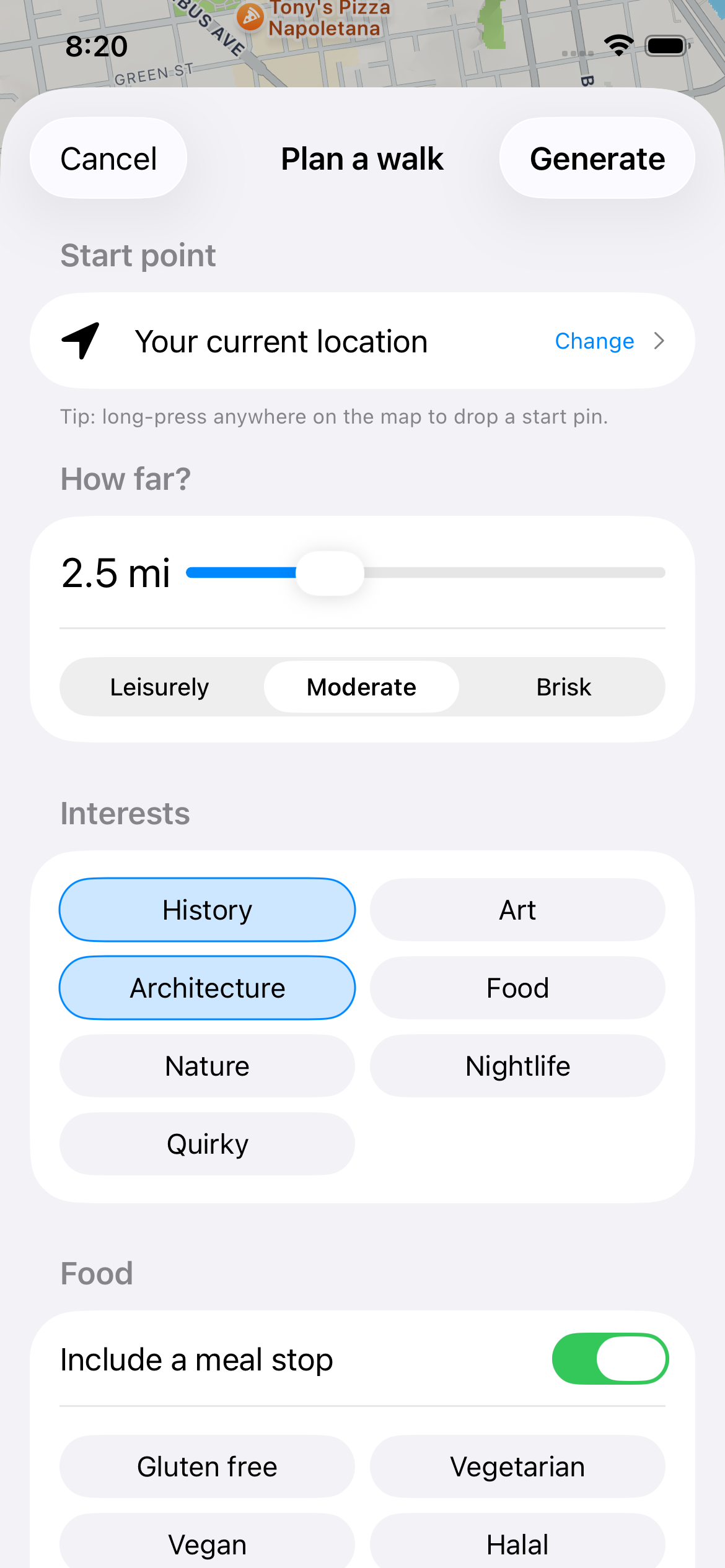
Mosey plans a walk like this one on your iPhone, starting wherever you choose.
- Set a distance or a time and pick what you're into
- Real stops in a walking order that makes sense on foot
- The story behind each stop, read aloud as you arrive
- A meal stop that fits the route

Free to download. iPhone, iOS 17 or later.
Frequently asked questions
How long does it take to walk the Houston Heights?
This route takes about two and a half hours, including a sit-down meal. The walking itself is a 2.2-mile loop, which most people finish in roughly an hour and a half at a relaxed pace. Add time if you browse the shops on 19th Street.
Is the Heights walkable?
Yes, especially along Heights Boulevard and West 19th Street. The terrain is flat and the blocks are small. Outside those corridors, some sidewalks are cracked by tree roots, and the neighborhood's edges are more car-oriented, so stick to the core streets if you are on foot.
What is the best time of year to do a Heights walking tour?
Late fall through early spring is best. Mid-November highs are typically in the 70s, with far less humidity than summer. In July and August, start before 9 a.m. or walk in the evening, because afternoon heat can make a two-hour walk unpleasant.
What is there to see on a self-guided Heights tour?
You can see the Heights Boulevard esplanade, Queen Anne and Craftsman houses in the historic districts, the Heights Theater (opened 1929), and the shops along West 19th Street. The neighborhood's appeal is mostly architectural, so expect streetscapes rather than a major museum.
Is it free to do a self-guided walking tour of the Heights?
The walk itself costs nothing, since the esplanade, houses, and streets are all public. You will only pay for food or shopping. If you use Mosey for the narration, the first three tours are free.
More Houston Neighborhoods to Walk
If you enjoy the Heights, Houston has other areas that reward walking with Mosey. Montrose has a mix of early twentieth-century houses and independent shops, and the Museum District has a cluster of cultural institutions around Hermann Park. Downtown's historic core offers older commercial buildings and the bayou-side Buffalo Bayou Park, and the Rice Village area is an easy add-on for a different kind of food route.