Downtown Eugene doesn't try to look like a postcard, and that's part of what makes it worth walking. This is a college town and a farm town at once, a place where the country's first Saturday Market started in a parking lot in 1970 and where murals cover the sides of buildings that used to sell hardware and shoes. The grid is small enough to cover on foot in an afternoon, but dense enough with public art, food carts, and odd bits of civic history that most people miss half of it walking straight to the Hult Center.
This route runs from the Park Blocks near Broadway and Oak, through the core retail streets, past several of the murals that give downtown its unofficial identity, and finishes at the Fifth Street Public Market — a former produce warehouse turned food hall. Along the way you'll pass the site of the original Saturday Market, the Eugene Public Library's public art collection, and a couple of buildings that survived a downtown that was, for decades, more parking lot than storefront.
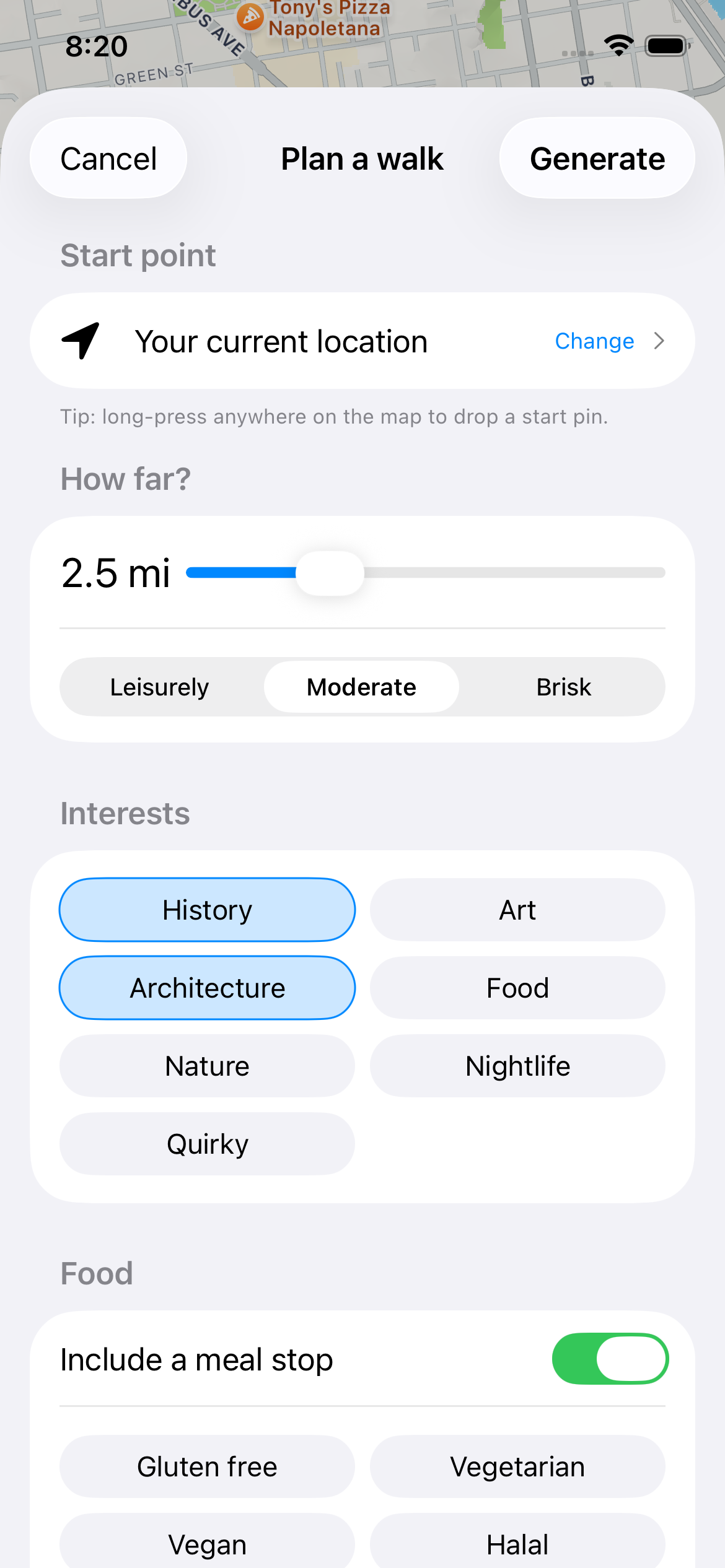
The Mosey app plots this walk with GPS-triggered narration, so you get the history at each stop without hunting for a plaque or squinting at a QR code. It's a good one to do on a Saturday morning when the Farmers Market is running in the Park Blocks, or on a weekday afternoon when the streets are quieter and you can actually see the murals without a food cart blocking the view.
The Route: Park Blocks to the Public Market
"The Lane County Farmers Market, which claims to be the first producer-only farmers market in the country, started here in 1970 as a handful of growers selling out of their trucks. Eugene's Saturday Market, a companion craft and food market, launched the following year in 1971 and has run continuously since, making it the oldest weekly open-air craft market in the United States. The Park Blocks themselves sit on land the city set aside for public use going back to Eugene's original 1852 townsite plan."
If you're walking on a Saturday between April and November, the market will be in full swing here and worth 20 minutes just wandering the food carts. On other days it's just a quiet plaza — don't plan your route around it outside market hours.
"Eugene's downtown mural program grew out of a 1990s effort by the city and local arts groups to fill blank commercial walls after decades of downtown disinvestment — Eugene lost much of its retail core to suburban malls and the Valley River Center in the 1960s and 70s, leaving a lot of unused brick facing. The Eugene, Cascades & Coast Convention & Visitors Bureau and the Lane Arts Council later formalized a mural map covering dozens of works across downtown and the Whiteaker neighborhood. Many pieces along Broadway and the connecting alleys were painted between the 1990s and 2010s by local and regional artists working directly on commercial building walls."
Walk the alley slowly — most people cut straight through without looking up. Lighting is best in mid-morning when the sun isn't glaring directly off the brick.
"The current library, at 100 West 10th Avenue, opened in 2002, replacing a 1959 building that had outgrown the city's needs. Oregon's Percent for Art law, passed in 1975, requires public building projects to set aside roughly 1% of construction cost for artwork, and the library's collection — sculpture, glasswork, and installations spread across its floors and plaza — was built under that program. The building was designed by Robertson/Sherwood/Architects with WGSA of Denver."
Entry is free and the art is scattered through the lobby and upper floors, not just the plaza, so it's worth stepping inside for five minutes even if you're not borrowing a library card. Public restrooms here are useful mid-walk.
"The building at 296 East 5th Avenue was originally a fruit and produce cannery and warehouse complex dating to the early 20th century, tied to Eugene's role as a shipping point for Willamette Valley agriculture. It was redeveloped into a retail and dining marketplace starting in 1975, one of the earlier adaptive-reuse projects of its kind in the Pacific Northwest, and has been renovated and expanded several times since, most substantially in the 2010s."
The market has multiple entrances off 5th, High, and Oak — come in from the 5th Avenue side to see the original brick and timber framing before you're in the newer retail wing.
"This small plaza is named for Ken Kesey, the Eugene-raised author of One Flew Over the Cuckoo's Nest, who grew up in nearby Springfield and attended the University of Oregon. A bronze statue of Kesey reading to his grandchildren, sculpted by Peter Helzer, was installed nearby in 2003. The square itself, at the corner of Broadway and Willamette, has been a persistent subject of city redevelopment debate for years over what to do with an underused block in the middle of downtown."
It's a small stop — five minutes is enough — but it's a good landmark for orienting yourself, since Broadway and Willamette is the rough center of the downtown grid.
"This stretch of Willamette Street mixes several mural-covered facades with longtime local food businesses, part of the same downtown revitalization push of the 1990s and 2000s that funded the alley murals near Broadway. The block has turned over storefronts many times, but the mural work has generally stayed, repainted or touched up rather than removed, which is part of why downtown Eugene's public art feels layered rather than curated all at once."
Good spot for photos in late afternoon light. If you're hungry before your final stop, this is also where several food carts cluster on weekday lunches.
"The food hall inside the Fifth Street Public Market has rotated vendors over the decades but has consistently anchored downtown Eugene's lunch crowd since the market's 1975 opening, with the building's original brick walls and exposed beams still visible in the dining areas. Provisions Market Hall, one of the longer-running tenants, focuses on Pacific Northwest cheese, charcuterie, and prepared foods sourced from Willamette Valley producers."
Grab a table upstairs near the skylight if it's sunny — it's the best-lit indoor seating downtown. Expect $10–18 per person depending on vendor; cash isn't required, most stalls take cards. Weekday lunches (11:30am–1pm) get crowded fast with UO staff and downtown workers, so aim slightly earlier or later.
Planning Your Walk
Best time to walk: Eugene gets real rain from October through May, so August is one of the driest, most reliable months to walk downtown — expect sun, highs in the low 80s, and almost no rain. Mornings before 10am are cooler and less crowded if the Farmers Market is running.
Shoes: Flat concrete sidewalks and a couple of brick plazas — regular walking shoes are fine, nothing technical about this route.
The narration: At each stop, Mosey surfaces short historical context pulled from local sources — the year a building went up, who painted a mural, what used to occupy the storefront — so you're not just looking at a wall, you know why it's there.
Walk Downtown Eugene with Mosey
Get this exact route loaded on your phone with GPS-triggered narration at every stop — no maps, no guesswork, just walk and listen.
Download on the App Store — FreeFrequently asked questions
How long does it take to walk downtown Eugene?
Plan on about two to two and a half hours for a 1.8-mile route covering the Park Blocks, murals, the library, and the Fifth Street Public Market, including stops to read historical context and a meal break. Without stops, the walking time alone is closer to 40 minutes.
Is downtown Eugene walkable?
Yes. Downtown Eugene sits on a compact grid roughly bounded by 5th Avenue, 13th Avenue, Willamette Street, and High Street, with flat sidewalks and short blocks throughout. Most attractions, including Kesey Square, the library, and the Fifth Street Public Market, are within a 10-minute walk of each other.
When is the best time to walk downtown Eugene for the Saturday Market?
Saturdays between April and November, ideally 10am to 1pm, when both the Lane County Farmers Market and Eugene Saturday Market are running in and around the Park Blocks. Arrive by 10am to beat the midday crowd and get first pick of food cart lines.
Where do I park to walk downtown Eugene?
The Overpark garage at 2nd and Willamette and the Broadway garage near Broadway and Charnelton are both central and affordable, typically under $2 an hour. Metered street parking is available throughout downtown but fills up fast on Saturday market days.
Are the downtown Eugene murals a formal tour or self-guided?
They're self-guided. The Eugene, Cascades & Coast Convention & Visitors Bureau and Lane Arts Council maintain a mural map covering dozens of works downtown and in the Whiteaker neighborhood, but there's no scheduled guided tour. Apps like Mosey route you between them with historical context at each stop.
Is downtown Eugene safe to walk during the day?
Yes, downtown Eugene is generally safe to walk during daytime hours, with steady foot traffic around the Park Blocks, library, and Fifth Street Public Market. Like many mid-sized downtowns, some blocks near the bus station and Kesey Square can feel less comfortable after dark, so daytime or early evening is the better window.
More Eugene Neighborhoods to Explore
If this route leaves you wanting more, the Whiteaker neighborhood just north of downtown carries the mural tradition further, with breweries and food carts packed into old industrial blocks along Blair Boulevard. The University of Oregon campus, a short walk southeast, adds another layer with its own public art collection, historic Deady Hall, and the Jordan Schnitzer Museum of Art. Mosey has routes for both, built the same way as this one — GPS-triggered stops with real historical context, no guesswork required.