Deep Ellum got its name from the way locals pronounced "Elm Street" a century ago, and the street still runs through the middle of everything that matters here. This was a freedman's settlement after the Civil War, then a cotton and leather-goods district, then the loudest blues and jazz strip between New Orleans and Kansas City. Blind Lemon Jefferson played these blocks. Robert Johnson recorded here in 1937. The neighborhood has been bulldozed, reborn, and bulldozed again, and what's left is a dense grid of brick warehouses now covered in some of the best mural work in Texas.
This walk covers the stretch between Good-Latimer Expressway and the east end of Elm and Main, the compact core where the history is thickest and the walls are busiest. You'll pass a Masonic-lodge-turned-blues-landmark, a converted Ford assembly plant, a mural by a Dallas-bred street artist with international reach, and a brewery that occupies a 1930s industrial building. None of it requires a car once you're parked, and none of it requires more than a few hours.
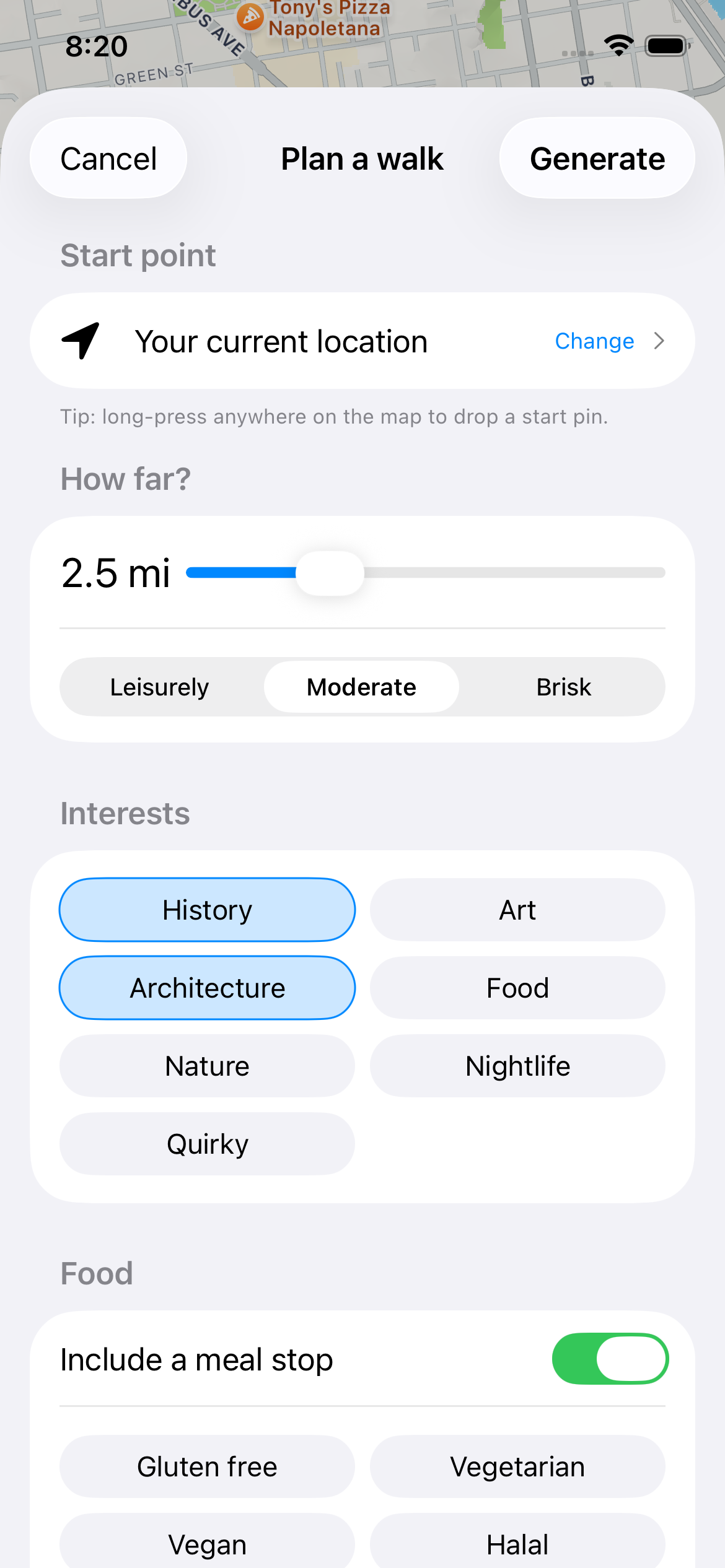
Mosey built this route to string together the stuff you'd miss walking through with your head down, the plaque on a wall, the year a building actually went up, the act that played a now-demolished club. Pull up the app at the first stop and it'll surface that context as you go, so you're not standing in front of a mural googling who painted it.
The Route: Blues History to Brewery
"In the 1920s and 30s, this block of Elm Street held more than a dozen clubs, theaters, and record shops serving Dallas's Black community, concentrated here because of segregation-era restrictions elsewhere in the city. Blind Lemon Jefferson, Lead Belly, and T-Bone Walker all worked this strip before any of them had national reputations. Columbia Records and Brunswick Records both ran field recording sessions in Deep Ellum during this period, cutting blues and gospel sides that got shipped out to the rest of the country. Most of the original buildings from that era are gone, torn down for the Central Expressway and later redevelopment."
Look for the historical markers along Elm between Good-Latimer and Crowdus, they mark sites that no longer physically exist. There's not much to photograph here beyond the plaques themselves, so don't expect a visual payoff, this stop is about context for what you'll see mural tributes to later on the walk.
"The building at 2713 Canton Street was constructed in 1912 as a Ford Motor Company assembly plant, one of the first outside Michigan. It later housed a manufacturer that made explosives for mining, which is where the current name comes from. The space sat empty and deteriorating for years before a 2015 renovation turned it into a 4,200-capacity concert hall, and it reopened with acts like My Morning Jacket and Erykah Badu in its first season."
Check the show calendar before you go if you want to see the inside; during the day it's usually locked unless there's a load-in happening. The exterior brick and the scale of the building are worth the short detour even if you can't get in, it's one of the few structures in the neighborhood that still reads as industrial at first glance.
"Deep Ellum's mural scene really took off after the city designated it an official Mural District in 2012, giving building owners a faster permitting path for approved public art. The '42' mural at the corner of Main and Crowdus, by Dallas artist Sean Starwars, pays tribute to Jackie Robinson's jersey number and is one of the most photographed walls in the district. Other blocks along Main and Elm rotate every year or two, since most are painted directly on building facades owned by private landlords who commission new work on their own schedule."
Early morning or late afternoon light works best for photos since the street runs east-west and direct overhead sun flattens the color. Don't expect every mural you've seen on Instagram to still be there, turnover is real and a wall that was a City of Angels work last year might be something else now.
"Deep Ellum Brewing Company opened in 2011 inside a renovated industrial building on Commerce Street, part of the first wave of breweries to take advantage of Texas's loosened self-distribution laws that year. Their Dallas Blonde and Deep Ellum IPA became some of the most widely distributed Texas craft beers in grocery stores statewide within a few years of opening. The taproom sits inside the original brick shell, with the brewing equipment visible from the bar area."
The taproom opens at 11am most days, call ahead or check their site since hours shift seasonally. A flight runs about $10-12 and is the easiest way to taste the range without committing to a full pint, good move if you've still got walking left to do.
"Trees opened in 1990 at 2709 Elm Street and became one of the defining alt-rock venues of the decade in Dallas, hosting early shows from Nirvana, Pantera, and Smashing Pumpkins before any of them were headlining arenas. Kurt Cobain's 1991 show here is still one of the most talked-about nights in the club's history, partly because of a notorious on-stage incident involving a stage security guard. The venue closed and reopened under different owners more than once but has kept booking touring acts continuously since."
It's a working venue, so daytime visits just mean a look at the marquee and the block it's on. If a show lines up with your walk, tickets run cheap compared to arena prices, this is still a room where you can stand close to the stage.
"Cisco's traces back to the 1950s as part of Dallas's long run of Tex-Mex restaurants, and the Deep Ellum location on Main Street has been a neighborhood fixture for decades, serving the kind of queso and brisket tacos that predate the craft-everything wave around it. It's a straightforward counter-and-table setup, not a destination restaurant trying to reinvent Tex-Mex, which is part of the appeal after a few hours of walking past murals and former club sites."
Go for the brisket tacos or the enchiladas, both consistently good, and the queso is a reasonable way to split an appetizer with a walking partner. It's cash-friendly and fast, usually under 20 minutes from order to table even at a Friday lunch rush, and patio seating is available when weather allows.
Planning Your Walk
Best time to walk: October in Dallas usually means afternoons in the 70s and 80s with low humidity, one of the more comfortable stretches of the year to be outside. Mornings can start cool enough for a light jacket. Afternoon sun is still strong, so sunglasses and water matter more than you'd think.
Shoes: Flat, even sidewalks and old brick crosswalks throughout, comfortable in sneakers. A few blocks have uneven pavers near loading docks, so skip anything with a thin sole.
The narration: Mosey surfaces the year each building went up, who played or painted where, and what used to stand on empty lots, right as you reach them.
Walk Deep Ellum with Mosey
Pull up this route in the Mosey app and get the full historical narration at every stop, timed to when you actually arrive.
Download on the App Store — FreeFrequently asked questions
How long does it take to walk Deep Ellum?
About 2 to 2.5 hours for the 1.8-mile core route covering Elm, Main, and Commerce streets, including stops at murals, the Bomb Factory, and a sit-down meal. Add 30 to 45 minutes if you're stopping inside Deep Ellum Brewing for a flight or lingering at multiple murals for photos.
Is Deep Ellum walkable?
Yes, the core of Deep Ellum is a compact grid of about six blocks, flat and easy on foot with sidewalks throughout. The DART Green Line's Deep Ellum station drops you right at Elm and Good-Latimer, so you don't need a car once you arrive from downtown Dallas or anywhere else on the rail line.
Is Deep Ellum safe to walk during the day?
Yes, daytime walking through Deep Ellum's main commercial blocks is generally safe and busy with foot traffic, especially on Elm and Main between Good-Latimer and Malcolm X Boulevard. Standard city precautions apply at night when bar crowds grow; stick to well-lit streets and avoid empty side lots near the expressway.
What's the best time of day to see the Deep Ellum murals?
Late morning to mid-afternoon gives the best light for photographing murals on Main and Elm streets, since the east-west street orientation means harsh midday sun can flatten colors. Weekday visits mean fewer people walking through your shots compared to Friday or Saturday evenings when bar crowds fill the sidewalks.
Where do you park for a Deep Ellum walking tour?
Metered street parking lines Elm, Main, and Commerce streets, and several surface lots near Good-Latimer Expressway charge flat daytime rates around $5 to $10. The DART Deep Ellum station is the simplest option if you're coming from downtown or uptown Dallas and want to skip parking entirely.
What music history is Deep Ellum known for?
Deep Ellum was Dallas's major blues and jazz corridor in the 1920s and 30s, with Blind Lemon Jefferson and Lead Belly performing on Elm Street and Columbia and Brunswick Records running recording sessions there. The neighborhood later became Dallas's alt-rock hub in the 1990s, anchored by venues like Trees and the Bomb Factory.