Ohio City was its own municipality before Cleveland annexed it in 1854, and it still carries the chip on its shoulder that comes with losing a bridge war. This is one of the oldest neighborhoods on the west side of the Cuyahoga River, settled by German and Irish immigrants who built breweries, churches, and rowhouses that still define the streetscape today. Walking it now means moving between restored 19th-century architecture and a food scene that's grown up around one of the great public markets in the country.
The route starts at the West Side Market, the neighborhood's anchor since 1912, and works through the residential blocks and church corridors that show how immigrant communities organized their lives here — work, worship, and home all within a few minutes' walk of each other. You'll pass Victorian houses, a landmark church with a spire that still dominates the skyline west of the river, and sites tied to Cleveland's brewing and labor history. It's a compact walk, but it covers a lot of ground historically.
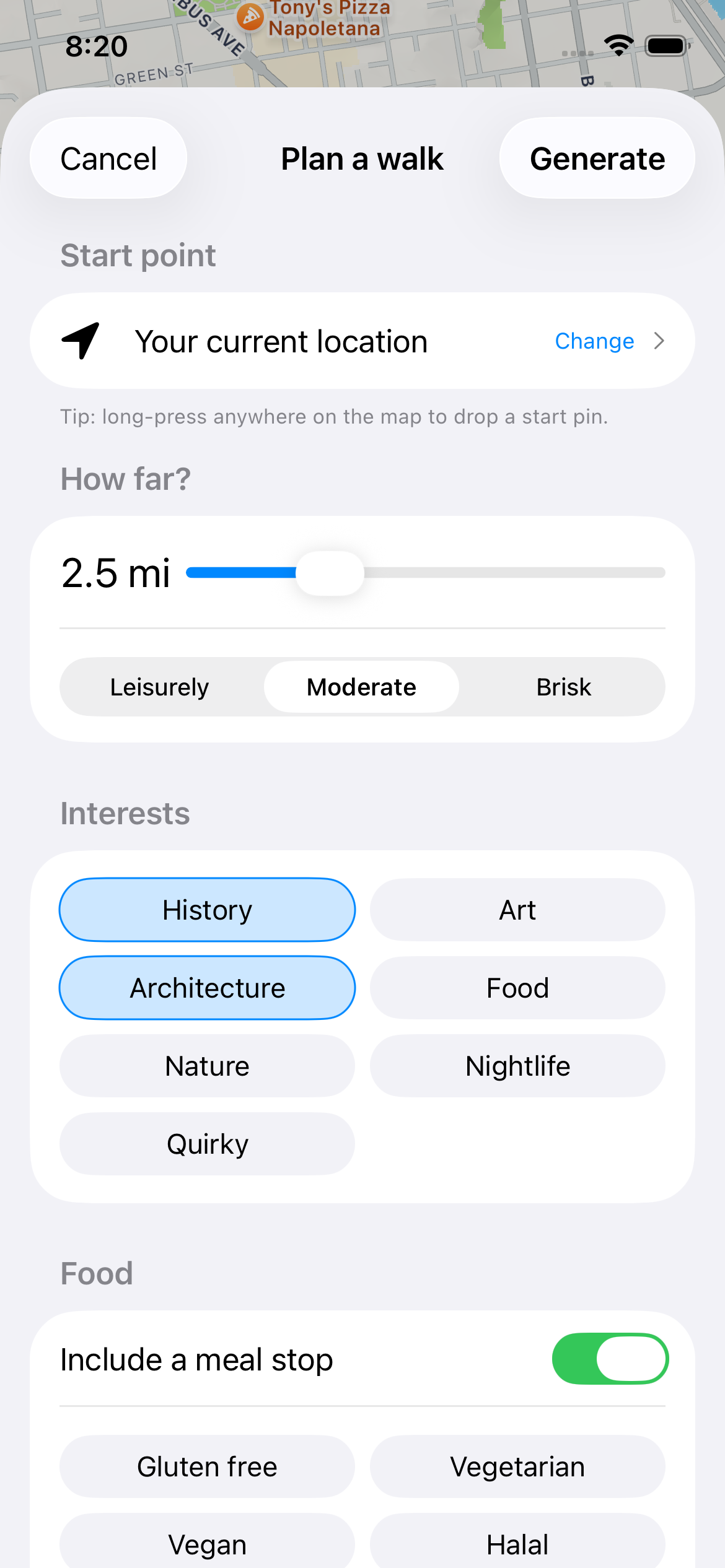
Mosey built this route to string together the stops that matter without extra backtracking, and the app surfaces historical context at each point so you're not guessing what you're looking at. You can walk it at your own pace, skip ahead if something doesn't interest you, and linger at the market or the meal stop as long as you want — the route doesn't care what time you finish.
The Route: Stop by Stop Through Ohio City
"The West Side Market opened in 1912, designed by architects Benjamin Hubbell and W. Dominick Benes, who also designed the Cleveland Museum of Art. Its clock tower rises 137 feet and was modeled loosely on European market halls, a nod to the German, Bohemian, and Polish vendors who filled the stalls from day one. It's the oldest continuously operating indoor-outdoor market in Cleveland and one of the oldest in the country, and the vaulted, tiled interior is largely unchanged from its original construction."
Walk the full interior loop before buying anything — vendors range from third-generation butchers to newer specialty stalls, and prices vary more than you'd expect. Go early on Saturday for the best selection, or later morning on a weekday for shorter lines. It's free to browse; you're only paying for what you eat or buy.
"This small triangular park sits directly across from the market and has functioned as informal public space for the neighborhood since the market's construction. It's flanked by 19th-century commercial buildings that once housed saloons and shops serving the market crowd and the surrounding immigrant workforce. The park's modest size belies its role as a social anchor — a place where market vendors and shoppers have crossed paths for over a century."
This is a quick stop — just enough to sit for a minute and take in the market building's facade from across the street, which is hard to appreciate up close. Good spot for photos of the clock tower without the crowds in frame.
"Built in the late 19th century to serve Cleveland's growing Catholic immigrant population, this parish reflects the wave of church construction that accompanied Ohio City's settlement patterns — congregations organized by ethnicity as much as denomination. The neighborhood at one point supported multiple Catholic parishes within a short walk of each other, each tied to a different immigrant group's identity. The brick and stone construction typical of these churches was meant to last, and most of them have."
You can usually view the exterior and grounds without going inside; check posted hours if you want to see the interior. Worth slowing down here just to notice the density of church architecture in a few square blocks — a clue to how crowded and layered this neighborhood once was.
"Built in 1881 for German immigrant and businessman Hannes Tiedemann, this Victorian mansion at 4308 Franklin Blvd is widely regarded as the most famous haunted house in Cleveland, though its real history is more about wealth and architecture than ghosts. Tiedemann made his fortune in banking and grocery wholesale, and the house's turrets, gables, and stonework were meant to signal status in a neighborhood full of far more modest homes. It changed hands numerous times over the 20th century, sat vacant for stretches, and has been the subject of persistent local legend ever since."
This is a private residence, so view it from the sidewalk only — respect the property line. It's one of the more photogenic stops on the route, especially in late afternoon light when the stonework casts long shadows.
"Founded in 1853 to serve Ohio City's Irish immigrant population, St. Patrick's predates the neighborhood's annexation into Cleveland the following year. The Irish community here worked largely on the docks, in the mills, and building the railroads that ran along the river, and the parish became a center of community life distinct from the German Catholic parishes elsewhere in the neighborhood. The current church building reflects later construction, but the parish's roots go back to Ohio City's founding decades."
Check exterior architectural details — the brickwork and window tracery are worth a slow look even if you don't go inside. This stop pairs well with St. Ignatius earlier in the walk if you want to compare how the German and Irish parishes differed architecturally.
"The blocks along here contain some of Cleveland's best-preserved 19th-century worker housing, built for the dockworkers, brewers, and market employees who populated Ohio City through the late 1800s. Many of these homes were built quickly and modestly compared to grander Cleveland neighborhoods, but their survival gives a rare intact look at how working-class immigrant families actually lived. Ohio City's preservation movement, which gained real momentum in the 1970s, focused heavily on saving exactly this kind of housing stock from demolition."
Walk slowly here — the interest is in the details, not a single landmark: porch styles, brick patterns, and lot sizes that reveal how tightly packed the original neighborhood was. No fees, no interiors to visit, just a good stretch for noticing the built environment.
"Great Lakes Brewing Company opened in 1988 inside a building dating to 1865, making it one of the pioneers of Ohio's modern craft beer movement and a fixture of Ohio City's revival. The building's bar itself has bullet holes reportedly left by Eliot Ness during Prohibition-era enforcement, when the space operated as a saloon and the neighborhood was thick with breweries tied to the German immigrant community that settled here in the 1800s. The brewery's founders deliberately chose Ohio City for its brewing history, reviving a tradition that had mostly died out locally by the mid-20th century."
Sit at the original bar if you can get a seat — ask staff about the bullet holes, they're used to the question and it's worth hearing the short version. The pub food is solid and the beer list covers their full lineup plus seasonal releases; this is a good place to end the walk and take your time rather than rush the last stop.
Planning Your Walk
Best time to walk: August in Cleveland runs warm and humid, typically 75-85°F; mornings before 10am are noticeably cooler and less crowded at the market, and afternoon storms roll in off Lake Erie often enough to justify carrying a light rain layer.
Shoes: Flat sidewalks and market floors throughout, with some uneven brick and cobblestone near the older residential blocks — comfortable walking shoes are enough, no need for hiking gear.
The narration: At each stop, Mosey surfaces the kind of specific historical detail — construction dates, immigrant origins, architectural quirks — that turns a building you'd otherwise walk past into something worth stopping for.
Walk Ohio City With Mosey
Get turn-by-turn guidance and historical narration at every stop, right in your pocket — download the Mosey app and start walking.
Download on the App Store — Free