Pilsen is named after Plzeň in Bohemia, and the name is the first clue that this Lower West Side neighborhood has been rebuilt by one immigrant group after another. Czech settlers arrived in force after the 1871 fire, Polish and other Catholic parishes put up enormous churches on side streets, and from the middle of the twentieth century Mexican families made 18th Street the center of the neighborhood's commercial and cultural life. Anyone searching for a Chicago Pilsen walking tour is really looking for that layering: Czech theater halls, Polish church towers, Mexican murals and bakeries, all within a few blocks.
This self-guided Pilsen tour is built for people who care about art and food. It starts at the 18th Street Pink Line station, passes one of the largest church towers in the neighborhood, goes inside a Czech-built music hall, spends real time in the National Museum of Mexican Art, and ends with a sit-down meal on 18th Street. Plan on about two and a half hours, longer if you linger in the museum.
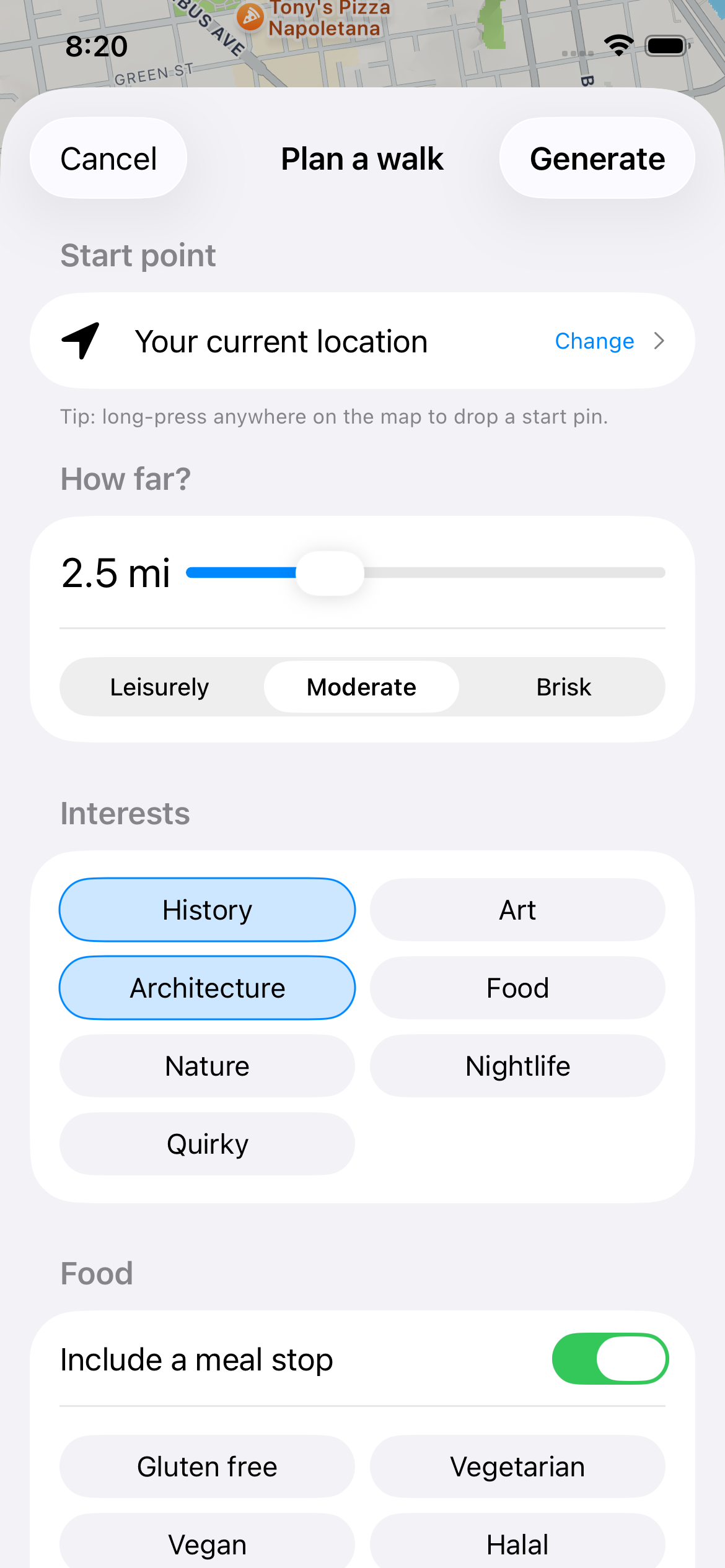
The Mosey app built this route and surfaces the history at each stop as you arrive, so you can keep your eyes on the buildings instead of a guidebook. The first three tours are free. Pilsen is flat and the blocks are short, which makes it one of the easier neighborhoods in Chicago to do on foot.
The Pilsen Route: From Czech Bohemia to 18th Street
"Pilsen took its name from Plzeň, the Bohemian city known for beer, because Czech immigrants made up the neighborhood's early population in the decades after the 1871 Chicago Fire. The area sat close to rail lines, lumber yards and factories along the South Branch of the Chicago River, which meant steady work for newcomers. The Pink Line, which began service in 2006, is the modern way in, and 18th Street remains the commercial spine."
Take a minute at the corner to look at how the storefronts on 18th Street are built: narrow lots, flat-front brick, apartments above shops. That is the pattern of the Czech-era neighborhood, now filled with Mexican restaurants and bakeries. Skip the urge to start shopping here; the better stops are a few blocks off the main drag.
"St. Adalbert was founded in 1874 as a Polish Catholic parish, and the present church at 1650 W. 17th Street was designed by architect Henry J. Schlacks and finished in 1914. Its twin towers rise roughly 185 feet, which makes them among the tallest landmarks in the neighborhood. The building reflects how much money Polish working families poured into their parishes: this was a congregation of factory and rail workers funding an Italian Renaissance-style church."
The best view is from the sidewalk across 17th Street, where both towers fit in a photo. Interior access depends on Mass times and the parish office, so treat the inside as a bonus and do not plan the walk around it. Entry to services is free if you do attend; dress respectfully.
"Thalia Hall, at 1807 S. Allport Street, opened in 1892, built by developer John Dusek and designed by the firm Faber & Rapp in a Czech Renaissance Revival style modeled on theaters in Prague. It combined a ground-floor commercial space with a performance hall upstairs, serving the Bohemian community for social events and theater. After decades of decline, it reopened in 2013 as a concert venue and restaurant under new ownership."
From outside you can read the facade details, including the ornamental brick and stonework, and that is free anytime. Tours of the hall are not guaranteed, so do not count on seeing the main room unless there is a show or a posted event. If you come at night, expect lines and noise on Allport Street.
"The museum at 1852 W. 19th Street was founded in 1982 as the Mexican Fine Arts Center Museum by Carlos Tortolero and others, and it sits inside Harrison Park on the edge of Pilsen. It focuses on Mexican art and culture on both sides of the border, and it is known for an annual Día de Muertos exhibition that has drawn visitors from across the city for decades. Admission has remained free, which was a deliberate choice for a museum rooted in a working-class community."
This is the stop worth lingering over, and the reason to start the walk in the morning rather than late afternoon. The museum is typically closed on Mondays, so check hours before you go. Donations are welcome but not required. In late October the Día de Muertos displays are usually on view, so expect more visitors on weekends and go on a weekday if you can.
"Nuevo Leon, at 1515 W. 18th Street, has been a fixture of the 18th Street corridor since 1962, a period when the neighborhood was shifting from its Czech and Polish past toward the Mexican community that has defined it since. It belongs to the generation of family-run restaurants that built Pilsen's reputation for traditional Mexican cooking. The menu leans toward classic dishes such as caldo, enchiladas, tacos and chilaquiles."
Go off-peak, between about 1:30 and 4:00 p.m., since weekends fill the dining room at midday. Order a soup or a plate of something you cannot easily get at a chain, and ask what is fresh that day. Afterward, a short walk down 18th Street will pass bakeries and small shops, which are good for a pastry to carry back to the Pink Line.
Before You Walk Pilsen: Timing, Crowds and What to Skip
Best time to walk: Late October in Chicago usually means jackets and a strong chance of wind; temperatures often sit in the 40s and 50s Fahrenheit and can swing quickly. Layers matter more than a heavy coat. Rain turns the sidewalks slick but the museum and restaurant give you good indoor stretches. Late morning to early afternoon is the best window, since the museum is open and the light is better for murals.
Shoes: Flat sidewalks and short blocks throughout, with some cracked pavement and uneven curbs on side streets. Comfortable everyday sneakers are enough. You will spend long stretches standing in the museum, so skip anything stiff.
The narration: At each stop Mosey surfaces the dates, builders and neighborhood events behind what you are looking at, from the Czech and Polish founding of Pilsen to the arrival of the Mexican community that defines it today.
Walk Pilsen With the Story Built In
Open Mosey to get this Pilsen route with narration at every stop, from St. Adalbert to 18th Street. The first three tours are free.
Download on the App Store — FreeFrequently asked questions
How long does it take to walk through Pilsen?
Plan on about two and a half hours for this route, which covers roughly 2 miles. The walking itself takes closer to 50 minutes. The rest is time inside the National Museum of Mexican Art and sitting down for a meal on 18th Street.
Is Pilsen walkable?
Yes, Pilsen is flat and compact, and most of what visitors want is within a few blocks of 18th Street. The Pink Line stops at 18th Street, so you can arrive without a car. Side streets have uneven pavement in places, so wear comfortable shoes.
Is the National Museum of Mexican Art free?
Yes, general admission to the National Museum of Mexican Art, at 1852 W. 19th Street, is free. The museum is typically closed on Mondays, so check its hours before you go. Donations are welcome but not required.
What is the best time of day to walk Pilsen?
Late morning to mid-afternoon on a weekday is best. The museum is open, restaurants are not yet crowded, and daylight makes the murals and church towers easier to see. Weekend afternoons draw heavier foot traffic on 18th Street, especially around mealtimes.
How do I get to Pilsen without a car?
Take the CTA Pink Line to the 18th Street station, at 18th Street and Paulina. The line runs from the Loop through the Near West Side, so it works from downtown. Street parking nearby is limited and often metered or permit-restricted.
More Chicago Neighborhoods Worth Walking
If Pilsen leaves you wanting more, the Mosey app can build routes through nearby Chicago neighborhoods with a similar immigrant-layered history. Bridgeport, to the southeast, has its own church towers and a long working-class story. Little Village, to the west along 26th Street, is the next major Mexican commercial corridor. Each can be walked with the same stop-by-stop narration, and the first three tours are free.