Old Town survived the Great Chicago Fire of 1871, then survived Chicago itself — decades of demolition pressure, gentrification, and shifting fortunes that leveled plenty of comparable neighborhoods. What's left is one of the city's best concentrations of 19th-century cottages, a German immigrant church that predates the fire, and a stretch of Wells Street that helped invent modern American comedy. It's a small neighborhood that rewards slow walking and looking up.
This route runs from the twin spires of St. Michael's Church through the narrow, brick-paved residential streets north of North Avenue, then down into the commercial stretch of Wells Street where Second City and The Old Town School of Folk Music built their reputations. You'll see workers' cottages that survived the Fire, Victorian houses with wildly different setbacks and styles crammed onto the same block, and a theater marquee that's launched more comedians than almost any stage in the country.
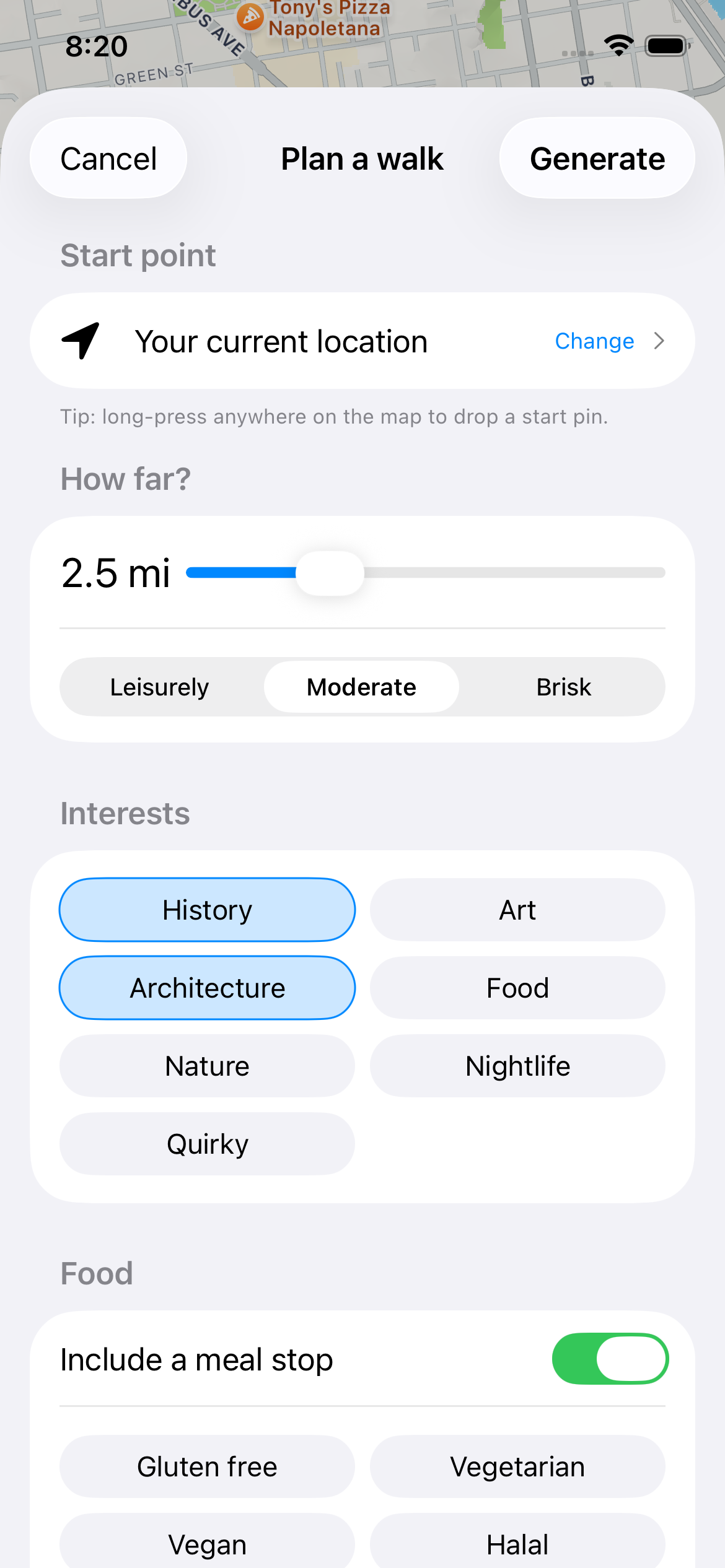
Mosey built this route to link the architectural history with the neighborhood's cultural reinvention in the 1960s, when Old Town became a countercultural hub before folk and comedy took root permanently. Pull it up on your phone and it'll surface the context at each stop as you walk — no need to look anything up mid-route or double back for a plaque you missed.
The Route: 7 Stops Through Old Town
"Built in 1869 by German immigrants and gutted in the Great Chicago Fire just two years later, St. Michael's was rebuilt by 1873 using the original brick walls, which had survived the flames. Its twin spires, rising 210 feet, became a landmark used by disoriented residents to relocate their homes after the fire erased most street markers. The church anchored what was then a heavily German enclave, and the surrounding blocks still carry that immigrant-era street grid."
The church is generally open during the day for visitors; step inside to see the ornate German Baroque-influenced interior, which is more elaborate than the plain brick exterior suggests. There's no admission fee — a small donation is appreciated if you sit for a few minutes.
"The Old Town Triangle Historic District, roughly bounded by North Avenue, Ogden Avenue, and Larrabee Street, contains one of Chicago's densest clusters of pre- and post-Fire cottages. Many of the small wood-frame houses on Cleveland, Crilly Court, and Lincoln Park West were built quickly and cheaply by working-class families rebuilding after 1871, using salvaged materials and simple balloon-frame construction. The district was formally designated a Chicago Landmark in 1977, protecting the irregular mix of scale and setback that gives the area its patchwork feel."
Walk the interior streets slowly — Menomonee Street and Cleveland Avenue between Eugenie and Willow have some of the best-preserved cottages. Look for the small plaques on several houses noting construction dates; anything built before 1874 in this area is genuinely rare for Chicago.
"Developed in 1885 by real estate businessman Daniel Crilly, this short block introduced Romanesque Revival row houses on one side and a courtyard apartment building on the other, an unusual mixed-density layout for its time. Crilly's son later named the block's row houses' street after his father and reportedly courted controversy by carving family members' names into building cornerstones. The block survived mid-20th-century urban renewal efforts that razed much of surrounding Old Town, largely due to preservationist pushback in the 1940s and '50s."
It's a quiet residential street, so keep voices down — people live here. The row houses on the west side and the courtyard building entrance on the east are the two things worth stopping to actually look at closely.
"Opened in December 1959 at 1616 N Wells Street, The Second City grew out of the University of Chicago's Compass Players and pioneered long-form improvisational comedy as a legitimate theatrical form. Alumni include Alan Arkin, Joan Rivers, John Belushi, Bill Murray, Gilda Radner, Tina Fey, and Stephen Colbert — a list that essentially maps the last 60 years of American sketch comedy. The theater's original building burned in a 1967 fire and was rebuilt on the same stretch of Wells Street, where it's operated continuously since."
You don't need a ticket to appreciate the exterior and marquee, but if timing allows, evening shows run most nights and tickets typically range $30–$45. The building itself is unassuming — the history is the draw more than the architecture here.
"Founded in 1957, the Old Town School of Folk Music started in a storefront and helped launch the Chicago folk revival that ran parallel to what was happening in Greenwich Village. Its original Old Town location on Armitage Avenue (the school later expanded to a larger Lincoln Square building in 1998) hosted early performances tied to the neighborhood's brief run as a bohemian, countercultural center in the 1960s. Old Town's identity as an arts destination — separate from its immigrant and architectural history — largely traces back to this era."
The original building's exterior is worth a quick photo stop if you're tracing the folk-revival history, though most programming now happens at the Lincoln Square campus. Check the current schedule online if you want to catch a concert while you're in the neighborhood.
"Wells Street between North Avenue and Armitage was Old Town's main commercial spine through its various reinventions — German beer halls and shops in the 19th century, then head shops, boutiques, and music venues during the 1960s hippie era when the strip earned comparisons to San Francisco's Haight-Ashbury. Much of that countercultural retail energy faded by the 1970s as rents rose and the neighborhood gentrified, but a handful of longtime businesses and building facades still hint at that period. The mix of low-rise 19th-century storefronts with later infill gives the street an uneven, layered look that's mostly disappeared elsewhere downtown."
Walk the full stretch rather than cutting through — the storefront architecture varies block to block and rewards a slower pace. This is also where you'll find most of the neighborhood's shops and cafes if you want to browse before the meal stop.
"Operating since 1932 at 1655 N Sedgwick Street, Twin Anchors began as a corner tavern during Prohibition's tail end and became known for ribs after the current owners' family took over in 1978. Frank Sinatra was a regular in the 1960s, reportedly requesting the restaurant stay open late for him after Second City shows, and his corner booth is still marked. The building itself is a low brick corner structure typical of Old Town's pre-Fire commercial architecture, largely unchanged since it opened."
Ribs are the reason to come — expect a wait on weekend evenings since they don't take reservations for parties under six. Arrive by 6pm on weekdays to skip the worst of the line, and expect to spend $25–$35 per person.
Planning Your Walk
Best time to walk: August in Chicago runs warm and humid, typically in the low 80s°F with occasional lake-effect breeze; mornings before 10am or early evening after 5pm are more comfortable for walking the shadeless stretches near North Avenue.
Shoes: Flat, comfortable shoes are fine — sidewalks throughout, with some uneven brick pavers on the residential side streets.
The narration: Mosey surfaces short historical notes at each stop — building dates, past residents, and the events that shaped the block — so you're not relying on scattered plaques or guesswork.
Walk Old Town With Mosey
Get turn-by-turn guidance and stop-by-stop history delivered right to your phone — no research required, just download the route and start walking.
Download on the App Store — FreeFrequently asked questions
How long does it take to walk Old Town Chicago?
Walking the full 2-mile Old Town route takes about 2 to 2.5 hours at a relaxed pace, including stops at St. Michael's Church, Crilly Court, and Wells Street. Add 45 minutes to an hour if you eat at Twin Anchors or another sit-down restaurant along the way.
Is Old Town Chicago walkable?
Yes, Old Town is highly walkable with flat sidewalks, low traffic on residential streets, and a compact footprint bounded roughly by North Avenue, Clark Street, and the Lincoln Park border. Most sites of interest sit within a 15-minute walk of each other, and the neighborhood connects easily to Lincoln Park and the Sedgwick Brown Line stop.
What is the best time of day to walk Old Town Chicago?
Late morning on weekdays offers the quietest residential streets, since Crilly Court and the Old Town Triangle are lived-in blocks without much daytime foot traffic. Evenings work better if you want to end at a Second City show or dinner at Twin Anchors, since Wells Street picks up energy after 5pm.
Is Old Town Chicago safe to walk at night?
Old Town is generally considered one of Chicago's safer, well-lit neighborhoods, with steady foot traffic around Wells Street into the evening due to restaurants and Second City shows. The residential Old Town Triangle streets get quieter and darker after 9pm, so stick to Wells Street or North Avenue if walking solo at night.
What's the difference between Old Town and Lincoln Park?
Old Town is a smaller, denser historic district known for surviving 19th-century cottages and Wells Street's comedy and folk-music history, while Lincoln Park is a larger neighborhood to the north and east centered on the park itself, the zoo, and DePaul University. Old Town sits just southwest of Lincoln Park and the two are often walked together.
Do I need tickets in advance for Second City?
Yes, booking ahead is recommended, especially for weekend shows, since Second City's mainstage and revue shows regularly sell out. Tickets run roughly $30–$45 and can be bought directly through secondcity.com; walk-up availability exists on weeknights but isn't guaranteed.
More Chicago Neighborhoods to Explore
If Old Town's mix of surviving 19th-century architecture and cultural history appeals to you, Mosey also maps self-guided routes through Lincoln Park's mansion-lined streets and lakefront history, Wicker Park's industrial-turned-artistic transformation, and the Gold Coast's Gilded Age residences just east along the lake. Each route works the same way — pull it up, walk it at your own pace, and let the app surface the context stop by stop.