Lincoln Square built its identity around German immigrants who settled along Lincoln Avenue starting in the 1860s, drawn by the streetcar line and cheap land north of the city. The neighborhood's name predates the avenue's renaming for the president, but the German character stuck for over a century, and you can still see it in the beer halls, delicatessens, and social clubs that survived long after most residents stopped speaking German at home. What's replaced some of that has its own texture: an Old Town School of Folk Music campus, a pedestrian plaza that used to be a car-clogged intersection, and a food scene that runs from 1875-era apothecaries to modern Vietnamese kitchens.
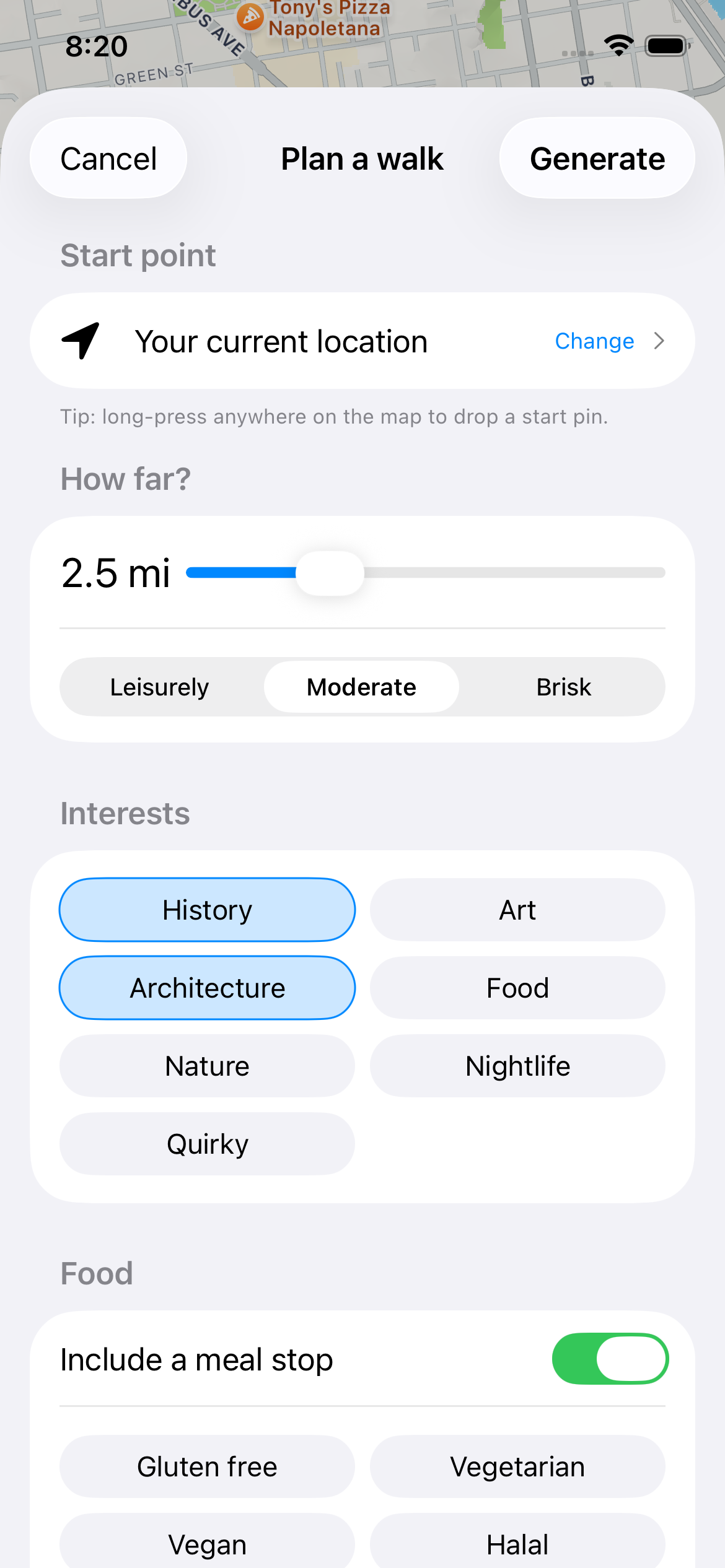
This route runs from the Western Brown Line stop down Lincoln Avenue to the heart of the neighborhood at Giddings Plaza, then loops through the commercial strip before ending at a meal stop. It's flat, entirely on sidewalks, and easy to do in an afternoon or early evening. Mosey built this as a self-guided walk, so you're not tied to a start time or a group — just your own pace and how long you want to linger at the plaza or duck into a shop.
Expect a mix of building-specific history (a movie palace, a century-old drugstore) and neighborhood-level context about why German Chicago concentrated here instead of, say, Old Town or Uptown. The app surfaces short historical notes as you approach each stop, so you're not stopping to read a paragraph on your phone before you can look up.
The Route: Western Avenue to Chicago Brauhaus
"The Ravenswood elevated line reached this stretch of the North Side in 1907, and the Western stop became the gateway for German and later other European immigrants moving into Lincoln Square. The 'L' made the neighborhood a viable commute to downtown factories and offices, which is a big part of why the commercial strip along Lincoln Avenue thrived instead of staying a farm road. The station itself has been rebuilt since, but the route it opened up hasn't changed."
Start here regardless of how you arrive — it orients you to the neighborhood's original spine. If you're driving, there's metered street parking nearby, but Lincoln Square is genuinely easier by train.
"This stretch of Lincoln Avenue near Lawrence was built up between the 1880s and 1920s with two- and three-story brick storefronts, a typical Chicago commercial vernacular with retail on the ground floor and apartments above. German-owned hardware stores, butcher shops, and bakeries lined this block for decades, serving a population that by 1900 made Lincoln Square one of the most concentrated German enclaves in the city. Many of the storefronts have turned over multiple times, but the building stock is largely original."
Look up rather than at street level — the cornices and window lintels on the upper floors are where the original 1890s-1910s detail survives. Ground-floor signage changes too often to be a reliable historical marker.
"This triangular intersection of Lincoln, Leland, and Giddings was reconfigured in the early 2000s, closing it partially to car traffic and creating the brick plaza that now anchors the neighborhood. It sits at what was historically the commercial crossroads of German Lincoln Square, where the streetcar lines converged. The bronze statue of Abraham Lincoln here, a copy of a piece by sculptor Charles Keck, was installed in 1956, decades before the plaza redesign, and is one of several Lincoln likenesses scattered through the neighborhood that shares his name."
This is the spot to slow down. There are benches, usually a farmers market or small event on summer weekends, and it's the natural photo stop of the walk. Weekday mornings are quiet; Friday and Saturday evenings the surrounding restaurants spill outdoor seating onto the edges.
"The Davis opened in 1918 as a silent-film and vaudeville house, one of dozens of neighborhood movie palaces built across Chicago in that era to serve residents who wouldn't travel downtown for a show. It's operated close to continuously since, surviving the multiplex era better than most of its peers, and underwent a significant renovation in 2015 that restored several of its original screens and added a bar. The building's terra cotta facade along Lincoln Avenue is largely intact from the 1918 construction."
Worth a look even if you're not catching a film — check the marquee for what's playing, since ticket prices run cheaper than downtown multiplexes. The lobby bar is open to walk-ins even without a movie ticket.
"Merz Apothecary traces back to 1875, when Peter Merz opened a drugstore on Milwaukee Avenue serving the German community; the business moved to its current Lincoln Square location in the 1970s. It's one of the oldest continuously operating apothecaries in the country and built its reputation stocking European soaps, homeopathic remedies, and imported toiletries that were hard to find elsewhere in Chicago for most of the 20th century. The current shop still carries brands like Weleda and L'Occitane alongside old-world medicinal goods."
Free to browse, and worth five minutes even if you're not buying — the shelves of European pharmacy brands are a genuine rarity. It gets busy on weekend afternoons; a weekday visit gets you more room to look around.
"Opened in 1985 and named for Conrad Sulzer, a Swiss immigrant physician who farmed land in this area in the 1830s before Chicago's street grid reached this far north, the library is one of the Chicago Public Library's larger regional branches. Sulzer's farmhouse stood roughly in this vicinity, and his name persists on the library, a nearby park, and Sulzer Avenue a few blocks south. The building itself holds a significant local history collection relevant to Lincoln Square and the broader North Side."
Free to enter, open library hours (check before detouring, since it's closed Sundays in summer at reduced hours). The local history room on an upper floor is worth ten minutes if you want more depth than a walking tour can give you.
"Chicago Brauhaus opened in 1962 on Lincoln Avenue and has anchored the neighborhood's German identity longer than almost any other business here, serving schnitzel, sauerbraten, and a rotating list of German draft beers under a room that still books live polka and oompah bands several nights a week. It's one of the last full sit-down German restaurants left in a neighborhood that once had dozens. The building predates the restaurant, part of the same early-20th-century commercial strip you've been walking past all afternoon."
Go for dinner if you can time it — that's when the band plays and the room fills up, usually Thursday through Sunday. Cash and card both accepted; expect $18-28 for most entrees. It gets loud and packed on weekend nights, which is either the appeal or a reason to go on a quieter weekday instead.
Practical Notes Before You Go
Best time to walk: Chicago summers run hot and humid by August; mornings before 11am or after 5pm avoid the worst of it. Winter walks here are legitimate too, since most stops involve stepping into warm shops.
Shoes: Flat sidewalks the whole way. Regular walking shoes are fine; no uneven terrain or hills to worry about.
The narration: Mosey surfaces short historical notes tied to specific buildings and businesses as you reach each stop, pulled from documented neighborhood history rather than generic plaques.
Walk Lincoln Square With Mosey
Open the Mosey app to get turn-by-turn guidance and historical context at every stop on this route, no tour guide or scheduled start time required.
Download on the App Store — FreeFrequently asked questions
How long does it take to walk Lincoln Square in Chicago?
Plan on two to two and a half hours for the full self-guided route, including stops. The walk itself covers about two miles at a relaxed pace. Add extra time if you plan to sit down at Giddings Plaza, browse Merz Apothecary, or eat a full meal at the end rather than just grabbing something quick.
Is Lincoln Square walkable without a car?
Yes, and it's easiest that way. The Western Brown Line 'L' stop drops you right at the start of Lincoln Avenue, and the whole neighborhood core is flat sidewalks with no major arterial crossings that require long waits. Street parking exists but is limited and metered, especially near Giddings Plaza on weekends.
What is Lincoln Square known for historically?
Lincoln Square was Chicago's main German immigrant neighborhood from the 1860s through much of the 20th century, built up around the streetcar and later the 'L' line on Lincoln Avenue. That German character survives in businesses like Merz Apothecary (1875) and Chicago Brauhaus (1962), even as the neighborhood's population has diversified significantly since the 1970s.
Is Lincoln Square safe to walk at night?
Yes, it's one of the lower-crime, more residential North Side neighborhoods, and the Lincoln Avenue commercial strip stays lit and active into the evening with restaurants and the Davis Theater open late. Standard city awareness applies, but this isn't an area with particular nighttime safety concerns.
What's the best time of day to walk through Lincoln Square?
Late afternoon into early evening works best, roughly 4-7pm, so you catch shops still open, Giddings Plaza with some activity, and end the walk right at dinner time for Chicago Brauhaus. Weekday visits mean shorter waits and easier parking than weekend afternoons, when the farmers market and outdoor dining crowd the plaza.
Are there paid attractions on this Lincoln Square walk?
No, every stop on this route is free to visit and browse — the plaza, the theater exterior, the apothecary, and the library. The only cost is the meal at the end and, optionally, a movie ticket at the Davis Theater if something's playing that interests you and you want to go inside beyond the lobby.