Lincoln Park is one of Chicago's most architecturally layered and scenically rewarding neighborhoods — a place where Gilded Age mansions share a streetscape with mid-century courtyard buildings, and where a 1,200-acre public park unfolds along the Lake Michigan shoreline without a single admission gate. The neighborhood takes its name from the park itself, which began its life as a municipal cemetery before the city reimagined it as open green space in the years following the Civil War. That history of transformation — from burial ground to beloved urban oasis — sets the tone for a walk full of surprising turns.
This Mosey route moves through the heart of Lincoln Park, threading between the lakefront and the dense residential streets to the west. You'll pass one of the country's oldest free zoos, a Victorian-era conservatory still doing exactly what it was built to do, and blocks of single-family homes and greystone two-flats that represent some of the finest late-19th-century domestic architecture in the Midwest. The route is deliberately paced, built for lingering rather than ticking boxes — Mosey surfaces historical context at each stop so you're never just looking at a building, you're understanding why it's there.
Plan your walk for a Saturday or Sunday morning in July, when the park is lively but not yet overwhelmed, the conservatory opens early, and the light off the lagoon is genuinely worth photographing. The meal stop near the end of the route gives you a reason to sit down and absorb the neighborhood before heading back out.
The Route: 7 Stops Through Lincoln Park's Architecture and Greenspace
"The Lincoln Park lakefront was not always the recreational paradise it appears today. For much of the 19th century, this shoreline was eroding, undeveloped, and dotted with the graves of a city cemetery established in 1843. When Chicago began converting the cemetery to parkland after the Civil War — relocating thousands of remains — it also began the aggressive landfill and breakwater projects that extended the shoreline eastward, creating the stable beachfront that exists today. The Fullerton Avenue Beach area reflects that engineered landscape: essentially all of the land east of Lake Shore Drive was lake bottom within living memory of the park's earliest visitors."
Stand at the edge of the beach and face north — the long green ribbon of parkland stretching toward Belmont Harbor gives you a clear sense of the scale of the 19th-century landfill project. This is a free, open beach with public restrooms at the nearby field house. Arrive early on a July weekend to claim a good vantage point before the crowds build.
"Founded in 1868 with a gift of two swans from New York's Central Park, Lincoln Park Zoo is one of the last free admission zoos in the United States and the oldest zoo in the country to have operated continuously under municipal management. The zoo expanded significantly in the 1870s and 1880s under the direction of the Lincoln Park Commission, and the Kovler Lion House (1912) and Regenstein Center for African Apes (1976) represent two very different eras of zoo architecture — one rooted in Beaux-Arts civic grandeur, the other in the functional naturalism that began reshaping zoo design in the mid-20th century. At its peak in the 1970s, the zoo attracted over four million visitors annually."
You don't need to do a full zoo loop to appreciate it — even a pass through the main gates along the south entrance gives you a strong sense of the historic layout and the contrast between the older ornate buildings and the newer habitat enclosures. Admission is free, though parking and special exhibitions may charge. The Farm-in-the-Zoo section near the south end is an underrated and rarely crowded spot.
"Completed in 1895 and designed by Joseph Lyman Silsbee — one of the architects who employed Frank Lloyd Wright early in his career — the Lincoln Park Conservatory is a Romanesque-influenced glass-and-iron structure that has been growing tropical plants for Chicago residents for over 130 years. The building houses four permanent display houses: the Palm House, Fern Room, Orchid House, and Show House, each maintaining distinct climatic zones. The conservatory was added to the National Register of Historic Places in 1991 and underwent a major restoration in the 1990s that preserved its original cast-iron framework. It operates year-round and has served as a warm-weather refuge during Chicago winters since the day it opened."
Entry to the conservatory is free. The Palm House is the most dramatic interior space — the central dome reaches 50 feet and the palms inside have been growing since the building opened. Go on a weekday morning if you want near-solitude; weekend afternoons get crowded. The formal French garden directly outside the south entrance is worth a five-minute walk even if you skip the interior.
"The South Pond, one of two lagoons within Lincoln Park, was created as part of the original landscape design overseen by Swain Nelson, a Swedish-born landscape architect who shaped much of Lincoln Park's formal layout in the 1870s. Nelson drew heavily on the pastoral English garden tradition while adapting it to Chicago's flat lakefront terrain. Grandmother's Garden, adjacent to the south side of the conservatory, is one of the oldest formal gardens in the Chicago park system, originally established in the 1890s as an outdoor annex to the conservatory's programming. The garden's name is apocryphal — it evokes the cottage-garden aesthetic it was designed to replicate."
The pond is an excellent place to pause and watch the skyline backdrop shift as clouds move through. Rental paddleboats have operated on the lagoon system historically, though availability changes seasonally — check the Chicago Park District website before your visit. The garden is at its peak in midsummer, which makes your July timing ideal.
"The blocks of Lincoln Park West facing the park's western edge constitute one of the most intact collections of late Victorian and Edwardian residential architecture in Chicago. The neighborhood was rebuilt almost entirely between 1880 and 1910, after the Great Chicago Fire of 1871 spared this area but triggered a city-wide building boom. You'll find Queen Anne row houses, Romanesque Revival greystones, and early Chicago School three-flats sharing the same block — a compressed architectural timeline that reflects the speed at which the city rebuilt and expanded northward. Several homes in this stretch were designed by architects who also worked on Chicago's downtown commercial buildings, and the domestic scale gives you a different lens on the same period."
Walk the west sidewalk so you're looking at the facades with the park at your back. The greystone two-flats with their rusticated limestone fronts — a style almost unique to Chicago — are the buildings to pay closest attention to. Most are private residences, so stay on the public sidewalk. No entry fees or tickets; this is a purely visual stop that rewards a slow pace.
"Opened in 1999 and designed by Muller + Muller Architects, the Peggy Notebaert Nature Museum replaced the Chicago Academy of Sciences' original 1893 Lincoln Park building and represents a late-20th-century rethinking of what a natural history museum should be. The building's form is deliberately low-slung and earth-toned, meant to blend with the park landscape rather than assert civic monumentality in the Beaux-Arts tradition of Chicago's older museums. Its Butterfly Haven — a 2,700-square-foot glass enclosure housing live butterflies — draws particular attention as both a scientific exhibit and an architectural set piece. The institution traces its roots to the Chicago Academy of Sciences, founded in 1857, making it one of the oldest scientific organizations in the Midwest."
Admission is approximately $9–$17 depending on age (check current pricing at naturemuseum.org). If you're keeping this stop brief, the exterior plaza and the views back toward the conservatory from this vantage are worth the detour even without going inside. The Butterfly Haven requires entry but is the clear highlight of the interior experience — budget extra dwell time if that interests you.
"Boka opened in 2003 on Halsted Street in the heart of Lincoln Park and has been one of the neighborhood's defining fine-casual dining destinations for over two decades. The restaurant operates in a converted Victorian building and has maintained a Michelin star for multiple consecutive years, making it one of the most decorated independent restaurants in Chicago's North Side dining scene. Its menus emphasize seasonal American cooking with an emphasis on locally sourced ingredients, and the interior — exposed brick, warm lighting, a back garden patio — reflects the residential character of the surrounding neighborhood rather than downtown restaurant formality."
Boka is at 1729 N. Halsted St., Chicago, IL 60614. Reservations are strongly recommended, especially for a Saturday or Sunday lunch in July — book at least a week in advance on OpenTable or Resy. The bar area sometimes accommodates walk-ins. The back garden patio is the place to sit on a July afternoon if the weather cooperates. Expect to spend $40–$70 per person for lunch with a drink.
Practical Tips for Your Lincoln Park Walk
Best time to walk: July in Chicago means highs in the mid-80s°F with high humidity and the occasional afternoon thunderstorm rolling in off the lake. Start your walk by 9–10am to get ahead of the heat and any afternoon weather. The park offers almost no shade on the lakefront path, so sunscreen and a water bottle are non-negotiable. If storms are in the forecast, the conservatory makes an excellent covered pause.
Shoes: The route mixes paved park paths, brick sidewalks on residential streets, and some gravel sections near the lagoon. Comfortable sneakers or light walking shoes are ideal — no trail footwear needed, but avoid sandals if you plan to explore the conservatory's outdoor gardens.
The narration: At each stop, Mosey surfaces historical context drawn from Chicago architectural surveys, park commission records, and neighborhood histories — the kind of detail that turns a pleasant walk into a genuinely informed one.
Take This Tour With You on Mosey
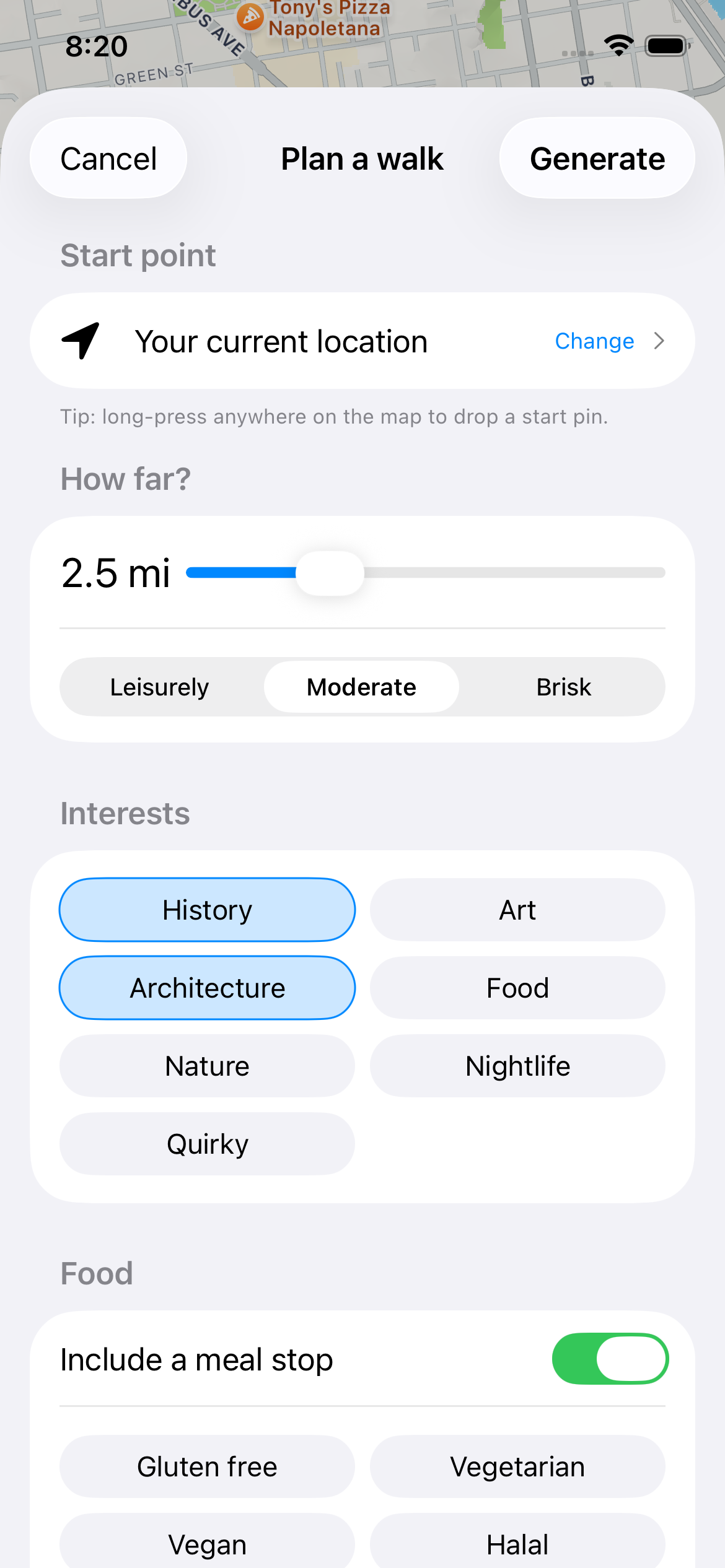
Mosey loads this route onto your phone with turn-by-turn directions and historical narration at every stop — no cell service required once you've downloaded it. Build your own Lincoln Park walk or explore curated routes across Chicago at moseytourbuilder.com.
Download on the App Store — FreeOther Chicago Neighborhoods Worth Exploring with Mosey
If the Lincoln Park walking tour leaves you wanting more Chicago architecture and green space, Mosey has routes worth queuing up in adjacent neighborhoods. Old Town, directly south of Lincoln Park, packs some of the city's best-preserved 1870s workers' cottages and Victorian row houses into a compact, walkable grid — a perfect half-day companion to this route. Lakeview to the north picks up where Lincoln Park leaves off along the lakefront, adding the Belmont Harbor, Wrigley Field, and a dense commercial streetscape along Southport Avenue. For a change of scene entirely, Mosey's Gold Coast route explores the lakefront mansions and early skyscraper architecture south of North Avenue, where Chicago's Gilded Age wealth expressed itself most extravagantly.