Hyde Park is the Chicago neighborhood where the layers are easiest to read. Paul Cornell platted the area in 1853, the World's Columbian Exposition set up in nearby Jackson Park in 1893, and the University of Chicago, which opened in 1892, filled in the blocks between with Gothic limestone, a Frank Lloyd Wright house, and a library that looks like a glass bubble. If you are searching for a Hyde Park walking tour, the draw is the density: major architecture and a world-changing science site within a few blocks of each other, on tree-lined streets that stay quiet.
This self-guided Hyde Park tour is built around architecture and history. It starts at a Gothic campus gate, passes the spot where the first nuclear chain reaction was achieved, and moves on to Wright's Robie House, Rockefeller Chapel, and the Institute for the Study of Ancient Cultures, formerly the Oriental Institute. It ends with lunch on 57th Street. Most of the route is exterior viewing, so you control the pace, and the interiors are optional add-ons.
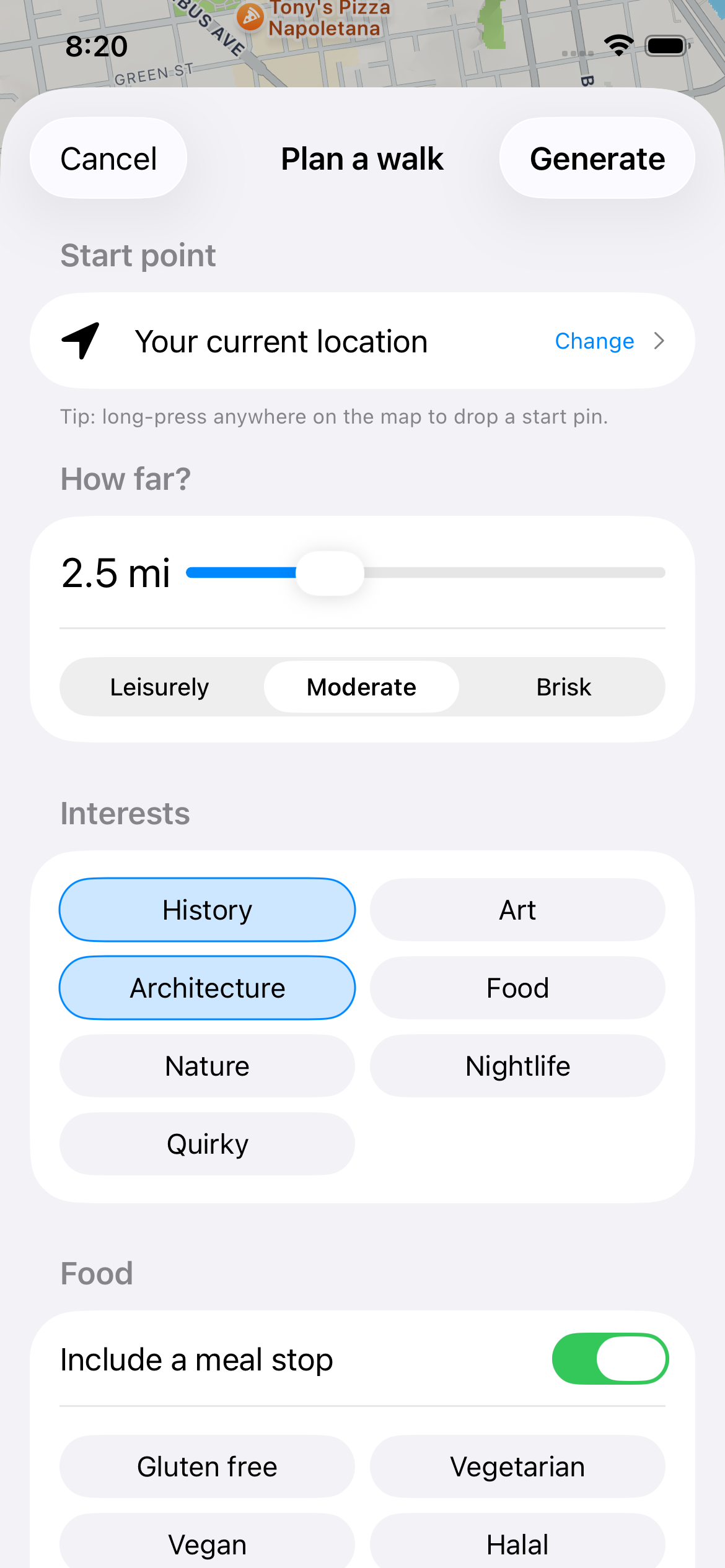
The route was assembled in the Mosey app, which surfaces a short piece of historical context at each stop as you reach it. Mosey's first three tours are free, so you can try this one before deciding anything. Plan on around two and a half hours of walking and stopping, longer if you tour the Robie House interior or the museum.
A Hyde Park Route from Gothic Gate to Ancient Gallery
"The University of Chicago opened in 1892 on land partly donated by Marshall Field, with major funding from John D. Rockefeller. Architect Henry Ives Cobb laid out the first Gothic quadrangles in Indiana limestone, and Cobb Hall (1892) was the first academic building finished. Cobb Gate, completed in 1900 and named for donor Silas B. Cobb, marks the entrance to Hull Court and is covered in carved grotesques."
Stand just outside the gate on 57th Street and look up at the carving before walking through. Hull Court on the other side is a good place to see how tightly the original buildings were packed. It is free and open, and mornings are quietest.
"On December 2, 1942, a team led by Enrico Fermi achieved the first controlled, self-sustaining nuclear chain reaction in a reactor called Chicago Pile-1, built under the west stands of Stagg Field. The stadium is gone, and Henry Moore's bronze sculpture Nuclear Energy was dedicated on the 25th anniversary in 1967. The site is a National Historic Landmark."
The sculpture sits on Ellis Avenue between 56th and 57th Streets. Walk all the way around it, since the skull-like profile from one side and the mushroom-cloud dome from the other are meant to be read together. A plaque marks the event; there is no admission and nothing else to see here, so ten minutes is plenty.
"The elliptical glass dome of the Joseph Regenstein Library's neighbor, the Mansueto Library, opened in 2011 and was designed by Helmut Jahn. The books are stored in an underground chamber that retrieves volumes by robotic crane. It sits beside the Regenstein Library, a concrete-and-limestone building by Walter Netsch of Skidmore, Owings & Merrill that opened in 1970 on the former Stagg Field site."
The Mansueto reading room under the dome is sometimes open to visitors, but access rules for non-affiliates change, so check before counting on it. From the outside, the contrast with the Gothic buildings behind you is the point. Skip the Regenstein interior unless you need a restroom.
"Frank Lloyd Wright designed the house in 1909 for bicycle and auto parts manufacturer Frederick C. Robie, and it was finished in 1910. Its long, thin Roman brick, continuous bands of art-glass windows, and cantilevered roofs are textbook Prairie style. In 1957 the Chicago Theological Seminary, which then owned it, planned to demolish it; public protest, including from Wright himself, helped save it, and it was named a National Historic Landmark in 1963. UNESCO listed it among Wright's World Heritage buildings in 2019."
The exterior is free to view from Woodlawn Avenue, and the best vantage is across the street where you can see the full roofline. Interior tours are ticketed and run by the Frank Lloyd Wright Trust, so book ahead on weekends. If you only have time for one paid thing today, this is the strongest candidate.
"Architect Bertram Goodhue designed the chapel, and it was dedicated in October 1928 with funding from John D. Rockefeller. The building is Gothic Revival in limestone, with a tower that houses the Laura Spelman Rockefeller Memorial Carillon of 72 bells. It stands at 59th Street and Woodlawn Avenue, facing the Midway Plaisance, the strip left over from the 1893 World's Fair."
The sanctuary is usually open to visitors during the day, but it closes for services and events, so check the schedule. Step inside for the vaulted ceiling, then stand on the lawn outside to take in the tower. Carillon recitals are periodic, and hearing one is worth timing if you can.
"Egyptologist James Henry Breasted founded the Oriental Institute in 1919, with Rockefeller support, to send University of Chicago teams to excavate across the Near East. The current building at 1155 E. 58th Street opened in 1931 and was designed by Mayers, Murray & Phillip. Its galleries hold a roughly 17-foot statue of Tutankhamun from Karnak and a human-headed winged bull from Khorsabad weighing about 40 tons."
Check current hours and admission policy before you go, and note that the museum is typically closed on Mondays. If the museum is closed or you are short on time, the building's exterior is still worth a look. Allow close to an hour if you want to see the Assyrian court and Egyptian gallery properly.
"Medici on 57th, at 1327 E. 57th Street, has fed students, faculty, and neighborhood regulars since the early 1960s and is one of Hyde Park's best-known sit-down restaurants. It is known for its pizza and burgers, and for wooden booths that decades of customers have carved their names into. It sits in the middle of the 57th Street commercial strip, a few blocks from where the walk began."
Expect a wait at peak lunch and on football or graduation weekends; a mid-afternoon late lunch is easier. Seating is casual and the menu is straightforward, so you are not paying for atmosphere you did not ask for. Check current hours before you go, since the schedule has varied.
What to Know Before You Walk Hyde Park
Best time to walk: Late October is one of the best times for this walk: the campus trees turn and temperatures are usually in the 50s, but wind off Lake Michigan can make it feel colder, so bring a layer. Rain makes the limestone slick and the lawns muddy. Sunset comes early at the end of the month, so start before mid-afternoon if you want daylight for the exteriors.
Shoes: Flat sidewalks and campus paths throughout, with a few brick and stone-paved courtyards that get slippery when wet. Any comfortable walking shoes work. Expect some stairs if you go inside the chapel tower or museum.
The narration: At each stop Mosey surfaces the founding date, the architect or scientist involved, and the specific event or material that explains why the place looks the way it does.
Walk Hyde Park with the history in your ear
Build this route in Mosey and get context at each stop as you arrive. The first three tours are free.
Download on the App Store — FreeFrequently asked questions
How long does it take to walk Hyde Park?
The route on this page is 2.4 miles and takes about two and a half hours with stops. Walking alone would be under an hour, but time at the Robie House, the chapel, and the museum adds up. Add another hour if you take the Robie House interior tour.
Is Hyde Park walkable for tourists?
Yes, the central part of Hyde Park around the University of Chicago is flat and easy to walk, with sidewalks on every street. The main sights are clustered between 55th and 59th Streets. You will need transit or a rideshare to reach it from the Loop, roughly 15 minutes by Metra Electric.
Can you tour the Robie House without a ticket?
You can see the Robie House exterior for free from Woodlawn Avenue at 58th Street, any time. Interior tours are ticketed and run by the Frank Lloyd Wright Trust, and they sell out on weekends, so book ahead. The outside view shows the cantilevered roofs and Roman brick well.
Where did the first nuclear chain reaction happen in Chicago?
It happened under the stands of Stagg Field, on the University of Chicago campus, on December 2, 1942. Enrico Fermi's team built Chicago Pile-1 there. Henry Moore's sculpture Nuclear Energy now marks the spot on Ellis Avenue between 56th and 57th Streets, and visiting is free.
Is Hyde Park safe to walk during the day?
The campus and the 57th Street corridor are busy and generally comfortable to walk during the day. Stay on main streets with foot traffic, particularly after dark, and be aware that conditions vary a few blocks outside the campus core. The University of Chicago Police patrol the campus area, so staying near it is sensible.
More Chicago Neighborhoods to Walk Next
If Hyde Park leaves you wanting more, Kenwood to the north has large late-19th-century houses, including several by Wright and his contemporaries. Woodlawn, just south of the Midway, has its own blocks of early-20th-century buildings and a different history. Farther afield, Chicago's Loop and Pilsen offer very different architecture and stories, and Mosey can build self-guided routes for each.