Chattanooga spent most of the 20th century with its back turned to the Tennessee River. The waterfront was rail yards, warehouses, and a sewage treatment plant, and the air quality was bad enough that CBS News called it the dirtiest city in America in 1969. What you're walking today is the result of a deliberate, decades-long civic decision to reverse that: tear out the industrial infrastructure, build a pedestrian bridge where a car bridge used to be, and put an aquarium where the ugliness used to sit.
This route starts downtown near Miller Plaza, moves through the historic core past the old Read House and the Tivoli Theatre, then drops down to the river for the walk across the Walnut Street Bridge and up into Bluff View Art District. It's a walk that mixes two things well: 19th-century commercial and railroad history, and a genuinely well-executed piece of urban river restoration. The Mosey app runs the route on your phone, so you're not toggling between a map and a guidebook — it just tells you what you're looking at when you get there.
Budget around two and a half hours if you want to actually go inside a museum or two, less if you're keeping it to street level. The walk is flat except for the bluff itself, which involves a short, real climb. Do it in the morning if you want the Aquarium without crowds, or save the second half for golden hour, when the light on the river from the bridge is worth the extra wait.
The Route: Downtown to the River and Back
"The Tivoli Theatre at 709 Broad Street opened in 1921 as a movie palace, built by the Loew's chain and designed by architect Rapp & Rapp, known for their ornate 'wonder theatres' around the country. It seated over 1,700 people and was billed at the time as the 'Jewel of the South.' It fell into disrepair by the 1960s and was nearly demolished before the city bought it in 1976, restoring it as a performing arts venue that still runs today."
You can usually see the lobby during box office hours without buying a ticket — worth a quick look at the restored plasterwork. Miller Plaza itself hosts a free concert series called Nightfall in summer; check if one's happening the evening you walk, since it changes the whole feel of the block.
"The Read House at 827 Broad Street opened in 1926, replacing an earlier 19th-century hotel on the same site that had served Union and Confederate officers at different points during the Civil War occupation of Chattanooga. The current Georgian Revival building was funded partly by the Read family, and it became the city's main society hotel through the mid-20th century, hosting a reported guest list that included several U.S. presidents."
The lobby is open to the public and worth walking through even if you're not staying there — check out the original 1920s detailing. It's a functioning hotel today, part of Curio Collection by Hilton, so there's no admission and no pressure to linger.
"Built in 1890, the Walnut Street Bridge was the first non-military bridge to cross the Tennessee River and connected downtown Chattanooga to the North Shore neighborhood. It carried vehicle traffic until 1978, when it was closed as structurally unsound and slated for demolition. A citizens' group fought to save it instead, and it reopened in 1993 as one of the longest pedestrian bridges in the world, at roughly 2,376 feet."
Walk the full length — it's flat, wide, and gives you the best sightline in the city for the riverfront and the Aquarium's glass towers. It's also documented as a site of racial violence in the early 1900s; some interpretive signage on the bridge addresses this history directly, and it's worth reading rather than skipping past.
"The Tennessee Aquarium opened in 1992 as the anchor project of Chattanooga's riverfront redevelopment, built on a site that had previously been industrial riverfront land. It was the first non-marine aquarium of its size in the country, organized around the idea of following a river system from mountain stream to ocean, reflecting the Tennessee River's own course. The building itself, with its distinctive glass peaks, was designed by Cambridge Seven Associates."
Tickets run around $35–40 for adults depending on season and whether you add the IMAX; buy online ahead of time to skip the line. If you're tight on time or budget, the river otters and the freshwater gallery on the lower level are the parts most worth prioritizing.
"Ross's Landing takes its name from John Ross, a Cherokee leader who operated a trading post and ferry here in the early 1800s and later became the last principal chief of the Cherokee Nation. In 1838, this site was one of the primary departure points for the forced removal of the Cherokee people during the Trail of Tears. The plaza today includes a memorial installation and markers documenting this history alongside the newer riverfront park design completed in the 2000s by landscape architect Hargreaves Associates."
Take the time to read the Passage memorial sculptures near the river's edge — they're easy to walk past if you're headed straight for the Aquarium next door, but they're the reason this ground matters. It's free, outdoors, and best visited without a rush.
"Bluff View sits on a limestone bluff overlooking the river and was originally a residential neighborhood of Victorian and Colonial Revival homes built in the late 1800s. In the 1980s and 90s, several of these houses were restored and converted into galleries, a bed and breakfast, and cafés, anchored by the Hunter Museum of American Art, which occupies a 1904 Classical Revival mansion built for Coca-Cola bottling magnate George Thomas Hunter alongside a modern addition completed in 2005."
The climb up from the riverwalk is short but steep — take the stairs near the Aquarium plaza rather than doubling back to find a ramp. The Hunter Museum charges admission (around $15), but the bluff-top garden and river overlook outside it are free and arguably the better view.
"Tony's Pasta Shop & Trattoria sits on Frazier Avenue on the North Shore side of the river, in a stretch of storefronts that was largely industrial and working-class housing until the North Shore's own revitalization picked up pace in the 1990s and 2000s, following the Walnut Street Bridge reopening. It's a longtime local fixture known for house-made pasta, run as a straightforward neighborhood Italian spot rather than a tourist draw."
Cross back over the Walnut Street Bridge to reach it, which doubles as your last river crossing of the walk and a good excuse to see the bridge at a different light than your first pass. Expect a wait on weekend evenings; portions are large enough that splitting a pasta dish is reasonable if you're planning to walk more afterward.
Planning Your Walk
Best time to walk: Tennessee River humidity makes summer walks sticky by late morning; September and October afternoons are mild and are the best window for the bridge and bluff sections. Winter is fine but check for river fog before sunrise walks.
Shoes: Mostly flat sidewalk and paved riverwalk, but the climb up to Bluff View is a genuine hill — regular walking shoes are fine, nothing technical needed.
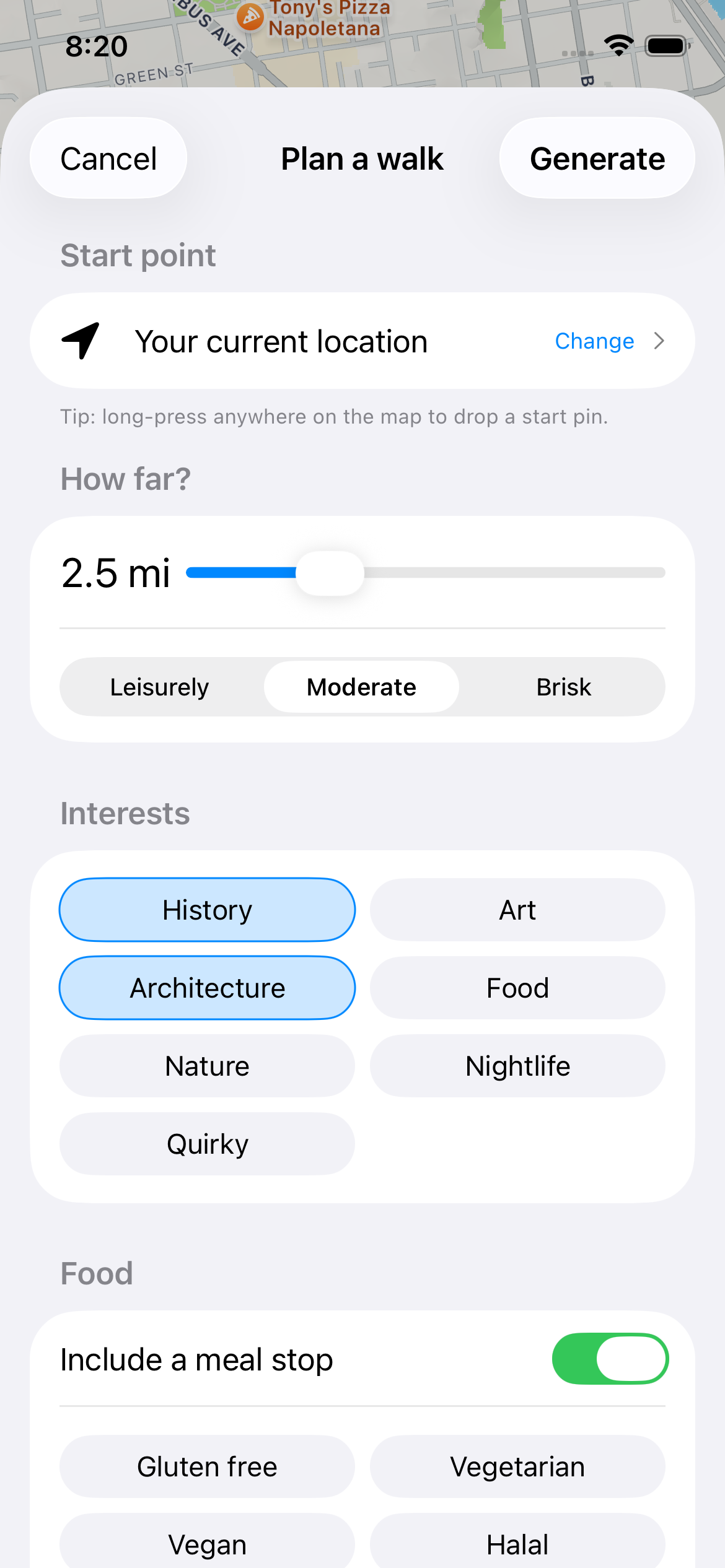
The narration: At each stop, Mosey surfaces the specific event, date, or building detail tied to that spot — the kind of context a historical plaque gestures at but rarely explains in full.
Walk it with Mosey
Get this exact route on your phone with turn-by-turn guidance and stop-by-stop history that plays automatically as you arrive — no earbuds fumbling with a guidebook.
Download on the App Store — FreeFrequently asked questions
Is downtown Chattanooga walkable without a car?
Yes. Downtown Chattanooga and the riverfront are compact and flat, connected by the free electric shuttle on Market Street and the pedestrian-only Walnut Street Bridge. Most major sights, including the Aquarium, Bluff View, and the historic core around Broad Street, sit within a 15–20 minute walk of each other.
How long does it take to walk the Chattanooga riverfront?
The full downtown-to-riverfront loop covering Miller Plaza, the Walnut Street Bridge, Ross's Landing, and Bluff View takes about 2 to 2.5 hours at a relaxed pace, including short stops. Add 45 minutes to an hour if you go inside the Tennessee Aquarium or the Hunter Museum.
Is the Walnut Street Bridge free to walk?
Yes, the Walnut Street Bridge is free and open to pedestrians and cyclists year-round, no tickets or hours restrictions. It connects downtown Chattanooga to the North Shore neighborhood and is roughly 2,376 feet long, one of the longest pedestrian bridges in the world.
What is the best time of day to walk the Chattanooga riverfront?
Early morning or late afternoon works best. Mornings before 10 a.m. avoid Aquarium crowds and summer heat; late afternoon into golden hour gives the best light on the river from the Walnut Street Bridge and Bluff View overlook, especially in fall.
Is Ross's Landing worth visiting if I've already seen the Aquarium?
Yes, and it's easy to skip by accident since it sits right next to the Aquarium entrance. Ross's Landing marks a Trail of Tears departure point and includes a memorial installation documenting Cherokee history that most Aquarium visitors walk past without stopping.
Do I need to buy tickets in advance for the Tennessee Aquarium?
It's recommended, especially on weekends and in summer. Tickets run around $35–40 for adults, and buying online ahead of time lets you skip the walk-up line. Off-season weekday mornings are the least crowded time to go without a reservation.
More Chattanooga Neighborhoods to Explore
If this walk left you wanting more of Chattanooga's river story, the North Shore neighborhood just across the Walnut Street Bridge rewards a slower second pass — Frazier Avenue's converted warehouses and the Coolidge Park carousel tell the story of the same riverfront revival from the other bank. Southside, near the old Chattanooga Choo-Choo depot, covers a different piece of the city's railroad history and is an easy add-on with Mosey if you've got another afternoon to spend.